Smooth at cruise, shaking the moment you touch the brakes — especially on that long deceleration coming down the I-26 off-ramp. Here's what's happening, and why South Carolina summers make it worse.
If your car rides perfectly smooth until you apply the brakes — and then the steering wheel starts shimmying in your hands — you can stop guessing. This specific symptom points at the front brake rotors with better than 90% certainty. It's one of the most common complaints we hear in the shop, it's very fixable, and it has a distinctly Lowcountry aggravator: summer heat cycling.
The important distinction first. If your car shakes at highway speed whether or not you're braking, that's a different problem with a different list of causes — tires, balance, alignment — and we covered it in Why Does My Car Shake at Highway Speed? . This article is about shaking that appears only when braking. That "only" is the diagnostic gold.
Shakes only under braking, felt in the steering wheel → front rotors. Pulsation felt in the brake pedal (pedal pushes back rhythmically against your foot) with less steering shake → rear rotors are likely involved too. Shakes all the time, braking or not → read the highway-speed article instead.
📋 In This Article
What's Actually Happening: "Warped" Rotors Explained
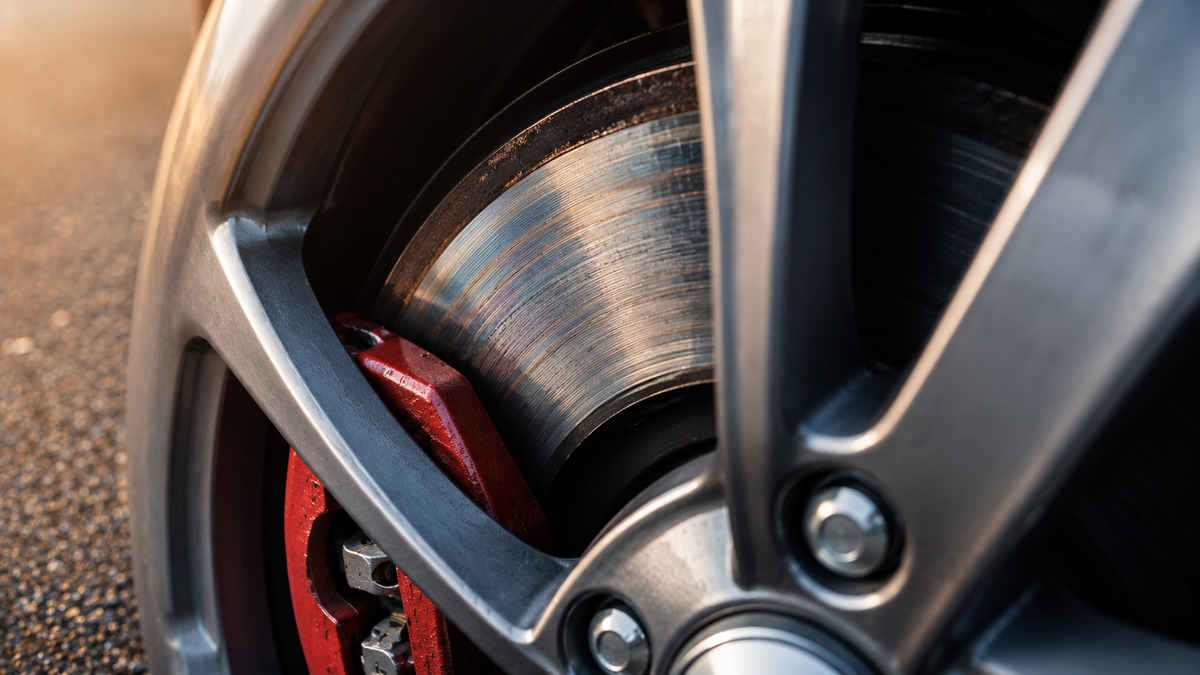
Your brake rotors are the heavy metal discs that spin with each wheel. When you brake, the caliper squeezes the pads against both faces of the rotor, and friction slows the car.
For that to feel smooth, each rotor face has to be flat and uniform to within a few thousandths of an inch. When it isn't — when the rotor develops thickness variation or runout (a slight wobble) — the pads clamp a surface that's alternately thicker and thinner, hundreds of times a minute. Every rotation, the grip pulses. You feel that pulse as:
- A shimmy in the steering wheel — the front wheels' steering linkage transmits front rotor pulsation directly to your hands.
- A pulsating brake pedal — the pressure fluctuation travels back through the hydraulic system to your foot.
- A rhythmic surging during long, gradual stops — most noticeable decelerating from highway speed, like coming down the College Park Road off-ramp, because higher wheel speed means faster pulsation.
Mechanics say "warped rotors" as shorthand. In reality the rotor rarely warps like a vinyl record left in the sun — what usually develops is uneven thickness (from uneven wear or corrosion) or runout (often from a rotor not seating flat against a rusty hub, or wheels over-torqued unevenly). The distinction matters for the fix, but the symptom is the same.
Why SC Heat Makes This Worse
Braking converts speed into heat, and rotors routinely reach several hundred degrees in normal driving. What rotors hate isn't heat itself — it's rapid, uneven cooling, and the Lowcountry is a factory for exactly that:
- Summer thunderstorms. Rotors at full operating temperature after a drive down Highway 78, then a sudden downpour throws cool water across hot metal — or you drive through standing water and quench one section of the rotor face while the rest stays hot. Repeated rapid heat cycling changes the metal's structure unevenly, and thickness variation follows.
- Stop-and-go heat soak. Crawling on I-26 into North Charleston in August means constant braking with no cooling airflow. Heat builds beyond what the rotor sheds, and the hottest spots wear and transfer pad material differently.
- Humidity and sitting. A car parked for a week or two in coastal humidity grows a layer of surface rust on the rotors. Normally the pads scrub it off in a few stops — but the strip under the parked pads corrodes differently, leaving a band that becomes a thickness variation seed.
None of this means SC brakes are doomed — it means rotor pulsation shows up here sooner and more often than in dry climates, and quality parts plus proper installation matter more.
Cause #2: Pad Material Deposits
Sometimes the rotor is flat, but there's a problem on it: an uneven layer of brake pad material transferred onto the rotor face. This happens after severe overheating — classically, a hard stop from high speed followed by holding the brake pedal firmly at a standstill, which cooks a pad-shaped deposit onto the hot rotor.
The symptom is identical to a warped rotor, because functionally it is thickness variation — just made of pad material instead of missing metal. Mild cases can sometimes be corrected without new parts; established deposits usually mean resurfacing or replacement. It's one reason we inspect rather than guess.
Cause #3: A Sticking Caliper
A caliper that doesn't fully release keeps light pad pressure on the rotor all the time. That drags, overheats that corner's rotor, and creates the uneven wear that becomes pulsation — plus a few telltales of its own:
- The shake or pull is one-sided; the car may pull toward one side under braking
- A hot, acrid smell from one wheel after driving (see our burning smells guide)
- One wheel noticeably hotter than the others after a drive
- Reduced fuel economy
Coastal humidity contributes here too — caliper slide pins corrode and seize in our climate more than in dry ones. If a sticking caliper caused your rotor problem, replacing rotors alone means the new ones warp within months. Finding the root cause is the difference between fixing it once and fixing it twice.
Cause #4: Worn Suspension Amplifying the Shake
Occasionally the rotors show only minor runout, but the shake in the wheel is dramatic. That mismatch usually means worn front-end components — tie rod ends, ball joints, control arm bushings — are amplifying a small pulsation into a big shimmy. The brake pulse excites the loose joint, and the whole steering system oscillates.
This matters because it changes the repair: new rotors alone will improve it but not cure it. Our brake inspection includes checking the front end for play, our suspension repair service addresses worn components, and our suspension and steering guide covers those components in depth.
How Urgent Is It?
Honest answer: moderate — weeks, not months, and not "someday."
The brakes still stop the car. But rotor pulsation gets steadily worse, and along the way it:
- Wears pads unevenly and fast — pulsating contact chews pads, so waiting often turns a rotor job into a rotor-and-pads job (though pads are usually replaced with rotors anyway).
- Reduces braking efficiency in hard stops — pulsing grip is less total grip. ABS can also engage earlier and less effectively on a pulsating rotor.
- Stresses steering components — the same shimmy you feel in your hands is hammering the tie rod ends thousands of times per drive.
- Masks other problems — a shaking wheel under braking makes it hard to notice a new noise or pull that would otherwise warn you of something more serious.
If the shake is severe, or accompanied by grinding ( grinding is a different, more urgent problem ), a soft pedal, or a brake warning light — get it inspected now, not in a few weeks.
Resurface or Replace?
Two ways to restore a flat rotor face:
Resurfacing (machining): The rotor goes on a brake lathe and a thin layer is cut from each face until it's flat and uniform. Cheaper — but only possible if the rotor has enough thickness remaining above its stamped minimum spec. Many modern rotors are made thinner from the factory to save weight, and often can't spare the material, especially if they've been resurfaced before.
Replacement: New rotors, correct for the vehicle, installed on a properly cleaned hub. This is the more common recommendation today, for three honest reasons: modern rotors have less material to spare, quality replacement rotors have gotten cheaper relative to machining labor, and a new rotor doesn't carry the heat history that made the old one pulse.
Either way, pads are replaced or addressed at the same time — old pads that wore against a pulsating rotor have an uneven face that will start damaging a fresh rotor immediately. And the detail that separates a lasting fix from a comeback: the hub face must be cleaned to bare metal and the wheel torqued evenly to spec. A quality rotor installed on a rusty hub or air-hammered unevenly can develop runout within weeks. This is part of every brake job in our brake repair service.
Repair Cost Table
| Repair | Typical Cost (Ladson area) | Notes |
|---|---|---|
| Brake inspection | Free – $50 | Free with most services |
| Rotor resurfacing + new pads (per axle) | $180 – $320 | Only if rotors have material to spare |
| New rotors + pads, front axle | $300 – $550 | Most common fix for this symptom |
| New rotors + pads, both axles | $600 – $1,000 | If rears are pulsing too |
| Caliper replacement (each) | $200 – $450 | Only if sticking/seized |
| Tie rod end / front-end repair | $150 – $500 | Only if play found in inspection |
Prices vary by vehicle — a Camry and an F-250 are different animals. We give a written estimate before any work, always.
How We Diagnose It
What you're paying a shop to do, so you know it's being done:
- Road test — confirm the shake is brake-applied only, note speed range, wheel vs. pedal, any pull.
- Measure, don't eyeball — dial indicator on each rotor for runout, micrometer at multiple points for thickness variation, checked against the rotor's stamped minimum thickness.
- Inspect the whole corner — pad condition and wear pattern (uneven wear tells a story), caliper slide function, hub face condition.
- Check the front end — tie rods, ball joints, bushings for the play that amplifies pulsation.
- Written findings and estimate — what we measured, what it needs, what it costs — before anything is repaired.
Frequently Asked Questions
The shake only happens braking from highway speed, not around town. Why?
Can I just replace the pads and keep my rotors?
My rotors were just replaced and it's shaking again after a couple of months. Was I ripped off?
Is it dangerous to drive this week?
Could it be the tires instead?
Steering Wheel Shaking When You Brake? We'll Measure It, Not Guess.
Rotor runout and thickness measured on every brake inspection. Written estimate before any work. Most brake jobs done same day.
Or book online: Book Appointment Online
Ladson Auto Repair Shop — 3322 Ladson Rd, Ladson, SC 29456. Serving Ladson, Summerville, Goose Creek, North Charleston, and the greater Charleston, SC metro area.
Need Help? Call Ladson Auto Repair Shop
If you have questions about your vehicle or need to schedule a repair, our experienced mechanics are here to help. We provide honest diagnostics, fair pricing, and a 12-month/12,000-mile warranty on all repairs.
📞 Call Now: 843-494-9179Serving Ladson, Summerville, North Charleston, Goose Creek, and Hanahan, SC.