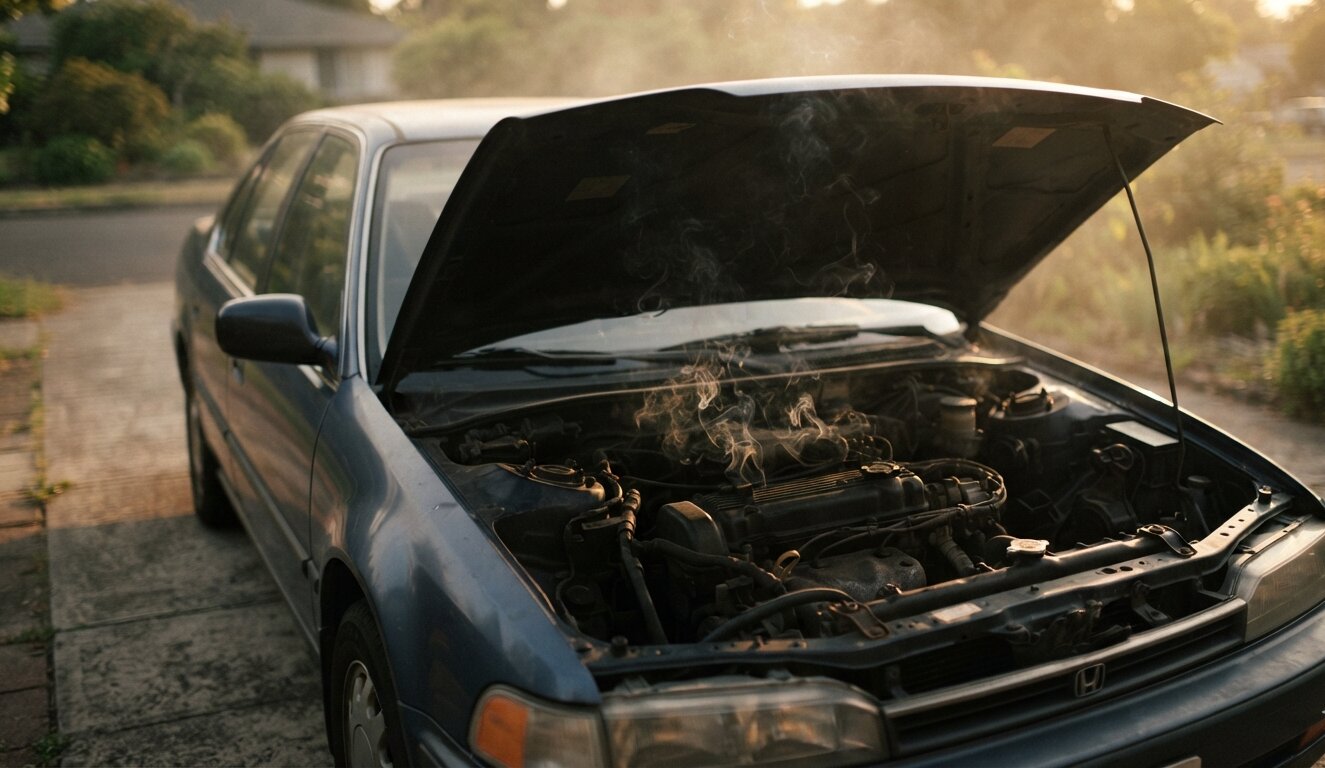
Your nose is one of the best diagnostic tools you have. Different burning smells point to very different problems — some minor, some serious, one potentially dangerous. Here's how to read them.
A burning smell from a car is never something to ignore — but it's also not automatically an emergency. The smell itself carries diagnostic information. Burning oil smells different from burning rubber, which smells different from burning plastic, which smells very different from an electrical fire. The character of the smell, combined with when it appears (after hard braking, while driving, only when the engine first starts, from inside the cabin), narrows the cause down quickly.
Read through the descriptions below and match them to what you're experiencing. We've ordered them from most to least urgent. If you're not sure, call us — describing a smell over the phone is surprisingly diagnostic, and we can tell you whether to drive in or call a tow.
Quick Reference: Burning Smell Guide
| Smell | Most Likely Cause | Urgency |
|---|---|---|
| Sharp burning + visible smoke | Active fire — pull over immediately | EMERGENCY |
| Electrical burning / acrid plastic | Wiring or electrical fault | Very High |
| Burning rubber near wheels after braking | Stuck brake caliper | High |
| Burning oil, outside the car | Oil leak onto hot exhaust | Moderate–High |
| Sweet, syrupy | Coolant burning or leaking | High |
| Rotten eggs / sulfur | Catalytic converter or battery | Moderate |
| Burning rubber from engine bay | Belt slipping or melting | Moderate |
| Burning smell only when heater runs | Dust on heater elements (first use of season) | Low — usually normal |
| Musty from AC vents | Mold on evaporator or cabin filter | Low |
📋 In This Article
- EMERGENCY: Visible Smoke or Strong Sudden Burning — Pull Over Now
- Electrical / Acrid Plastic Burning
- Burning Rubber Near the Wheels After Braking
- Burning Oil Smell From Outside the Car
- Sweet or Syrupy Smell
- Rotten Eggs or Sulfur
- Burning Rubber From the Engine Bay While Driving
- Burning Smell Only When the Heater First Runs
- Musty Smell From the AC Vents
- FAQ
EMERGENCY: Visible Smoke or Strong Sudden Burning — Pull Over Now
If you see smoke — from the engine bay, from under the car, or from the dashboard — pull over immediately at the nearest safe location and turn off the engine. Do not keep driving.
Visible smoke combined with a burning smell means something is actively burning or overheating to the point of combustion. This could be an oil or coolant leak onto hot exhaust, an electrical fault, or in the worst case, a vehicle fire beginning.
If you see flames or the smoke is black and acrid: Get everyone out of the vehicle immediately, move away from the car, and call 911. Do not attempt to open the hood if there's any chance of an active fire — oxygen will accelerate it. A car fire escalates extremely fast.
If it's white or grey steam-like smoke: This may be coolant burning off hot surfaces — still serious (means there's a coolant leak) but less immediately dangerous than an oil or electrical fire. Get off the road, turn off the engine, and call for help.
If there's any ambiguity about smoke versus steam, treat it as an emergency until proven otherwise.
Electrical / Acrid Plastic Burning
What it smells like: A sharp, acrid, distinctly chemical smell — like burning plastic or insulation. It's one of the most distinctive and unpleasant smells a car can produce and is immediately recognizable as something synthetic burning.
Where it comes from: Electrical wiring or components overheating. A short circuit heats wire insulation to the point of combustion. A failing motor (blower motor, power window motor, starter) may burn its windings. Rodents chewing wiring — a growing problem in our area with the soy-based wire insulation some manufacturers use — can expose copper conductors to shorts.
How serious: Very. An electrical fire is particularly dangerous because it can start in hidden locations behind panels and dashboards where you can't see or access it easily. If you smell this strongly and persistently while driving, pull over and turn off the car. If you can smell it from outside the car after parking without it being from a specific obvious source, don't restart it until it's been inspected.
Specific situation — burning smell from the HVAC vents: If the acrid smell is coming from your vents, the blower motor (which pushes air through the system) may be failing. The motor windings overheat and produce this smell. You may also notice reduced airflow from the vents. The blower motor is replaceable: $200–$450 depending on vehicle.
Fix: Electrical diagnosis required to find the fault. Cost: $80–$150 diagnostic, plus repair based on what's found. Our auto electrical repair includes wiring inspection, module testing, and blower motor replacement.
Burning Rubber Near the Wheels After Braking
What it smells like: Hot rubber with a metallic undertone, distinctively coming from near one or more wheels rather than the engine bay. Most noticeable after sustained braking or at a stop after a stretch of driving.
What's happening: A brake caliper that's seized or partially stuck is keeping the brake pad in continuous contact with the rotor. The friction generates heat continuously rather than only during braking. The rotor gets extremely hot, the brake pad material burns, and you smell it near the wheel.
How to confirm: After a normal drive, park and carefully — without touching anything — hold your hand near each wheel (about 6 inches away). A normal wheel should be warm but not hot. A seized caliper makes the wheel too hot to comfortably hold your hand near.
Also check for: The car pulling to one side during braking (toward the seized side), unusual brake fade (brakes that feel effective when cold but less so after driving), and a grinding noise in the severe cases where the pad has worn through.
How serious: High. A severely seized caliper can heat the brake fluid in that caliper to boiling, causing a sudden, total loss of braking effectiveness on that corner. The fluid around the caliper can also catch fire in extreme cases.
Fix: Caliper rebuild or replacement, plus new pads and often a rotor on the affected corner. Cost: $350–$700 per corner. Our brake repair services cover caliper diagnosis, rebuild, and complete brake system overhaul.
Burning Oil Smell From Outside the Car
What it smells like: Engine oil burning — a heavy, somewhat acrid smell with a petroleum base. Clearly coming from outside or under the hood rather than from the vents. Often strongest right after parking.
What's happening: Oil is leaking from somewhere in the engine and dripping onto a hot surface — most commonly the exhaust manifold, exhaust pipe, or catalytic converter. These surfaces run at 400–1,400°F, and oil that contacts them burns immediately.
Is it dangerous: On its own, a slow oil drip burning off the exhaust is unlikely to cause a fire (modern exhaust is designed to handle incidental oil contact), but it signals an oil leak that should be addressed. A significant oil leak — one that's producing continuous smoke from the engine bay — can cause a fire if the oil contacts sufficient hot surface area.
Check: Look under the car for oil drips on the exhaust. Check the oil level — if it's low, the leak is significant. Look on top of the engine for wet areas around the valve covers, which is the most common oil leak source.
Fix: Depends on the source. Valve cover gaskets: $200–$350. Oil pan gasket: $300–$500. More significant leaks require diagnosis first. Our engine repair services cover all oil leak repairs from simple gasket replacements to full engine overhaul.
Sweet or Syrupy Smell
What it smells like: Distinctly sweet, sometimes described as maple syrup, candy, or a pleasant but out-of-place sugary smell. Ethylene glycol — the base of most coolant — has this distinctive odor. It's sweet enough that many people momentarily can't identify it as a car problem.
Where it comes from: Outside the car near the engine — coolant leaking onto hot engine surfaces or exhaust. Inside the cabin from the vents — a leaking heater core (which routes coolant through the dashboard to heat the cabin) dripping coolant that then evaporates through the ventilation system.
How serious: High. Coolant loss causes overheating. A sweet smell from the vents specifically suggests the heater core is leaking — which means coolant vapor is entering the cabin (an unpleasant exposure to ethylene glycol), and you may also notice a slight fogging of the inside of the windshield, a slight oily film on the inside glass, or the floor on the passenger side becoming damp.
Fix: Coolant leak outside: find and fix the source ($100–$700 depending on cause). Heater core replacement: $600–$1,200 — labor-intensive because the heater core is inside the dashboard.
Rotten Eggs or Sulfur
What it smells like: Unmistakably sulfurous — like rotten eggs or the smell near a wastewater treatment plant. Strong and distinctive.
Two main causes:
Catalytic converter failure. The catalytic converter processes exhaust gases and eliminates sulfur compounds. When the converter is failing — internally damaged, clogged, or running too rich from a misfiring engine — it can't process sulfur compounds efficiently and they exit the tailpipe. A rotten egg smell from the rear of the car, particularly noticeable while accelerating, points here. A failing catalytic converter usually also triggers a P0420 or P0430 check engine code.
Overcharging battery. A conventional lead-acid battery that's being overcharged (from a faulty voltage regulator or alternator) can vent hydrogen sulfide gas — the rotten egg smell. This would typically be accompanied by battery swelling, electrolyte boiling, and corrosion around the terminals. Less common on modern vehicles with sealed batteries.
How serious: Moderate. A catalytic converter failure isn't immediately dangerous (the smell is unpleasant but not acutely harmful in a moving vehicle), but it means the emissions system is failing and the underlying engine problem causing it — typically a misfire feeding unburned fuel into the cat — needs to be addressed. A clogged catalytic converter can eventually restrict exhaust flow enough to affect engine performance.
Fix: Catalytic converter replacement: $600–$1,200. But first, diagnose the cause — if the engine is sending bad combustion products into the cat (misfire, rich running, oil burning), fix that first or the new cat will fail too.
Burning Rubber From the Engine Bay While Driving
What it smells like: Hot rubber, but coming clearly from under the hood rather than near the wheels.
What's happening: The serpentine belt or one of the accessory belts is slipping against a seized or sticky pulley — a pulley whose bearing has failed and isn't turning freely. The belt slides across the frozen pulley surface, generating heat and burning rubber.
How to confirm: After the car has been running, open the hood (carefully, it will be hot) and look for black smearing or glazing on the belt, and listen for a squealing sound that might correspond to the smell. A seized idler pulley or tensioner pulley can usually be identified visually — it will have rubber smeared on it and may feel very stiff to rotate by hand (with the engine off).
How serious: Moderate, but with urgency if the belt snaps. A snapped serpentine belt immediately disables the alternator (charging stops, you'll drain the battery), the power steering pump (on hydraulic systems), and the water pump (overheating begins in minutes on many engines). On vehicles where the serpentine belt also drives the water pump, a snapped belt leads to overheating very quickly. Don't continue driving if you smell burning rubber from the engine bay.
Fix: Belt replacement: $80–$200. Seized pulley replacement: $150–$350. Both done together when the belt has been smearing: $200–$450.
Burning Smell Only When the Heater First Runs
What it smells like: A burning dust smell — like when you first run a heater in a house that's been off for months. Faint, dusty, and brief.
When it happens: First few minutes of running the heater at the start of fall or winter, or after the car has sat for a long period.
What's happening: Dust, pollen, and debris accumulate on the heater core fins and blower housing during months of non-use. When the heater runs for the first time, that accumulated debris burns off. It typically lasts only a few minutes and completely resolves.
How serious: Almost none — this is normal for vehicles that haven't had the heater running for months. If the smell persists beyond the first few minutes, or if it's accompanied by any smoke, it's no longer "first-use dust" and should be investigated.
Fix: Usually none needed. Running the heater for 10–15 minutes clears it. A cabin air filter change and a professional HVAC system cleaning can reduce how much this happens.
Musty Smell From the AC Vents
What it smells like: Damp, earthy, mildew-like. Often most noticeable when the AC first turns on. Some describe it as smelling like dirty socks or a basement.
What's happening: The evaporator core inside the dashboard condenses moisture from the air. In our coastal humid climate, a combination of that moisture and biological material from the outside air — pollen, spores, road dust — creates an ideal environment for mold and bacteria on the evaporator fins and in the surrounding housing. The musty smell is that mold colony wafting into the cabin every time the system runs.
How serious: Low — this won't damage your car or leave you stranded. But mold in the HVAC system is an air quality issue and is genuinely unpleasant. People with respiratory sensitivities or allergies may find it significantly worsens their symptoms in the car.
Fix: Start with a cabin air filter replacement ($40–$80) — a moldy filter is often the primary source. An evaporator deodorizer treatment (we spray an antimicrobial into the system) costs $40–$80 additional and significantly reduces or eliminates the smell. In severe cases, professional evaporator cleaning is more involved.
Frequently Asked Questions
The burning smell goes away after a few minutes. Does that mean it's fine?
I smell something burning but I can't tell if it's coming from my car or someone else's. How do I check?
Can I drive to the shop if my car smells like burning?
Smell Something Burning? Don't Guess — Call Us.
We can narrow it down significantly from a description over the phone.
Or book online: Book Appointment Online
Ladson Auto Repair Shop — 3322 Ladson Rd, Ladson, SC 29456. Serving Ladson, Summerville, Goose Creek, North Charleston, and the greater Charleston, SC metro area.
Need Help? Call Ladson Auto Repair Shop
If you have questions about your vehicle or need to schedule a repair, our experienced mechanics are here to help. We provide honest diagnostics, fair pricing, and a 12-month/12,000-mile warranty on all repairs.
📞 Call Now: 843-494-9179Serving Ladson, Summerville, North Charleston, Goose Creek, and Hanahan, SC.