The short answer: it's almost always a brake problem, it's almost always serious, and it's almost always going to get more expensive the longer you wait. Here's exactly what's happening.
If your car is grinding when you brake, stop reading this and call us. That's the honest one-sentence answer. But since you're here at whatever hour it is and you want to understand what's going on before you do anything else, here's the complete picture — what's causing it, how urgent each cause is, and what it costs to fix.
Grinding when braking is not like a rattle or a squeak that might go away on its own. It is metal contacting metal in your braking system, which is both damaging your components with every stop and reducing your ability to stop effectively. One situation causes minor damage and a straightforward repair. The others cause progressive, compounding damage that gets significantly more expensive the longer you drive on them.
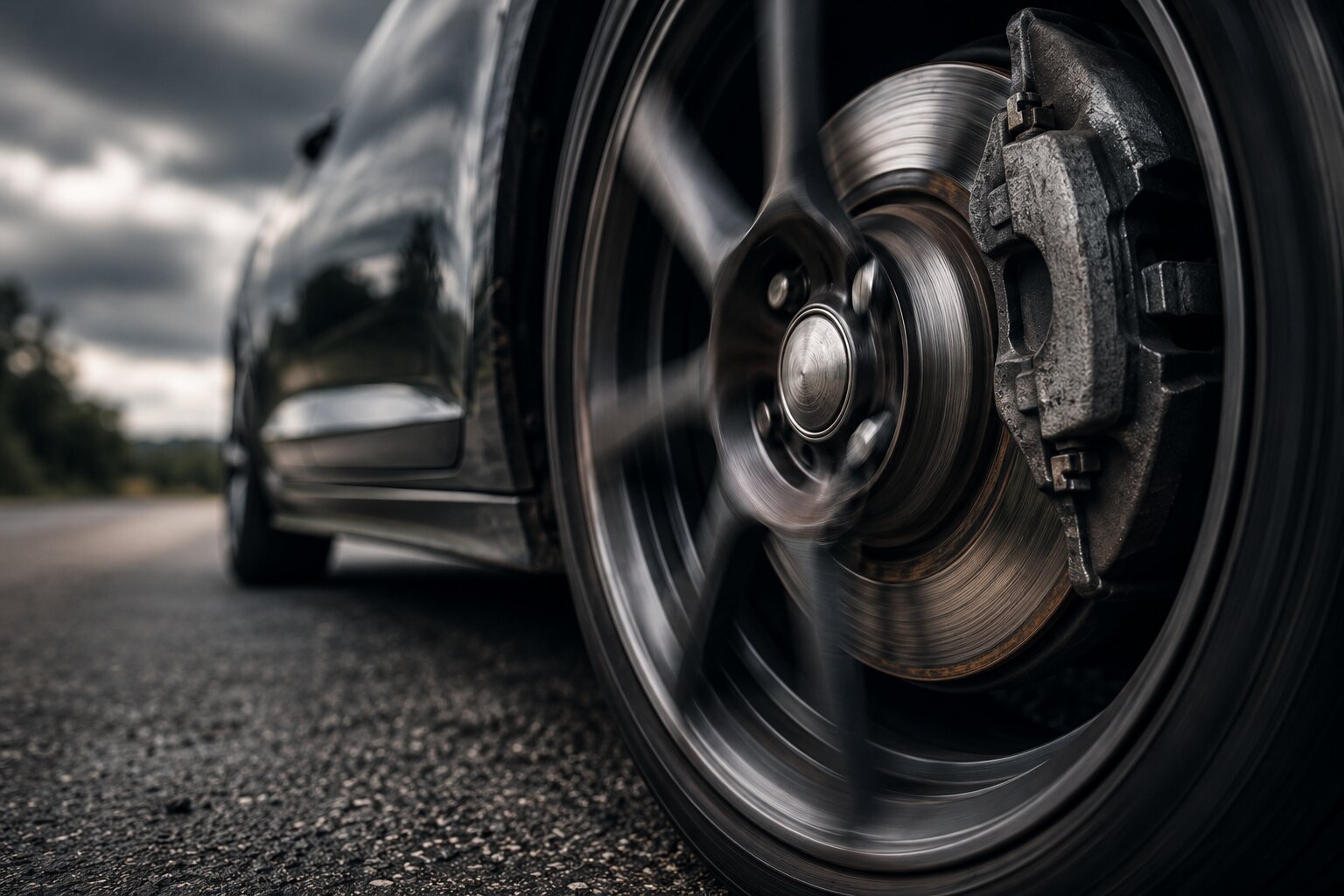
How quickly you should have grinding brakes inspected. Not this weekend. Not when you get a chance. Today, or as close to it as possible. Here's why.
📋 In This Article
The Four Most Likely Causes
Grinding when braking almost always comes from one of four sources. They range from completely harmless to genuinely dangerous. The key distinction is whether the grinding happens only for the first stop or two, or whether it happens consistently every time you brake.
1. Morning surface rust on the rotors. This is the harmless one. If the grinding only happens on your first stop or two of the day — and then completely disappears — this is almost certainly light surface rust on the rotor faces. In our Lowcountry climate, brake rotors rust overnight from humidity. The first few brake applications grind off that surface rust, after which the brakes work normally and sound completely fine. This requires no repair.
2. Worn brake pads (metal backing on rotor). This is the most common serious cause. Brake pads have a wear indicator — a metal tab designed to squeal when pads reach 2–3mm. If that squeal was ignored, the friction material has now worn completely through. The metal backing plate of the pad is contacting the rotor directly. The grinding is steel on iron. This needs repair today.
3. A rock or road debris trapped in the caliper. Small stones, acorns, and road grit can occasionally get lodged between the pad and rotor. When this happens, you get a consistent grinding or scraping that may not directly track with your brake application — the noise can happen while rolling without braking. Sometimes it resolves on its own when the debris works its way out. Often it needs the wheel pulled to clear it.
4. A seized brake caliper. A caliper that's partially or fully seized keeps the brake pad in constant contact with the rotor even when you're not pressing the pedal. The grinding comes from continuous friction. You may also notice the vehicle pulling to one side, or one wheel significantly hotter than the others after a drive. Seized calipers are common in our coastal environment — salt air corrodes the slide pins that allow the caliper to move freely.
How to Tell Which One It Is
Timing is the first diagnostic. Ask yourself: does the grinding happen only on the very first stop of the day and then go away entirely? That's morning rust — harmless. Does it happen every time you apply the brakes? That's one of the serious causes.
Does it happen without braking? If you hear scraping while rolling at low speed without touching the pedal, it's either a seized caliper keeping the pad in contact or debris trapped in the caliper. Either way, it needs to be looked at.
Is it from one side or both? A seized caliper typically affects one corner. You may be able to identify which side the sound is coming from. The vehicle may also pull toward the seizing side when braking.
Is there a burning smell? A seized caliper generates continuous heat. If you smell burning from near the wheels after driving, especially combined with grinding, that's a seized caliper until proven otherwise.
The One That's Not Serious (Morning Rust)
In the Lowcountry especially, overnight humidity deposits a thin layer of iron oxide on brake rotor surfaces. When you make your first stop of the morning, the pad scrapes across this rust layer and you hear a brief grinding or scraping — sometimes quite loud. After that first stop or two, the rust is gone and the brakes operate silently and normally.
This is completely normal. It doesn't indicate worn pads or any damage to the braking system. It's more common on vehicles that sit overnight outside, more common in humid weather, and more prominent in vehicles that don't drive far before the first stop.
The only thing that makes morning rust worse is letting brake surfaces sit for days without use — coming back from a vacation to find your car has been sitting for a week in our coastal humidity. A few firm brake applications on the first drive will clear it.
If your grinding disappears completely after the first stop and doesn't return until the next morning: no action needed.
The Ones That Are Serious
Worn pads with metal-to-metal contact. This is the most urgent. Every stop you make is scoring the rotor surface, generating metal particles in the brake fluid and caliper, and creating heat from metal-on-metal friction rather than designed friction material. Your stopping distance is increasing. The rotor is being damaged with each stop.
At the squeal stage (wear indicator), a pad replacement typically runs $150–$280 per axle. At the metal-on-metal grinding stage, the rotor is damaged and usually needs replacement as well — adding $100–$200 per rotor. Continue grinding long enough and you may damage the caliper too. What could have been a $200 repair becomes a $500–$700 repair just from delay. Our brake repair services include complete brake inspection, pad and rotor replacement, caliper service, and brake fluid flushing.
Seized caliper. A caliper that won't release means one brake is always partially engaged. The pad wears down rapidly on that corner. The rotor overheats from continuous friction. The brake fluid in that caliper can boil from sustained heat, causing a sudden, complete loss of braking on that corner. On a vehicle where you're already pulling to one side under braking, this is a genuine safety hazard.
Debris in the caliper. A rock that's trapped and scoring the rotor leaves distinct circular scratches. If it doesn't work itself out quickly, it needs the wheel pulled to clear it. Leaving it risks rotor damage that will require replacement.
What Happens If You Keep Driving on Grinding Brakes
The progression from "grinding" to "failure" follows a predictable and expensive path:
Day 1–3 of grinding: Metal backing on rotor. Rotor surface scored. Brake effectiveness reduced. Repair: pads + rotors, $300–$500 per axle.
Week 1–2 of grinding: Rotor scoring deepens. Metal debris entering caliper piston bore, scoring the bore surface. Brake fluid contaminated with metal particles. Repair: pads + rotors + possible caliper replacement, $500–$900 per axle.
Weeks of grinding: Rotor worn through minimum thickness. Caliper piston potentially seized. Brake fluid degraded from heat. Risk of sudden, partial brake failure on the affected corner. Repair: pads + rotors + calipers + brake fluid flush, $800–$1,400+ per axle.
Extreme neglect: The metal backing plate can cut through the rotor hat, causing catastrophic rotor failure. At this point brake effectiveness on that wheel is essentially zero and the vehicle is dangerous to operate.
None of this is exaggeration. We see the full range at our shop, including vehicles brought in after the rotor failed through. The repair bill is always larger than the owner expected. The earlier in the progression you address it, the less it costs.
What the Repair Will Cost
At Ladson Auto Repair Shop, here are realistic estimates for brake grinding repairs:
| Situation | Typical Cost |
|---|---|
| Morning rust only — no repair needed | $0 |
| Pads worn, rotors resurfaceable | $200 – $380 per axle |
| Pads worn, rotors need replacement | $320 – $520 per axle |
| Seized caliper + pads + rotors | $500 – $900 per corner |
| Debris removal (wheel off, clear and inspect) | $80 – $150 |
| Brake fluid flush (recommended with brake work) | $80 – $120 |
We always provide a written estimate before any work begins. If you bring the car in and the diagnosis is morning rust and nothing else, we tell you that and charge you nothing for the inspection.
Frequently Asked Questions
My brakes grind but only sometimes. Does that mean it's not serious?
My brakes grind but I just had them done six months ago. What happened?
Can I drive to your shop if my brakes are grinding?
How do I know if it's the front or rear brakes?
Don't Wait on Grinding Brakes — Call Us Today
Walk-ins welcome Monday through Friday, 10 AM – 5 PM.
Or book online: Book Appointment Online
Ladson Auto Repair Shop — 3322 Ladson Rd, Ladson, SC 29456. Serving Ladson, Summerville, Goose Creek, North Charleston, and the greater Charleston, SC metro area.
Need Help? Call Ladson Auto Repair Shop
If you have questions about your vehicle or need to schedule a repair, our experienced mechanics are here to help. We provide honest diagnostics, fair pricing, and a 12-month/12,000-mile warranty on all repairs.
📞 Call Now: 843-494-9179Serving Ladson, Summerville, North Charleston, Goose Creek, and Hanahan, SC.