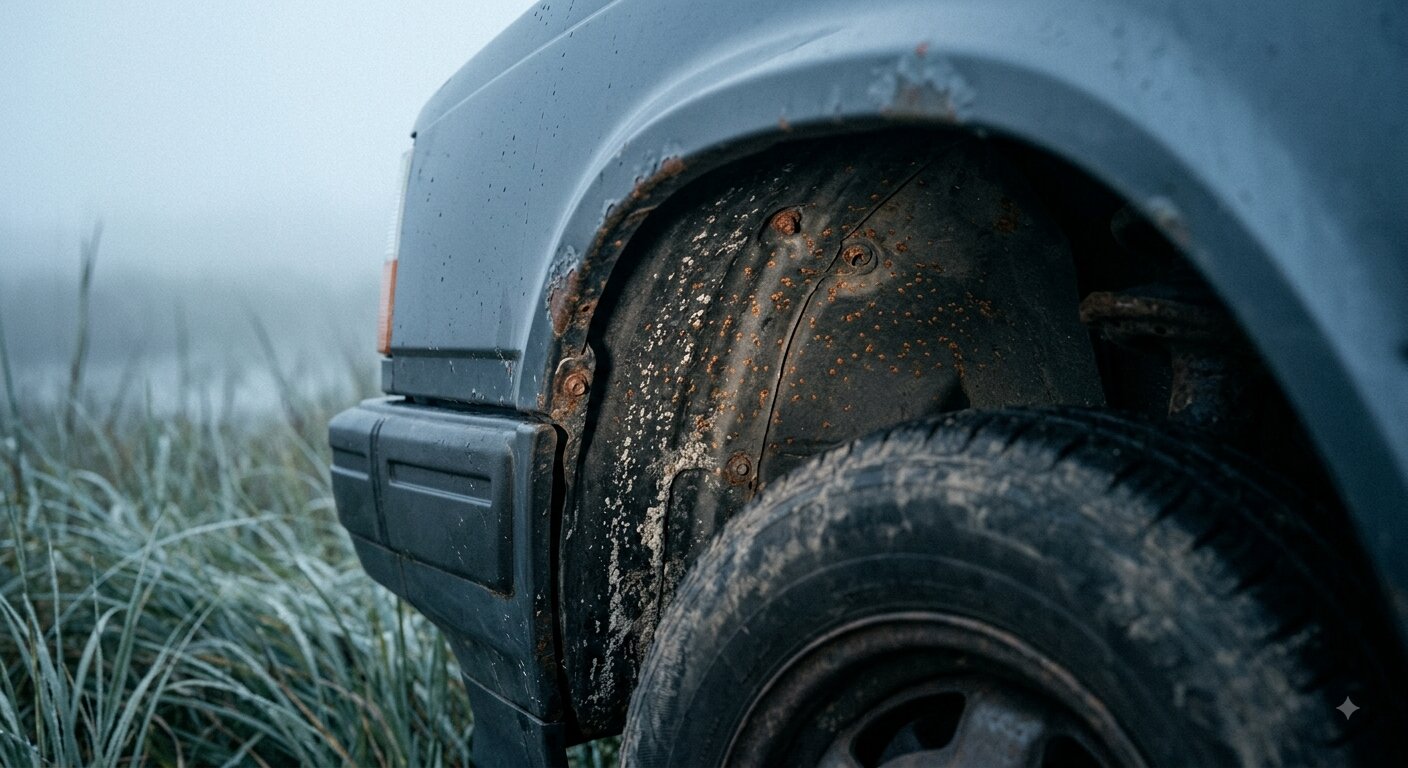
What every driver in Ladson, Summerville, Goose Creek, and the Charleston area needs to know — and what to do about it.
Picture this: You buy a clean, rust-free 2015 pickup from a dealer in Ohio — good bones, solid undercarriage, not a spot of rust to be found. Three years later, you're living off Dorchester Road and your mechanic is pointing a flashlight at your rear brake lines and showing you something that looks like orange lace. The steel isn't just surface-rusted. It's eaten through.
That's not an exaggeration. We see it regularly at our shop in Ladson. The Lowcountry's combination of salt air, year-round humidity, and tidal flooding creates one of the most corrosive environments a vehicle can live in outside of actual beachfront parking. And unlike the rust belt up north — where vehicles are attacked by road salt in winter and then get months of dry air to recover — our vehicles get hit continuously, every day, twelve months a year.
If you've lived here your whole life, you may have never thought much about it. If you moved here from the Midwest or the Northeast, you've almost certainly noticed it. Either way, understanding what's actually happening to your car — and what you can do to slow it down — is worth your time.
How much faster steel corrodes in coastal humid air compared to dry inland climates, according to corrosion engineering standards. The Lowcountry sits at the extreme end of that range.
📋 In This Article
- Why Coastal Salt Air Is So Hard on Cars
- Where Corrosion Hits First
- Brake Lines: The Silent Safety Risk
- Undercarriage and Frame Damage
- How Body Rust Actually Starts
- Electrical Corrosion: The Sneaky One
- Which Vehicles Are Most Vulnerable
- What Actually Protects Your Car
- Cost of Prevention vs. Cost of Repair
- Frequently Asked Questions
Why Coastal Salt Air Is So Hard on Cars
Salt doesn't just settle on the outside of your car. It's suspended in the air as fine aerosol particles — microscopic droplets of salt-laden moisture that drift inland from the coast and tidal marshes. Depending on wind direction, you can be getting meaningful salt exposure well inland from the water's edge. Ladson is roughly 20 miles from the Atlantic by road, but we're surrounded by tidal waterways — the Ashley River, the Cooper River, the North Edisto — and our air is marine in character year-round.
Here's why that matters for your car: steel corrodes through an electrochemical process. For rust to form, you need moisture, oxygen, and an electrolyte — a substance that allows electrical current to flow between anodic and cathodic sites on the metal surface. Salt water is a nearly perfect electrolyte. It dramatically accelerates the electrochemical process that turns steel into iron oxide. What might take ten years to rust noticeably in a dry climate can happen in two or three here.
The humidity compounds this. Relative humidity in the Charleston-Ladson area routinely exceeds 80% in summer, and even in our mild winters, it rarely drops below 50%. That means your car is almost never in truly dry air. Moisture is always present, always available to partner with whatever salt is clinging to your undercarriage, your brake lines, your suspension components.
The customers who keep their vehicles longest in this area are the ones who wash underneath them regularly and stay on top of brake line inspections. The ones who find out the hard way are usually shocked — they didn't realize how bad it had gotten because it's all out of sight under the car.
— Service Technician, Ladson Auto Repair Shop
— Ladson Auto Repair Shop Mechanics
Where Corrosion Hits First
Not all parts of your vehicle corrode at the same rate. Some are protected — either by paint, by plastic shielding, or by their location. Others are completely exposed, unprotected, and made of materials that have no resistance to salt-air corrosion. Here's how it typically progresses on a vehicle that's spent years in the Lowcountry without targeted protection:
Year 1–2: Surface oxidation begins on exposed unpainted metal. Brake rotors, caliper brackets, and suspension components show surface rust after light rain. This is normal and largely cosmetic at this stage.
Year 2–4: Structural corrosion begins on exposed steel brake lines, fuel lines, and subframe components. Rubber bushings start to dry-rot from UV exposure and ozone degradation accelerated by heat and humidity.
Year 4–7: Brake line corrosion may penetrate wall thickness on vehicles without protection coatings. Subframe components and rear crossmembers begin to lose structural material. Floor pans and rocker panels show rust perforation if paint protection has been breached.
Year 7+: Severe corrosion can compromise structural integrity of the unibody or frame. Brake line failure risk becomes serious. Major undercarriage repairs may be required to pass inspection or maintain safe operation.
The progression varies significantly by vehicle. Trucks and SUVs with body-on-frame construction tend to hold up better in the undercarriage than unibody vehicles because the frame is heavier-gauge steel. But they're not immune — we've seen full-size truck frames that looked like Swiss cheese after a decade in the coastal Lowcountry.
Brake Lines: The Silent Safety Risk
This deserves its own section because it's both the most dangerous corrosion problem and the least visible one to the average driver.
Your brake lines are small-diameter steel tubes — typically 3/16" outside diameter — that run from the master cylinder at the firewall to each wheel. They carry brake fluid under high pressure (up to 2,000 PSI when you stomp on the brakes in an emergency stop) and are the only thing translating your foot pressure into actual stopping force at the wheels.
Steel brake lines in the Lowcountry environment are attacked simultaneously from the outside (salt air, road spray, humidity) and sometimes from the inside (brake fluid that's absorbed moisture and become acidic over time). The lines are routed along the frame rails and undercarriage — areas that collect salt spray and stay wet the longest.
What makes this so dangerous is that a brake line doesn't fail all at once. It corrodes gradually, thinning the wall from the outside in. The line might hold 2,000 PSI for years with 80% wall thickness — and then fail suddenly when that last 20% gives way under a hard stop. When it goes, brake fluid evacuates, pedal goes to the floor, and you have whatever stopping power remains from the wheels that still have intact lines. That's a genuinely terrifying scenario, and it's preventable.
Signs of brake line trouble to watch for:
- Soft or spongy brake pedal that's getting progressively worse
- Brake pedal that sinks under sustained pressure at a stop
- Any visible fluid on the ground under the vehicle when parked
- Visible reddish-brown surface corrosion on the lines during an oil change
- Brake warning light illuminating
At Ladson Auto Repair Shop, we inspect brake lines as a standard part of every oil change and every brake service. If you haven't had your undercarriage looked at in the last two years — especially on a vehicle that's been here longer than five years — schedule an inspection. This is not an area where you want to find out there's a problem the hard way.
The hydraulic pressure your brake lines carry during a hard stop. A pinhole-sized perforation from corrosion is enough to cause sudden, total failure of that line. This is why brake line inspection isn't optional in the Lowcountry.
Undercarriage and Frame Damage
Below the body panels and behind the plastic trim pieces, your vehicle has a skeleton — either a full frame (on trucks and body-on-frame SUVs) or a unibody structure (on most cars and crossovers). Both are made primarily of steel, and both are vulnerable.
Frame and unibody corrosion matters for two reasons: structural integrity and repairability. A vehicle with significant frame corrosion may not meet the crash safety specifications it was designed to. And from a practical standpoint, severely corroded frames and subframes can make routine repairs extremely difficult. We've had brake jobs that turned into multi-day projects because a corroded caliper bracket bolt snapped at the subframe, requiring drilling, tapping, and sometimes a subframe replacement that cost ten times what the brake job should have.
The most vulnerable undercarriage areas on typical vehicles in our area:
Rear subframe and crossmember: Often the lowest point, gets the most road spray, and is typically hollow steel that traps moisture inside. We see severe corrosion here on imports and domestic unibody vehicles.
Fuel and brake lines along frame rails: Discussed above — but worth reiterating that lines clipped to the frame share whatever moisture and salt the frame accumulates.
Rear wheel wells: The inner fender liners trap debris and moisture against the sheet metal. Once the paint is scratched through, rust accelerates quickly in this pocket.
Floorboards and trunk floor: Carpet holds moisture from tracked-in rain and condensation, and floor pans rust from the inside out in vehicles that spend years in high-humidity environments.
Exhaust system: The exhaust system gets hot enough to self-clean during operation, but the sections near the muffler and tips stay cooler and corrode more readily. Hangers, heat shields, and clamps go first.
How Body Rust Actually Starts
The paint on your car is your primary defense against corrosion. It seems obvious, but it's worth understanding the mechanism — because once you know how rust starts, you understand why certain maintenance habits matter.
New car paint is actually a multilayer system: a zinc-phosphate conversion coating on the bare steel, a primer layer, a base coat for color, and a clear coat for UV and scratch protection. That stack is quite good when it's intact. The problem is that it doesn't stay perfectly intact forever.
Stone chips are the most common entry point. On Highway 78 or I-26, a piece of gravel kicked up by a semi chips through all four layers of paint at once, exposing bare steel to the elements. In a dry climate, that chip might sit there for years before anything serious happens. In our environment, moisture and salt attack the exposed steel immediately. And here's the important part: rust doesn't just grow where the chip is. It creeps laterally under the surrounding paint, lifting and bubbling it from underneath. By the time you see a rust bubble on the surface, there's typically a dime-sized or larger rust spot underneath.
That's why the commonly seen advice to "touch up stone chips quickly" is particularly important here. A few dollars of touch-up paint applied within the first month after a chip can prevent what becomes a significant rust repair two or three years later.
Electrical Corrosion: The Sneaky One
Salt air doesn't just attack metal structural components. It attacks electrical connections, terminals, and ground points throughout your vehicle — causing a wide range of problems that often get misdiagnosed as sensor failures, module failures, or "gremlins."
The mechanism is the same: salt is an electrolyte that allows current to flow where it shouldn't, and it accelerates oxidation of copper and aluminum electrical contacts. A slightly corroded ground connection at the chassis can cause everything from random warning lights to transmission shift issues to complete no-start conditions — none of which obviously point to "corroded ground strap" when you're staring at the symptom.
Battery terminals are the most visible and most commonly affected electrical connection. You'll often see a white or blue-green powder (zinc oxide or copper sulfate) around the terminal posts, especially on the negative terminal. This is salt-accelerated oxidation, and it increases resistance in the circuit. The results range from hard starting to false battery-failure readings on diagnostic equipment. We test and replace batteries as part of our battery, starter, and alternator services — including conductance testing that catches degradation before it leaves you stranded.
Less visible but equally important: grounds strapped to the firewall, engine mounts, and body. These are often overlooked during routine service and can corrode completely unnoticed for years.
If your vehicle has been giving you intermittent electrical issues — sensors throwing codes without apparent cause, flickering interior lights, accessories that work sometimes and not others — corrosion on ground connections is high on our list of suspects, especially on vehicles over six years old. Our auto electrical repair services specialize in tracking down these elusive coastal corrosion issues, from ground strap replacement to module-level diagnosis.
Which Vehicles Are Most Vulnerable
Not all vehicles handle the Lowcountry equally. Some are better engineered for it, and some are demonstrably worse. Here's what our shop experience tells us:
| Vehicle Type | Corrosion Vulnerability | Notes |
|---|---|---|
| Japanese imports (Toyota, Honda, Subaru) | Moderate | Generally better undercoating from factory; still not immune |
| German imports (BMW, Mercedes, Audi, VW) | High | Thinner steel, complex wiring harnesses, expensive to repair |
| Domestic trucks (F-150, Silverado, RAM) | Moderate-High | Frame is heavy steel but often inadequately protected in cavities |
| Domestic cars (Camaro, Charger, Malibu) | High | Unibody thin-gauge steel; floor pans and rockers vulnerable |
| Korean imports (Hyundai, Kia) | Moderate | Improved significantly on 2015+ models; older ones are vulnerable |
| Lifted trucks and off-road vehicles | Very High | Aftermarket lifts often remove undercoating; off-road use adds damage |
Older vehicles (pre-2010) that were built before galvanized steel became standard throughout the body structure are particularly susceptible. If you're driving a well-maintained older vehicle, the Lowcountry environment is a significant accelerant.
What Actually Protects Your Car
The good news: corrosion in the Lowcountry is not inevitable. It's manageable. Here's what actually works, in order of impact:
Regular undercarriage washing: This is the single highest-impact thing you can do. Salt and grime accumulate on the undercarriage and brake in the crevices of frame members, line clamps, and suspension components. Washing the undercarriage with a pressure washer — particularly after driving on roads near tidal areas or after any flooding event — removes the salt before it has time to work. Most full-service car washes have an undercarriage rinse cycle. Use it.
Professional undercoating: Rubberized undercoating applied by a shop to frame rails, floor pans, and wheel wells creates a physical barrier between steel and the environment. It's not permanent — it should be inspected and reapplied every few years — but on an older vehicle or a new one you're planning to keep, it's money well spent.
Brake line replacement before failure: If your brake lines have significant surface corrosion and your vehicle is more than eight years old, consider proactive replacement with stainless steel or coated aftermarket lines rated for coastal environments. It's far cheaper than the emergency scenario.
Battery terminal protection: Dielectric grease on battery terminals and any electrical connectors exposed to the elements dramatically slows oxidation. It's cheap, takes five minutes, and should be done at every battery service. We handle battery testing, terminal cleaning, and replacement as part of our battery, starter, and alternator services.
Paint chip repair: Touch up stone chips within weeks, not months. The longer bare steel is exposed in our environment, the more expensive the repair becomes.
Annual undercarriage inspection: Have a shop put your vehicle on a lift and inspect brake lines, frame, fuel lines, and suspension components every year. We include this in our routine service at no additional charge. It takes us ten minutes and catches problems while they're still inexpensive. Salt air also accelerates AC condenser corrosion — our auto AC repair includes condenser inspection for coastal vehicles.
Cost of Prevention vs. Cost of Repair
The financial argument for proactive corrosion management is overwhelming. Here's a realistic comparison:
| Preventive Measure | Typical Cost | Frequency |
|---|---|---|
| Undercarriage wash (car wash) | $10 – $20 | Every 2–4 weeks |
| Professional undercoating | $150 – $400 | Every 3–5 years |
| Brake line inspection | Included in service | Annual |
| Battery terminal service | $20 – $50 | Every 2 years |
| Touch-up paint (stone chips) | $15 – $30 | As needed |
| Reactive Repair | Typical Cost | When |
|---|---|---|
| Brake line replacement (full set) | $400 – $900+ | After failure or imminent failure |
| Subframe replacement (severe corrosion) | $800 – $2,500+ | After structural compromise |
| Floor pan rust repair | $500 – $1,500+ | After perforation |
| Rust repair and paint (body panel) | $300 – $1,200 per panel | After visible bubbling |
| Electrical harness repair (corrosion-caused) | $200 – $1,000+ | After intermittent failures |
The math isn't complicated. Prevention wins decisively, every time.
Frequently Asked Questions
My car is only two years old — do I need to worry about this?
I park in a garage. Does that help?
What about rust-proofing products I've seen advertised?
How do I know if my brake lines are getting bad?
Are trucks better than cars for this environment?
I bought a used vehicle from up north. How bad is it likely to be?
Don't Let the Lowcountry Environment Win
Your car can absolutely last 200,000 miles and beyond in this climate — we see it regularly. But the vehicles that make it that far aren't the ones that got lucky. They're the ones whose owners washed the undercarriage, caught rust before it spread, replaced brake lines before they failed, and had a shop that actually looked underneath instead of just checking the oil.
We've been maintaining vehicles in this environment for years. We know what the Lowcountry does to cars, and we know how to slow it down. If you want to bring your vehicle in for a full undercarriage inspection — brake lines, frame, suspension, fuel lines — we'll put it on the lift, show you what we find, and give you a written estimate before we do anything. No pressure, no surprises.
Schedule an Undercarriage Inspection Today
📞 Call 843-494-9179 to Schedule
Or book online: Book Appointment Online
Need Help? Call Ladson Auto Repair Shop
If you have questions about your vehicle or need to schedule a repair, our experienced mechanics are here to help. We provide honest diagnostics, fair pricing, and a 12-month/12,000-mile warranty on all repairs.
📞 Call Now: 843-494-9179Serving Ladson, Summerville, North Charleston, Goose Creek, and Hanahan, SC.