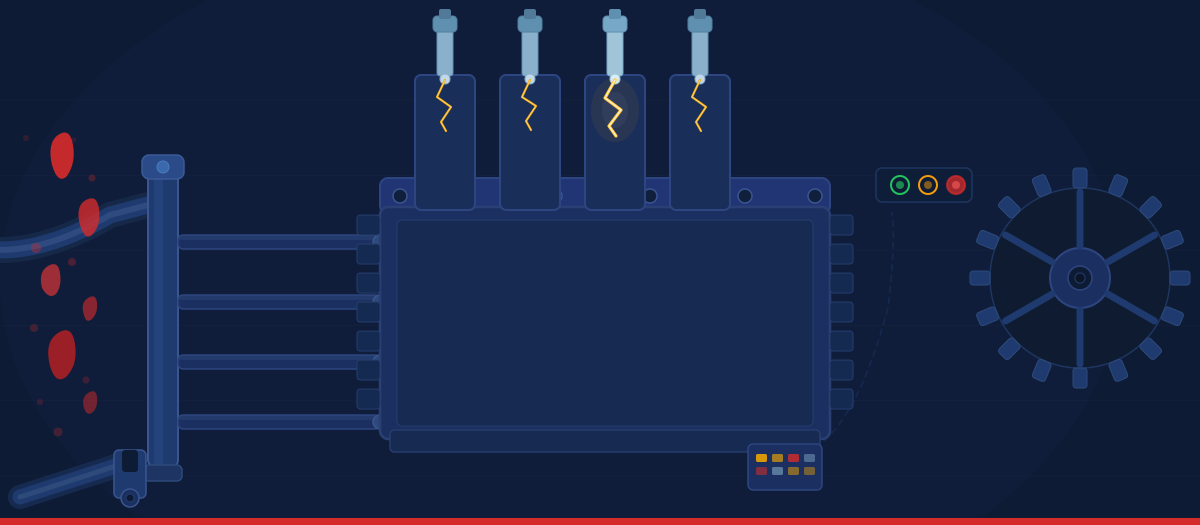
Picture this: You're sitting at the light where Ladson Road crosses College Park, engine idling rough, the whole car shuddering like it's cold even though it's 88°F outside. You've noticed the fuel mileage dropping — you used to get 28 MPG on the highway to Charleston, now you're lucky to hit 24. The engine hesitates when you step on the gas leaving the Walmart parking lot. Nothing is broken, exactly. Everything just feels… tired.
That's not bad luck. That's a car that's overdue for a tune-up and almost certainly has a fuel system coated in years of deposits, varnish, and carbon buildup. It happens to every car on the road — the question is whether you catch it before those small inefficiencies turn into big, expensive failures.
At Ladson Auto Repair Shop — where we pair every tune-up with our professional oil change and tune-up services — we perform tune-ups and fuel system cleanings every single week. In this guide, we're going to tell you exactly what both services involve, when you actually need them, what happens if you skip them, and what it's going to cost — with no sugarcoating. By the time you're done reading, you'll know more about this topic than most car owners ever learn.
The average cost of a fuel injector replacement — versus roughly $150 for a professional fuel system cleaning that prevents it. Maintenance always beats repair.
📋 In This Article
- What Is a Tune-Up (and What's Included)?
- When Do You Actually Need One?
- 7 Warning Signs Your Engine Needs a Tune-Up
- What Is a Fuel System Cleaning?
- Where Fuel Deposits Come From
- Real Benefits of Fuel System Cleaning
- Why DIY Fuel Additives Don't Cut It
- The South Carolina Factor
- Cost Breakdown: What to Expect in Ladson
- Frequently Asked Questions
What Is a Tune-Up — and What's Actually Included?
The term "tune-up" gets thrown around loosely, and that causes a lot of confusion. Fifty years ago, a tune-up meant resetting ignition timing, replacing points and condenser, adjusting the carburetor, and setting valve clearances. Modern fuel-injected engines with electronic ignition systems have eliminated most of those jobs — but a tune-up today is still a meaningful, important service. It just looks different.
A proper modern tune-up at Ladson Auto Repair Shop includes the following:
Spark Plug Replacement
This is still the core of any tune-up. Spark plugs fire thousands of times per minute, creating the tiny explosions that power your engine. Over time, the electrode wears down, the gap widens, and the spark weakens. A weak spark means incomplete combustion — which means rough running, harder cold starts, worse fuel economy, and more unburned fuel reaching your catalytic converter (which shortens its life significantly).
Most older vehicles use copper plugs (replaced every 30,000 miles), while most 2005+ vehicles use iridium or platinum plugs rated for 60,000–100,000 miles. We always install the OEM-specified plug type for your vehicle.
Ignition System Inspection
We inspect and, if needed, replace ignition coils, distributor caps, and rotor buttons (on vehicles that still have them). A weak coil can misfire intermittently — especially under load on I-26 on a hot day — and eventually throw an engine code that triggers your check engine light.
Air Filter Replacement
Your engine needs a precise air-to-fuel ratio to run correctly. A clogged air filter restricts airflow into the engine, effectively starving it of oxygen. This richens the fuel mixture, hurts performance, and drops fuel economy. Air filters should be replaced every 15,000–30,000 miles in normal conditions — but in the Lowcountry's pollen-heavy springs, you may need it more frequently.
Fuel Filter Service
On vehicles with external, serviceable fuel filters, we inspect and replace it as needed. The fuel filter keeps debris and contaminants from reaching your fuel injectors. A clogged fuel filter starves the engine at high loads — you'll notice hesitation when you try to accelerate hard or merge onto the interstate.
PCV Valve Check
The Positive Crankcase Ventilation valve routes harmful crankcase gases back into the intake manifold to be burned rather than vented to the atmosphere. A stuck-open or stuck-closed PCV valve causes rough idle, increased oil consumption, or excessive pressure buildup in the crankcase. It's cheap to replace and commonly overlooked.
Belt and Hose Visual Inspection
Tune-up time is a natural opportunity to inspect belts and hoses for cracking, fraying, or hardening — issues that are far cheaper to address preventively than after a side-of-the-road failure.
Diagnostic Scan and Fluid Check
We always scan for stored trouble codes (even if the check engine light isn't on — pending codes are common), check all fluid levels, and verify tire pressure as part of a complete tune-up service.
A tune-up isn't just about replacing parts — it's a chance for a trained technician to look at the whole engine system and catch small problems before they become expensive ones. Half the value is what we find while we're in there.
— Lead Technician, Ladson Auto Repair Shop
When Do You Actually Need a Tune-Up?
This varies by vehicle age and engine type. Here's a simple reference:
| Vehicle Type | Spark Plug Type | Recommended Interval |
|---|---|---|
| Older vehicles (pre-2000), most domestic trucks | Copper | Every 30,000 miles |
| Most 2000–2010 vehicles | Platinum | Every 60,000 miles |
| Most 2010+ vehicles | Iridium | Every 60,000–100,000 miles |
| High-performance engines (turbocharged, etc.) | Iridium (shorter life) | Every 30,000–60,000 miles |
Don't rely solely on mileage, either. If you've purchased a used car and don't have service records, or if your car is exhibiting any of the symptoms below, schedule a tune-up regardless of mileage.
7 Warning Signs Your Engine Is Overdue for a Tune-Up
Your engine won't send you a text message, but it's actually very good at communicating when something is wrong — if you know what to look for. Here are the seven most common signs we see at our shop:
1. Rough Idling or Shaking
When one or more cylinders misfires — because of a worn spark plug or weak ignition coil — the engine runs unevenly. You'll feel it as a vibration or shudder at a red light or in a drive-through. In severe cases, you might feel it through the steering wheel or floor.
2. Trouble Starting, Especially When Cold
On a winter morning (even the mild winters we get in Ladson), a worn-out spark plug struggles to fire in the cold air. You'll notice extended cranking before the engine catches, or multiple attempts needed before it starts.
3. Engine Hesitation or Stumbling Under Acceleration
Stepping on the gas and feeling the car stutter, stumble, or temporarily lose power before accelerating is a classic tune-up symptom. It's especially noticeable during highway on-ramps — like merging onto I-26 from Ladson Road when you need power right now.
4. Declining Fuel Economy
This is the one most people dismiss as "the car's just getting old" — but it's not normal. Worn spark plugs and a restricted air filter mean your engine is working harder to produce the same power. If your MPGs have dropped noticeably over the past year, a tune-up is likely to restore most of what you've lost.
5. Check Engine Light
A flashing check engine light almost always means an active misfire — which is a direct indicator that a spark plug or ignition coil has failed. A steady (non-flashing) check engine light can also indicate ignition-related codes like P0300 (random misfire), P0301–P0308 (cylinder-specific misfire), or related issues. Don't ignore it.
6. Engine Surging or Hunting at Idle
If the engine RPM rises and falls rhythmically on its own when you're stopped — the tachometer needle swinging up and down — this often points to a vacuum leak, a dirty throttle body, or a failing PCV valve. All things we address during a tune-up.
7. Unusual Exhaust Smell or Black Smoke
A rich-running engine (too much fuel, not enough air or spark to burn it) produces black smoke from the tailpipe and often smells strongly of unburned gasoline. This is both a performance problem and an emissions problem — and it's hard on your catalytic converter.
What Is a Fuel System Cleaning — and Why Does It Matter?
A tune-up handles the ignition and air sides of the equation. But the third leg of the combustion triangle — fuel delivery — needs attention too. That's where fuel system cleaning comes in.
Your fuel system consists of several components that all need to work together to deliver precisely the right amount of atomized fuel into each cylinder at exactly the right moment:
- Fuel tank — where debris and water contamination can accumulate
- Fuel pump — delivers fuel under pressure from the tank to the engine
- Fuel filter — traps particles before they reach the injectors
- Fuel pressure regulator — maintains consistent fuel pressure regardless of demand
- Fuel injectors — spray atomized fuel into each cylinder in a precise pattern, at a precise quantity, at a precise time
- Throttle body and intake manifold — where air enters the engine, and where carbon deposits love to build up
A professional fuel system cleaning addresses all of these components with specialized cleaning agents and, depending on the service level, mechanical cleaning of critical surfaces.
Where Fuel Deposits Actually Come From
This is the part most drivers don't know about — and it's important for understanding why fuel system cleaning isn't just a upsell gimmick.
Fuel Injector Deposits
Modern gasoline isn't perfectly clean — it contains heavy hydrocarbons that don't fully vaporize under all conditions. When an engine shuts off, residual fuel in the injector tip is exposed to extreme heat (the engine bay retains heat long after shutdown). These heavy components "bake" onto the injector nozzle as a hard varnish. Over time, this varnish partially blocks the tiny injector ports — typically 6–10 microns wide — changing the spray pattern from a fine mist to an irregular dribble.
Intake Valve Carbon Deposits (The GDI Problem)
On older port fuel-injected engines, the fuel spray naturally washed the intake valves clean every time the injector fired. Modern Gasoline Direct Injection (GDI) engines — found in many newer Fords, Hyundais, VWs, and others — inject fuel directly into the cylinder, bypassing the intake valves entirely. Without that fuel bath, oil vapor from the PCV system bakes onto the intake valves as hard carbon deposits.
These deposits reduce airflow, cause rough idle, and can eventually cause misfires. We've seen intake valves coated so heavily that they look like they've been dipped in black tar. Walnut blasting (a specialized physical cleaning process) is sometimes required for severe GDI carbon buildup.
Throttle Body Deposits
The throttle body controls airflow into your engine. Oil vapor and airborne particulates (especially significant in the Lowcountry's pine pollen season) accumulate on the throttle plate and bore as a dark, sticky film. A dirty throttle body causes rough idle and hesitation at low speeds.
Average fuel economy improvement reported after professional fuel injector cleaning on engines with moderate-to-heavy deposit buildup — enough to save real money over a South Carolina summer.
The Real Benefits of a Professional Fuel System Cleaning
Here's what you can realistically expect after a professional fuel system service on a vehicle with moderate deposit buildup:
- Improved throttle response — acceleration feels crisp and immediate rather than hesitant
- Smoother idle — the engine no longer hunts or surges at a stop
- Better fuel economy — atomized fuel burns more completely; less fuel is wasted
- Easier cold starts — clean injectors deliver the right amount of fuel on first crank
- Reduced emissions — complete combustion produces less hydrocarbon and CO output
- Longer injector life — clean injectors run cooler and don't develop the tip erosion that leads to failure
- Catalytic converter protection — unburned fuel from dirty injectors is the #1 cause of premature catalytic converter failure
The cars that benefit most dramatically from fuel system cleaning are usually the ones where the owner has been filling up with whatever's cheapest — off-brand gas, low-detergent blends — for years. The difference after cleaning can be remarkable. Customers sometimes say it feels like a different car.
— Service Manager, Ladson Auto Repair Shop
One important caveat: if your injectors are already failing mechanically — the internals are cracked, the solenoid is burned, or the tip is physically damaged — no cleaning service will restore them. At that point, replacement is the only option. This is another reason to address deposits early, before they cause mechanical damage.
Why DIY Fuel Additives Don't Cut It
You've seen them on the shelf at the O'Reilly on North Main Street: fuel injector cleaner, fuel system cleaner, "guaranteed to clean your injectors." They're cheap, you just pour them in the gas tank, and they promise the world. What's not to like?
Here's the honest answer:
- Tank additives reach injectors at very low concentration. A 12 oz bottle of additive diluted into a 16-gallon tank produces a solution too dilute to effectively dissolve hard varnish deposits. It's the difference between rinsing a dirty dish and actually scrubbing it.
- They don't address throttle body deposits at all. Nothing poured in the gas tank ever reaches the throttle plate — those deposits require physical cleaning.
- GDI intake valve carbon requires mechanical removal. No liquid additive, delivered in any quantity, can dissolve the hard carbon deposits on GDI intake valves. This requires either solvent injection directly into the intake manifold or walnut blasting.
- Overuse can damage oxygen sensors and catalytic converters. Some aggressive fuel additives, used repeatedly, can contaminate emissions components — turning a maintenance item into a costly repair.
- They mask the problem rather than fix it. A slight, temporary improvement from a tank additive can delay a driver from getting the real service their vehicle needs — long enough for the problem to escalate.
The South Carolina Factor: Why It Matters Here More Than Up North
Drivers who move to the Lowcountry from colder states are often surprised by how quickly their vehicle develops issues they never experienced before. There are specific reasons why South Carolina's environment accelerates fuel system and ignition wear.
Heat-Accelerated Deposit Formation
Every time you shut off a hot engine in 95°F Ladson heat, residual fuel in the injectors bakes at higher temperatures than it would in, say, Cleveland. Higher temperatures mean faster varnish formation, heavier deposits, and a faster path to injector restriction. Engines that might go 60,000 miles without significant deposit problems in cooler climates may need attention at 30,000–40,000 miles here.
Ethanol-Blend Fuel and Humidity
South Carolina pumps predominantly E10 fuel — 10% ethanol blended with gasoline. Ethanol is hygroscopic, meaning it absorbs moisture from the air. In a high-humidity environment like ours — where relative humidity exceeds 80% on summer afternoons — ethanol in your fuel tank is actively pulling water vapor into the system. Water in the fuel tank can cause phase separation (the ethanol separates from the gasoline) and introduces corrosion risk inside the tank, fuel pump, and lines.
Stop-and-Go Driving Patterns
The commute corridors in our area — Ladson Road, Dorchester Road, Highway 78, I-26 near the Ashley Phosphate interchange — involve a lot of low-speed, high-idle driving. Engines running at idle or low load run richer (more fuel than necessary) and at lower temperatures, conditions that favor incomplete combustion and deposit formation.
Pollen and Airborne Contaminants
Anyone who's parked outside in Ladson during late March knows what pine pollen season looks like — everything turns yellow-green overnight. A significant portion of that airborne material gets through imperfect air filter seals and accumulates in the intake manifold and throttle body. Combined with oil vapor from the PCV system, it creates a particularly stubborn deposit layer.
Cost Breakdown: What to Expect in Ladson
We believe in transparent pricing. Here are realistic estimates for tune-up and fuel system services based on our current shop pricing. Your actual cost depends on your vehicle make, model, year, and the specific components required.
| Service | Typical Cost Range | Frequency | Time Required |
|---|---|---|---|
| Spark Plug Replacement (4-cyl) | $10 – $100 | 30,000–100,000 miles | 1 – 2 hours |
| Spark Plug Replacement (V6 / V8) | $150 – $150 | 30,000–100,000 miles | 2 – 4 hours |
| Ignition Coil Replacement (per coil) | $10 – $150 | As needed | 30 min – 1 hour |
| Air Filter Replacement | $10 – $15 | 15,000–30,000 miles | 15 – 30 min |
| Throttle Body Cleaning | $10 – $150 | 30,000–60,000 miles | 1 hour |
| Fuel Injector Cleaning (on-car) | $100 – $100 | 30,000–60,000 miles | 1 – 2 hours |
| Fuel Injector Cleaning (off-car ultrasonic) | $100 – $100 | 60,000–100,000 miles (or as needed) | 2 – 4 hours |
| Complete Fuel System Service | $150 – $100 | 30,000 miles | 1 – 2 hours |
| GDI Intake Valve Cleaning (Walnut Blast) | $100 – $100 | 60,000–80,000 miles (GDI engines) | 3 – 5 hours |
| Complete Tune-Up Bundle | $150 – $100 | Per manufacturer schedule | 2 – 4 hours |
*Prices are estimates based on our Ladson shop's current labor and parts pricing. Final cost always provided in a written estimate before work begins. No surprises — ever.
Frequently Asked Questions
Here are the most common questions we hear from drivers in the Ladson and Summerville area about tune-ups and fuel system cleaning:
How do I know if I need a tune-up or a fuel system cleaning — or both?
My car runs fine. Do I really need these services?
How long does a tune-up take at Ladson Auto Repair Shop?
My check engine light is on and showing a misfire code. Is that a tune-up issue?
Do you service all makes and models for tune-ups?
Will a fuel system cleaning actually improve my gas mileage?
How often should I have a fuel system cleaning done?
What's the difference between on-car and off-car fuel injector cleaning?
Don't Let South Carolina's Heat Eat Your Engine Alive
The engines we see holding up best at 150,000, 200,000 miles and beyond have one thing in common: their owners maintained them. Not obsessively — just consistently. Tune-ups on schedule. Fuel system cleanings every 30,000 miles. A shop they trusted to be honest with them about what was actually needed versus what could wait.
That's what we aim to be for drivers in Ladson, Summerville, Goose Creek, and the rest of the Tri-County area. A local shop with honest technicians, fair prices, and the expertise to take care of everything from a spark plug to a complete engine rebuild — right here on Ladson Road.
If your car is running rough, your fuel economy has dropped, your check engine light is on, or you simply can't remember the last time your plugs were changed — give us a call. We'll take care of it.
Schedule Your Tune-Up Today
Call us or book online. Same-day appointments available. We always provide a written estimate before any work begins.
📞 Call 843-494-9179 to ScheduleOr book online: Book Appointment Online