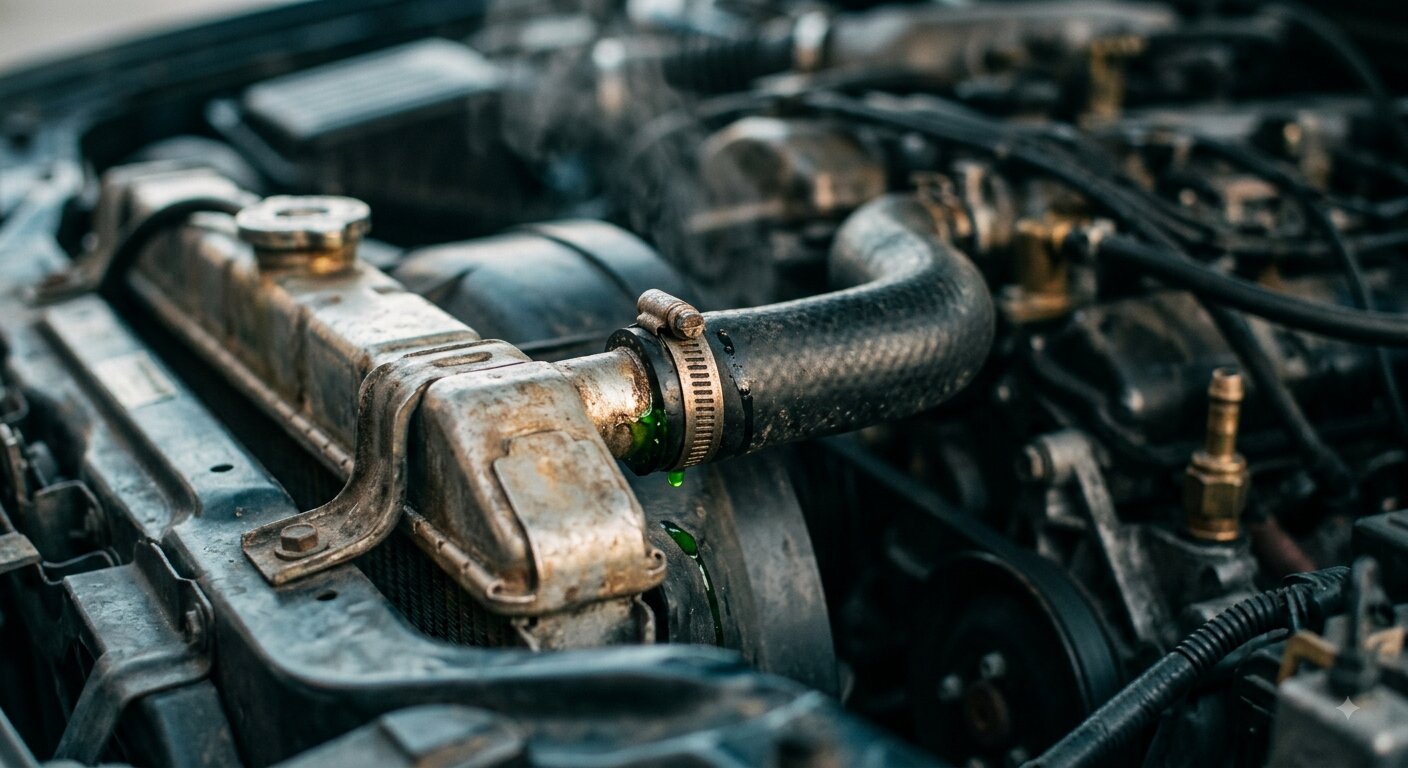
Your temperature gauge is creeping toward the red. There's a sweet, syrupy smell coming from under the hood. Maybe there's a small puddle of bright-green fluid where you parked last night. Whatever combination of symptoms led you here, one thing is clear: your car's cooling system is in trouble — and the radiator is the most likely culprit. The good news: most radiator repair jobs are straightforward when caught before the engine overheats. If you're also experiencing AC or heating problems, those may share common cooling system components worth mentioning during your diagnostic visit.
Ignoring a failing radiator isn't an option. A single overheating event can destroy a head gasket, warp a cylinder head, or seize an engine outright — turning a $100 radiator repair into a $1,000+ engine rebuild. In this guide, the ASE-certified technicians at Ladson Auto Repair Shop — experts in engine and transmission repair — break down every warning sign, every cause, every repair option, and exactly what each one costs — so you can make an informed decision before it's too late.
The average additional repair cost when drivers continue driving with an overheating engine. A radiator repair that would have cost $100–$100 turns into head gasket replacement, cylinder head resurfacing, or engine replacement — all from one ignored warning sign.
📋 In This Article
- How Your Car's Cooling System Actually Works
- 7 Warning Signs Your Radiator Needs Repair
- Top 6 Causes of Radiator Failure
- The Overheating Damage Timeline
- Your Repair Options
- Complete Cost Comparison Table
- South Carolina Heat Factors
- What to Do Right Now
- How to Make Your Radiator Last
- Radiator Repair Near Me (Ladson & Charleston)
- Frequently Asked Questions
How Your Car's Cooling System Actually Works
Before you can understand what goes wrong, you need to understand what the radiator is doing. Your engine generates enormous heat — internal combustion temperatures can exceed 4,500°F at the moment of ignition, and the surrounding metal surfaces regularly reach 400–500°F during normal operation. Left unmanaged, that heat would destroy your engine in minutes.
Coolant absorbs engine heat
The water pump circulates a mixture of antifreeze and water through passages (called "water jackets") cast directly into the engine block and cylinder head. The coolant absorbs heat from the metal, rising from roughly 160°F at the inlet to 200–220°F at the outlet.
Hot coolant travels to the radiator
The now-hot coolant exits the engine through the upper radiator hose and enters the top of the radiator. The thermostat regulates this flow — it stays closed when the engine is cold, allowing it to warm up quickly, and opens at the correct operating temperature.
The radiator dissipates heat into the air
Inside the radiator, hot coolant passes through dozens of narrow aluminum or copper tubes, surrounded by thin metal fins. Air flowing through the fins — either from driving speed or the electric radiator fan — carries the heat away. The coolant exits the bottom of the radiator 30–50°F cooler than it entered.
Coolant returns to the engine
The cooled coolant travels back through the lower radiator hose and into the water pump, which pressurizes and recirculates it through the engine. The cycle repeats thousands of times during a typical drive.
The pressure cap maintains system pressure
The radiator (or coolant reservoir) cap maintains the system at 14–18 PSI above atmospheric pressure, raising the coolant's boiling point from 212°F to roughly 265°F. Without that pressure, the coolant would boil away far too easily — a critical safety margin on hot days and under heavy load.
7 Warning Signs Your Radiator Needs Repair
Your car gives you clear warnings before a catastrophic overheating event. Learning to recognize these signs is the difference between a $100 repair and a $1,000 engine job.
⚠️ Sign #1: Temperature Gauge Rising Above Normal
Your temperature gauge should sit in the middle of its range during normal operation. If you notice it climbing toward the red zone or higher than usual on a hot day, treat it as an emergency. Don't "wait to see if it comes back down." Pull over and call us.
💧 Sign #2: Coolant Leak (Puddle Under the Car)
Coolant is typically bright green, orange, pink, or blue depending on the type — and it has a distinctly sweet, syrupy smell. A puddle of any of these colors under the front of your vehicle is a strong indicator of a cooling system leak.
- Coolant: bright green/orange/pink/blue, sweet smell, watery consistency
- Oil: brown/black, oily texture, acrid smell
- Power steering fluid: reddish/tan, oily
- Water: clear, no smell — usually normal AC condensation
🌫️ Sign #3: Steam or Smoke From Under the Hood
Visible steam rising from under the hood is a major red flag. This means coolant is reaching a hot surface — either the engine is overheating and coolant is boiling, or coolant is leaking onto hot exhaust components and vaporizing.
🍬 Sign #4: Sweet Smell From the Engine Bay
Ethylene glycol — the main component of antifreeze — has a distinctive sweet smell. If you notice this scent from the engine area, there's likely a coolant leak somewhere in the system.
🟤 Sign #5: Discolored, Rusty, or "Milky" Coolant
Pop your hood and look at the coolant in the transparent reservoir tank. If you see any of these instead, you have a problem:
- Brown or rust-colored coolant: Internal corrosion — the radiator is degrading from the inside
- Milky/frothy coolant: Oil contamination — likely a blown head gasket
- Oily sheen on coolant surface: Same as above — serious internal engine damage
📊 Sign #6: Heater Not Working Properly
If your heater suddenly produces weak, lukewarm air even when the engine is fully warmed up, it often means the coolant level is low (from a leak) or the heater core or thermostat is failing.
🔄 Sign #7: Coolant Level Drops Repeatedly
If you find yourself adding coolant every few weeks to keep the reservoir at the correct level, you have a leak somewhere. Even a slow leak can lead to sudden overheating.
Top 6 Causes of Radiator Failure
Cause #1: Degraded or Acidic Coolant
This is the single most preventable cause of radiator failure. Fresh antifreeze contains corrosion inhibitors that protect the radiator's internal metal surfaces. Over time, these inhibitors deplete, and the coolant becomes acidic, actively corroding the radiator from the inside out.
"Old coolant is the quiet killer. The car runs fine for years, then one day the temperature gauge spikes on the highway and you've got a $100 radiator because the acidic coolant ate through the core. We do a pH test on coolant at every oil change — it's one of the most valuable things we check."
Lead Technician, Ladson Auto Repair Shop
Cause #2: Physical Damage from Road Debris or Collision
The radiator sits directly behind the front grille — the first line of contact for anything that gets sucked under the car. Rocks, road debris, and the occasional animal strike can puncture the radiator core or damage the plastic end tanks.
Cause #3: Failed Radiator Cap
The radiator cap maintains the system pressure that keeps coolant from boiling. A worn spring inside the cap may not hold the correct pressure, causing the coolant's effective boiling point to drop. This is a surprisingly common cause of overheating.
Cause #4: Failed Thermostat
When a thermostat fails stuck closed, the coolant can't reach the radiator at all — the engine overheats rapidly. When it fails stuck open, the engine never reaches proper operating temperature.
Cause #5: Failed Water Pump
The water pump drives all coolant circulation. When the pump fails or the impeller slips, coolant circulation stops. A leaking water pump shaft seal is an early warning — look for coolant weeping from the front of the engine.
Cause #6: Clogged Radiator Passages
Mineral deposits from using tap water instead of distilled water can accumulate inside the narrow tubes of the radiator, restricting flow and reducing cooling efficiency.
The Overheating Damage Timeline: What Happens Every Minute
Understanding what physically happens inside your engine when it overheats is the most important thing we can tell you.
| Time Driving Overheated | What's Happening Inside the Engine | Repair Cost at This Stage |
|---|---|---|
| 0 – 2 min | Gauge enters red zone. Coolant approaching boiling point. No structural damage yet. | $150–$100 |
| 2 – 5 min | Coolant begins boiling. Head gasket starts experiencing abnormal thermal stress. | $100–$1,200 |
| 5 – 10 min | Head gasket failure allows combustion gases into coolant. Cylinder head begins warping. | $1,200–$1,000+ |
| 10 – 20 min | Coolant in cylinders creates hydraulic lock — bending or breaking connecting rods. | $1,500–$1,000+ |
| 20+ min | Oil starvation from coolant contamination. Engine seizure. Total loss scenario. | $1,000–$1,000+ |
🚨 If Your Temperature Gauge is in the Red Zone Right Now:
- Pull over safely — do NOT push on to your destination
- Turn off the engine immediately — every second of overheating causes damage
- Do NOT open the radiator cap — pressurized coolant will cause severe burns
- Wait 30+ minutes for the engine to cool before checking anything under the hood
- Call for a tow or call us at 843-494-9179
Your Repair Options: Flush vs. Repair vs. Replacement
Not every cooling system problem requires a full radiator replacement. Here's what each level of service addresses.
✅ Coolant Flush & Refill
- Coolant is discolored or past its service interval
- pH test shows acidic coolant
- Preventive maintenance
✅ Hose or Thermostat Replacement
- Visible crack or soft spot in a hose
- Thermostat stuck open or closed
- Hose clamp corrosion
✅ Radiator Cap Replacement
- Cap fails pressure test
- Overflow/boilover issues
- Coolant loss without visible leak
🔴 Full Radiator Replacement
- Visible crack or puncture in the core
- Cracked plastic end tanks
- Severe internal clogging
Complete Radiator Repair Cost Comparison
| Repair Type | What's Included | Typical Cost (Ladson Area) | Cost If Ignored |
|---|---|---|---|
| Coolant Flush & Refill | Drain old coolant, flush system, refill with new coolant, pressure test | $100 – $175 | $150 – $100 |
| Radiator Cap Replacement | Pressure test old cap, replace with OEM-spec cap | $10 – $10 | $100 – $100 |
| Thermostat Replacement | Replace thermostat & gasket, refill and bleed coolant | $150 – $100 | $1,200 – $1,000 |
| Radiator Hose Replacement | Replace upper and/or lower hose, refill and bleed | $15 – $150 | $1,200 – $1,000 |
| Water Pump Replacement | Replace pump, flush coolant, inspect belts | $100 – $100 | $1,500 – $1,000 |
| Radiator Replacement | New radiator, new cap, fresh coolant, pressure test | $150 – $100 | $1,500 – $1,000+ |
| Head Gasket Replacement | Cylinder head removal, resurface or replace head, new gasket | $1,200 – $1,500+ | $1,000 – $1,000+ |
The South Carolina Factor: Why Radiators Fail Faster Here
South Carolina's climate is tough on cooling systems. The combination of extreme heat, high humidity, and salt air from the coast creates a perfect storm for radiator failure.
"We always joke that the Lowcountry is the worst place in America to own a car and never maintain it. The heat, the humidity, the salt air — they wear down cooling system components faster than anywhere else."
Owner, Ladson Auto Repair Shop
What to Do Right Now: Step-by-Step Emergency Response
-
Pull over safely Get off the road immediately as soon as you see signs of overheating.
-
Turn off the engine Do NOT let it idle. Shut it down completely to stop generating heat.
-
Do NOT open the radiator cap Wait at least 30–45 minutes. Pressurized steam can cause severe burns.
-
Note your symptoms Write down smells, smoke, or gauge readings to tell the mechanic.
-
Arrange a tow Call us at 843-494-9179. Don't risk driving an overheating car.
How to Make Your Radiator Last 150,000 Miles
| Maintenance Task | Interval | Why It Matters |
|---|---|---|
| Coolant flush & refill | Every 2–3 years | Prevents acid buildup that destroys the radiator from inside |
| Radiator cap pressure test | Every 4 years | Ensents correct system pressure to prevent boiling |
| Hose inspection | Every 2 years | Catches cracks/swelling before failure |
| Use distilled water | Always | Prevents mineral scale buildup in narrow tubes |
Your cooling system should always contain a 50/50 mix of antifreeze and distilled water. Pure antifreeze actually has a higher freezing point and lower boiling point than the 50/50 mix — the water is what makes the mix work.
Radiator Repair Near Me (Ladson & Charleston)
If you typed "radiator repair near me," the closest full cooling-system shop is right here: Ladson Auto Repair Shop at 3322 Ladson Rd, Ladson, SC 29456. We handle coolant flushes, radiator cap and thermostat replacement, hose repair, water pump service, and complete radiator replacement — and every job includes a system pressure test before we quote you.
Radiator Repair Charleston, SC
Drivers in Summerville, North Charleston, Goose Creek, and Hanahan bring their cooling system problems to us every day — and drivers on the Charleston side of the peninsula are welcome, too. If you're closer to the city, our auto repair in Charleston, SC page covers what we handle there and how to get in. If your temperature gauge is climbing right now, don't wait: call 843-494-9179 and we'll tell you exactly what to do next.
Related Articles
⚡ Electrical Problems
Read Electrical Repair Guide →⚠️ Check Engine Light Flashing
Read Check Engine Guide →Frequently Asked Questions
How do I know if my radiator needs repair?
The most common signs are: rising temperature gauge, visible coolant puddles (bright green, orange, or pink), sweet antifreeze smell, steam from under the hood, or discolored/sludgy coolant in the reservoir.
How much does radiator repair cost?
Costs vary: Flush ($100–$175), Cap ($10–$10), Thermostat ($150–$100), Hose ($15–$150), Radiator Replacement ($150–$100). Head gasket repairs can exceed $1,200.
Can I drive with an overheating engine?
No. Driving with an overheating engine can warp the cylinder head or blow the head gasket within minutes, turning a small repair into a massive engine replacement bill.
How long does a car radiator last?
Typically 8–10 years or 100k–150k miles, but in South Carolina's heat and humidity, we often see failure closer to 7–8 years.
What causes a radiator to fail?
Common causes include acidic/degraded coolant, physical damage from debris, failed radiator caps, faulty thermostats, worn water pumps, and clogged passages from mineral buildup.
Where can I get radiator repair near me in Ladson or Charleston?
Ladson Auto Repair Shop at 3322 Ladson Rd, Ladson, SC 29456 handles everything from coolant flushes and hose or thermostat replacement to full radiator replacement, for drivers across the Tri-County area and the Charleston side of the peninsula. Call 843-494-9179 or book online; every repair is backed by our 12-month/12,000-mile warranty.