You turn the key and hear a click. Or nothing. Or the car starts fine but the dashboard lights are flickering, the radio cuts in and out, and the battery warning light is glowing steadily. Maybe the car started yesterday but won't today. Maybe your mechanic replaced the battery three months ago and it's dead again.
Auto electrical problems are among the most frustrating in all of car repair — because the same symptom can have a dozen different causes, and the wrong diagnosis means paying for a part you didn't need while the real problem keeps eating your battery. At Ladson Auto Repair Shop, our ASE-certified technicians electrical repair service with professional-grade equipment every day. In this guide, we'll explain exactly how your car's electrical system works, every warning sign to watch for, the six most common failure points, and what each repair actually costs — so you're never flying blind at the shop. If you suspect AC or cooling system issues alongside your electrical symptoms, mention them during your diagnostic visit.
- Turn off every non-essential accessory — AC, radio, rear defroster, seat heaters
- Drive directly to a mechanic — do not stop at home first, do not run errands
- Do NOT turn the engine off — with a failing alternator, you may not be able to restart
- Budget 20–40 minutes of driving time before the battery's stored charge is depleted
- Call us at 843-494-9179 — we'll advise you based on your exact situation
Of "dead battery" complaints at our shop have a root cause other than the battery itself — usually a failing alternator, a parasitic drain, or corroded terminals. Replacing the battery without diagnosing the real problem means it will go dead again within weeks.
📋 In This Article
- How Your Car's Electrical System Works
- 8 Warning Signs of an Electrical Problem
- The 6 Components That Fail Most Often
- Component #1: Battery
- Component #2: Alternator
- Component #3: Starter Motor
- Component #4: Fuses & Relays
- Component #5: Wiring & Ground Connections
- Component #6: ECU / PCM
- Complete Cost Comparison Table
- South Carolina: Why Electrical Problems Are Worse Here
- What to Do Right Now (Step-by-Step)
- Prevention: Keep Your Electrical System Healthy
- Frequently Asked Questions
How Your Car's Electrical System Works
Modern vehicles contain more computing power than the Apollo moon missions — up to 150 individual electronic control units (ECUs), miles of wiring, and a 12-volt electrical system that powers everything from the ignition spark to the anti-lock brakes to the seat position memory. Understanding the basic architecture of this system makes it much easier to understand why electrical failures cascade the way they do.
The Battery: Stored Energy for Starting
The 12-volt lead-acid (or AGM, in newer vehicles) battery stores electrical energy chemically and delivers a large burst of current — typically 400–600 amps for a fraction of a second — to spin the starter motor and fire the engine. Once the engine is running, the battery's role is largely secondary. It also acts as a voltage buffer, smoothing out electrical fluctuations that could damage sensitive electronics.
The Alternator: Power Generation While Running
Once the engine starts, the alternator — a generator driven by the serpentine belt — takes over as the primary power source. It converts mechanical energy from the engine into electricity, producing 13.5–14.5 volts at varying amperage to power all vehicle systems AND simultaneously recharge the battery. A healthy alternator is the reason your battery never goes flat during normal use.
The Distribution Network: Fuses, Relays & Wiring
Power from the battery and alternator flows through a main fuse box (and often a secondary under-dash fuse/relay panel) to every consumer in the vehicle — engine control module, fuel injectors, headlights, climate control, power windows, infotainment, and dozens of sensors. Fuses protect each circuit; relays switch high-current circuits on and off; ground connections complete every circuit back to the battery's negative terminal.
The Brain: ECU / PCM and Sensor Network
The Engine Control Unit (ECU) — also called the Powertrain Control Module (PCM) — is the central computer that reads dozens of sensor inputs (oxygen sensors, crankshaft position sensor, throttle position sensor, etc.) and controls outputs (fuel injectors, ignition timing, idle speed). It communicates with transmission, ABS, airbag, and body control modules over a vehicle-wide data network called the CAN bus. Any disruption to power or ground at the ECU causes cascading faults throughout the vehicle.
8 Warning Signs of an Auto Electrical Problem
| Symptom | What You're Experiencing | Most Likely Cause |
|---|---|---|
| Engine won't crank at all | Turn key (or push button) — complete silence, or a single loud click | Dead battery, failed starter relay, or bad starter |
| Engine cranks slowly | "Wuh-wuh-wuh" sound that barely turns over, especially when cold | Weak/failing battery or corroded terminals |
| Battery warning light on | Red battery icon lit on dashboard while driving | Failing alternator — not charging the battery |
| Dimming or flickering lights | Headlights dim at idle and brighten when you rev; or interior lights flicker randomly | Failing alternator or loose/corroded battery connections |
| Battery keeps going dead | Car needs a jump-start repeatedly — battery fine when tested, but drains overnight | Parasitic drain (something drawing power when car is off), failing alternator |
| Multiple accessories failing | Radio, power windows, AC fan, seat heaters — multiple things stop working at once | Blown fuse, failed relay, or failing Body Control Module (BCM) |
| Burning smell from engine bay | Sharp burning plastic or rubber odor — not oil, not coolant | Overloaded wiring, a short circuit melting insulation, or a seized charging component |
| Random warning lights / Check Engine | Dashboard lit up with multiple unrelated warning lights simultaneously | Failing battery (low voltage corrupts ECU sensor readings), bad ground, or CAN bus fault |
If your dashboard suddenly shows warning lights for ABS, traction control, power steering, and the engine — all at the same time, on a car that was running fine — resist the urge to diagnose each light individually. Multiple simultaneous, unrelated warnings almost always trace back to one electrical root cause: a battery with very low voltage, a failing ground connection, or a dying alternator producing fluctuating voltage. Diagnose the electrical system first; the other lights usually clear on their own.
The 6 Electrical Components That Fail Most Often
🔋 Battery
The #1 cause of no-start calls. Lifespan: 3–5 years in SC heat. Most commonly misdiagnosed — the real problem is often elsewhere.
⚡ Alternator
Fails silently until the battery warning light appears. A failing alternator kills batteries — replacing the battery without the alternator is a recurring expense.
🔩 Starter Motor
Fails after 80,000–150,000 miles. Classic symptom: loud single click on turn of key. Can also fail intermittently — works sometimes, not others.
🔌 Fuses & Relays
Protect circuits from overload. A blown fuse is the cheapest fix in electrical repair — if you know which one. Finding why it blew is the real diagnostic work.
🌐 Wiring & Grounds
Corroded ground cables cause more mysterious electrical gremlins than any other single failure. Especially severe in SC's salt-air and humidity environment.
🧠 ECU / PCM
Rare but expensive. True ECU failures are uncommon — most "ECU codes" are actually sensor or wiring failures. When an ECU does fail, the repair requires professional reprogramming.
Component #1: The Battery (Most Common — ~40% of No-Start Cases)
What's Happening
A lead-acid car battery works by converting chemical energy to electrical energy through a reaction between lead plates and sulfuric acid electrolyte. Over time — typically 3–5 years under South Carolina conditions — the lead plates sulfate (develop a layer of lead sulfate crystals that resist the chemical reaction), the electrolyte degrades, and the battery loses its ability to hold a full charge or deliver adequate cranking current.
The most deceptive thing about a failing battery is how it fails. A battery at 70% health can start the car normally a hundred times — until one cold morning, or after the car sits for a few days, or with the AC running, when it simply doesn't have enough reserve to spin the starter. Drivers are often blindsided because "it was fine yesterday."
Signs Specific to a Battery Problem
- Engine cranks slowly, especially on cold mornings (below 60°F)
- Battery warning light on after sitting parked for several days
- Car needed a jump-start but ran fine after — until next time it sat
- Headlights dim noticeably when you start the car
- Battery is more than 4 years old (in SC: more than 3 years)
- Visible white or blue corrosion on the battery terminals
How We Test It
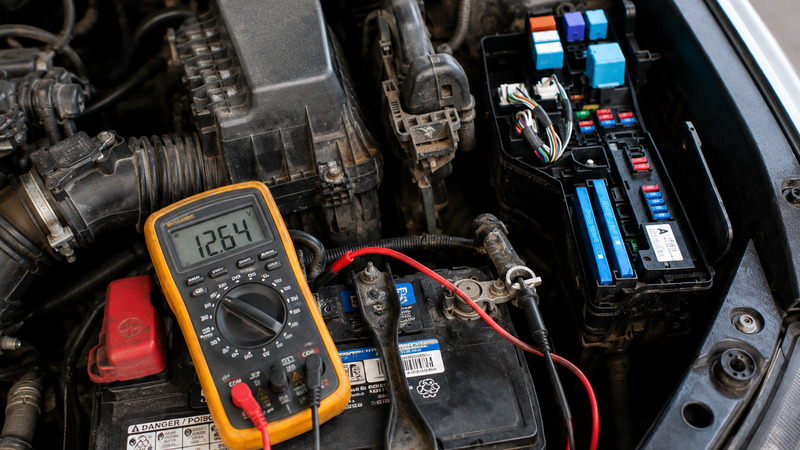
We never recommend a battery replacement based on a simple voltage reading. A battery at 12.4 volts looks "fine" on a meter — but when you put it under a 400-amp load test that simulates actual starting conditions, it may drop to 8 volts. Our shop uses a professional conductance tester that measures the actual cold-cranking amp (CCA) capacity of the battery and compares it to its rated specification. This takes about 5 minutes and tells us definitively whether the battery is the problem.
"The number of times someone comes in and says 'I just replaced the battery three months ago and it's dead again' — it's every week. Nine times out of ten, the old battery didn't kill itself. The alternator was failing and couldn't recharge it, or something was draining it overnight. We always test the full charging system, not just the battery in isolation."
Lead Technician, Ladson Auto Repair Shop
Typical Cost at Ladson Auto Repair Shop
- Battery test (standalone): $1 — included with any service visit
- Standard battery replacement (most sedans/SUVs): $150 – $180
- AGM battery replacement (start-stop vehicles, luxury cars): $150 – $100
- Terminal cleaning and anti-corrosion treatment: included with battery replacement
Component #2: The Alternator (~25% of Charging System Failures)
What's Happening
The alternator is a compact AC generator containing a rotor (spinning magnetic field), a stator (stationary coil that generates AC current), diodes that convert AC to DC, and a voltage regulator that keeps output steady at 13.5–14.5 volts regardless of engine speed or electrical load. When any of these internal components fail — the most common are worn brushes, failed diodes, or a seized bearing — alternator output drops or disappears entirely.
What makes alternator failure especially dangerous: it's usually gradual. The alternator may produce enough voltage to run the car but not enough to fully recharge the battery. You drive, come home, and the battery slowly loses capacity week by week. Eventually the battery is so depleted it can't start the car — and you replace the battery, which fixes the symptom for a month or two before the same thing happens again. Meanwhile, the real culprit — the alternator — goes undiagnosed.
Once the alternator fails completely, your car is running entirely off battery reserve. That reserve typically lasts 20–40 minutes of driving with normal electrical loads — less in heavy traffic with the AC on. Modern vehicles with electric power steering will lose steering assist before the engine dies. Drive directly to us or pull over safely and call for a tow. Do not turn the engine off — you may not be able to restart.
How We Test It
We measure alternator output voltage with the engine running (should be 13.5–14.5V), test output under load (AC fan, rear defroster, headlights on simultaneously), check for AC ripple (a sign of failed diodes), and inspect the serpentine belt and tensioner that drive the alternator. A complete charging system test takes about 15 minutes and definitively identifies whether the alternator, battery, or wiring is responsible for the fault.
Typical Cost at Ladson Auto Repair Shop
- Alternator replacement (most 4-cylinder vehicles): $100 – $100
- Alternator replacement (V6/V8 or difficult access): $150 – $100
- Serpentine belt replacement (recommended at same time): $10 – $150
Component #3: The Starter Motor (~18% of No-Start Cases)
What's Happening
The starter motor is a powerful DC electric motor that engages a small gear (the drive pinion) with the ring gear on the engine flywheel, spinning the engine fast enough to initiate combustion — typically 200–300 RPM. It operates for just a second or two each start, but the enormous current draw (300–700 amps) and the heat generated mean starter motors have a finite lifespan, typically 80,000–150,000 miles or more depending on vehicle use.
Starters fail in two primary ways: the motor windings burn out from heat and age (the motor makes no sound or just clicks once), or the drive mechanism wears out and the pinion gear no longer engages the flywheel properly (you hear the starter spinning freely — a high-pitched whirring — without the engine turning over). Intermittent starter failure is common: the car starts fine most of the time but occasionally requires multiple attempts.
🔋 Likely Battery / Connection Issue
- Rapid clicking (click-click-click-click) when you turn the key
- Very slow cranking that gives up
- Interior lights dim severely when trying to start
- Car jump-starts and runs normally
🔩 Likely Starter Issue
- Single loud clunk or click — then silence
- Lights are bright but engine won't crank at all
- High-pitched whirring without engine turning
- Car jump-starts but still won't crank
Typical Cost at Ladson Auto Repair Shop
- Starter replacement (most vehicles, easy access): $100 – $100
- Starter replacement (difficult access — V6, V8, or FWD transverse): $150 – $150
- Starter relay replacement: $10 – $150
Component #4: Fuses, Relays & the Fuse Box
What's Happening
Every circuit in your car is protected by a fuse — a sacrificial element that melts and breaks the circuit if current exceeds a safe level. Modern vehicles contain 40–80 fuses in one or more fuse boxes, typically located under the hood (for high-current circuits like the cooling fan, fuel pump, and ECU) and under the dashboard (for interior accessories).
A blown fuse cuts power to the circuit it protects — which is why a single fuse can knock out a seemingly unrelated collection of things (for example, a common fuse might power the interior lights, the radio, and the cigarette lighter simultaneously). Fuses blow for two reasons: a genuine short circuit that created too much current, or simple old age on a circuit that's near its rated load.
This is one of the most dangerous DIY mistakes in automotive electrical work. Fuses are sized specifically for the wiring they protect. Replacing a 15A fuse with a 30A fuse because "the 15A keeps blowing" means the wiring can now be overloaded to twice its safe capacity — melting insulation and potentially causing a vehicle fire — before the fuse blows. The right fix is finding why the fuse is blowing. We do this with a circuit-by-circuit current draw test.
Relays: The Overlooked Culprit
Relays are electromechanical switches that use a small control signal to switch a much larger current on or off — essentially a remote-controlled circuit breaker. The fuel pump relay, cooling fan relay, AC compressor relay, and main power relay are all common failure points. A failed relay can mimic many other problems: intermittent no-starts (fuel pump relay), AC that stops working (AC relay), a radiator fan that doesn't come on (cooling fan relay — which leads to overheating on a car with a perfectly good radiator). We always include relay testing in any electrical diagnosis.
Typical Cost at Ladson Auto Repair Shop
- Fuse replacement (single fuse): $10 – $10 (including diagnosis)
- Relay replacement (single relay): $10 – $150
- Parasitic drain diagnosis (finding what's draining battery overnight): $100 – $100
- Main fuse box repair or replacement: $100 – $100
Component #5: Wiring, Grounds & Connectors
The Most Underestimated Cause of Electrical Problems
Corroded ground connections are, in our experience, the single most misdiagnosed source of electrical problems in vehicles driven in the Lowcountry. Here's why: every electrical circuit in your car needs a complete loop — positive current flows from the battery, through the component, and back to the battery negative terminal through a ground connection. In most vehicles, those ground connections are bolts attaching a copper cable to the metal body or engine block.
When those ground connections corrode — from moisture, salt air, road spray, or simple oxidation over time — resistance increases. The ground circuit can no longer carry full current. The result is a voltage drop across the ground connection that mimics a dozen different failures: sensors reading incorrectly, warning lights activating, accessories behaving erratically, engines misfiring, or transmission shifting oddly. We've diagnosed "transmission problems," "ABS module failures," and "MAF sensor failures" that turned out to be a single corroded ground bolt on the engine block.
How We Find Wiring Faults
Wiring diagnosis requires a combination of a wiring diagram specific to the vehicle, a professional digital multimeter capable of measuring millivolt-level voltage drops, a lab scope for measuring signal quality, and — most importantly — systematic circuit tracing. There's no shortcut that replaces this process. We measure voltage drops across suspected connections under load, compare signal waveforms to known-good specifications, and use a tone generator to trace wires through harnesses when necessary.
We also use our smoke machine (the same one used for vacuum leak detection) to pressurize wiring harness conduits and identify damaged wire insulation at high-wear points — door jamb hinges, hood movement areas, and under-hood routing points where chafing is common.
Typical Cost at Ladson Auto Repair Shop
- Ground cable cleaning and re-termination: $10 – $180
- Single wire splice or terminal repair: $100 – $150
- Battery cable replacement (positive or negative): $150 – $150
- Wiring harness repair (damaged section): $100 – $100
- Full wiring harness replacement: $100 – $1,500+ (labor-intensive)
"I've been fixing cars for 22 years and the one thing I tell every new technician is this: when you have a weird electrical problem that doesn't make sense, check the grounds before you do anything else. Half the time, that's it. A $15 bolt cleaned and re-torqued. The other half, at least you've ruled it out. Skipping grounds in electrical diagnosis is like diagnosing a misfire without checking spark plugs — you're just guessing."
Owner, Ladson Auto Repair Shop
Component #6: ECU / PCM (Rare — Under 3% of Electrical Failures)
What's Happening — and What Usually Isn't
The Engine Control Unit (ECU) or Powertrain Control Module (PCM) is the central computer that manages engine and transmission operation. True ECU failures are genuinely rare — modern ECUs are designed to last the life of the vehicle and are quite robust. The vast majority of "ECU codes" or "ECU faults" we see are actually caused by sensor failures, wiring faults, or power supply issues at the ECU — not the ECU itself failing.
How do we know the difference? We check power supply and ground quality at the ECU connector pins, verify that all sensor inputs are within specification, clear the faults and verify whether they return, and perform module-specific tests. Only after eliminating every other cause do we conclude that the ECU itself has failed. Replacing a $1,500 ECU when the real cause is a $10 sensor or a corroded connector is an expensive mistake that, unfortunately, some shops make.
When ECU Failure Is Genuine
Real ECU failures typically result from: water intrusion (a leak in the cabin or a flooded engine bay), a voltage spike that burned internal components (from a faulty alternator or a jump-start with reversed cables), physical impact damage, or — in rare cases — transistor failure from age on very high-mileage vehicles. The symptoms are usually severe: the car may not run at all, may run extremely poorly with multiple codes that make no logical sense together, or may experience total communication loss with the scan tool.
Typical Cost at Ladson Auto Repair Shop
- ECU diagnosis (ruling out other causes first): $100 – $100
- ECU / PCM replacement + programming: $100 – $1,500 (most vehicles)
- ECU replacement on European or luxury vehicles: $1,200 – $1,500+
Complete Auto Electrical Repair Cost Comparison
| Repair Type | Typical Cause | Cost (Ladson Area) | Cost If Ignored / Misdiagnosed |
|---|---|---|---|
| Battery Replacement | Age, sulfation, deep discharge from alternator failure | $150 – $100 | $100–$100 if alternator also fails |
| Alternator Replacement | Worn brushes, failed diodes, seized bearing | $100 – $100 | $150–$1,200 after replacing battery multiple times |
| Starter Replacement | Worn motor windings, failed drive mechanism | $100 – $150 | Stranded — towing costs add $100–$100 |
| Fuse / Relay Replacement | Short circuit, overloaded circuit, component failure | $10 – $100 | $100–$1,000+ if underlying short causes wiring fire |
| Ground Cable Repair | Corrosion, impact damage, loose connection | $10 – $150 | $100–$1,000 in misdiagnosed sensor/module replacements |
| Battery Cable Replacement | Corrosion at terminals, insulation damage | $150 – $150 | $100–$100 (battery and alternator premature failure) |
| Wiring Harness Repair | Chafing, rodent damage, water intrusion, collision | $100 – $1,500+ | $1,500–$1,000+ if multiple modules damaged by short |
| Parasitic Drain Diagnosis + Repair | Stuck relay, aftermarket accessory, body module fault | $150 – $100 | $100–$100 per year in repeated battery replacements |
| ECU / PCM Replacement | Water damage, voltage spike, transistor failure | $100 – $1,500+ | Vehicle inoperable — towing + rental costs add up fast |
*Costs are estimates for the Ladson/Summerville area and vary by vehicle make, model, and year. We provide a written estimate before any work begins.
Years: the typical battery lifespan in South Carolina — compared to 5–7 years in cooler Northern climates. Extreme heat accelerates the chemical degradation inside the battery. We recommend proactive battery testing every year after the 3-year mark on any vehicle driven in the Lowcountry.
South Carolina: Why Electrical Problems Are Worse in the Lowcountry
Heat Kills Batteries Faster Than Cold Does
The automotive industry talks a lot about batteries and cold weather — and cold-cranking amps are indeed important. But heat is the actual enemy of battery longevity. High temperatures accelerate the internal chemical reactions that degrade the lead plates, boil off electrolyte, and cause internal short circuits. A battery that would last 6 years in Ohio lasts 3–4 years in South Carolina. This isn't a sales pitch — it's chemistry.
We recommend proactive battery testing starting at 3 years for any vehicle regularly driven in the Lowcountry. Finding a battery at 60% health costs nothing. Getting stranded in a parking lot or on I-26 at rush hour costs a tow, your time, and your composure.
Humidity and Salt Air Corrode Every Connection
With average humidity above 75% year-round and salt air reaching well inland from the coast, every exposed electrical connection in your vehicle is under constant attack. Battery terminals, ground cable ends, alternator connector pins, sensor harness connectors, and the exposed copper strands inside every wire are all subject to accelerated oxidation and galvanic corrosion. A connection that looks clean from the outside can have significant resistance buildup at the interface where metal meets metal — invisible to the eye but measurable with the right equipment.
Rodents: The Hidden Electrical Destroyer
This may seem unrelated to South Carolina specifically, but our shop sees more rodent-chewed wiring than we'd like. The Lowcountry's warm climate supports large rodent populations year-round — and vehicles parked in driveways, near wooded areas, or adjacent to fields are vulnerable. Mice and rats are attracted to the warm engine bay and have a destructive habit of chewing through wiring harness insulation. One rodent can create dozens of intermittent faults across multiple systems in a single evening. If you're seeing random, unexplained electrical faults on a vehicle that parks outside, ask us to inspect the wiring harness.
- Test your battery every year after the 3-year mark — we do it free at every oil change
- Apply anti-corrosion spray to battery terminals after every cleaning
- Have terminal connections inspected if the car sits outside near the coast
- If you park near wooded areas, consider placing a deterrent around the engine bay
- Don't ignore a single flickering dome light — intermittent symptoms always get worse
What to Do Right Now: Step-by-Step
-
Identify whether it's a no-start or a while-running problem These point to different systems. Won't start at all = battery, starter, or ignition circuit. Starts but has issues while driving = alternator, wiring, sensor, or ECU. This distinction helps the mechanic prioritize testing.
-
Note every symptom — all of them, not just the main one The radio that's been cutting out for a month. The dome light that flickers. The AC that hesitates. These details are often the most important clues in electrical diagnosis. Use your phone to write them down, with approximate timing ("started 3 weeks ago," "happens every morning," "only when hot").
-
If the car won't start: try a jump-start and note the result carefully If it starts instantly and runs fine → likely battery. If it starts but dies again within a day → alternator not charging. If it doesn't start even with a jump → likely starter or ignition circuit. This information is genuinely useful — tell your mechanic exactly what happened.
-
If the battery warning light comes on while driving: reduce load and drive straight to a shop Turn off the AC, rear defroster, seat heaters, and any other non-essential electrical loads. You have a limited time window before the battery is fully depleted. If you're more than 20–30 minutes from a shop, pull over and arrange a tow.
-
Do NOT replace parts blindly based on a code reader An OBD-II code can tell you which circuit or sensor is involved — it cannot tell you which component in that circuit has failed. A "P0562 — Low System Voltage" code could mean a bad battery, a failing alternator, a corroded terminal, or a bad body control module. Professional diagnosis identifies the actual faulty component before anything is replaced.
-
Request a full charging system test, not just a battery test When you bring the car in, ask specifically for a charging system test — battery, alternator output, and key connections. At our shop, this is standard with any electrical complaint. A battery test alone only tells half the story.
⚡ Electrical Problem? We'll Find It — Not Just Replace Parts
We use professional charging system analyzers, lab scopes, and factory-level scan tools to diagnose the real cause — so you pay for the right repair once, not the wrong repair twice.
📞 Call 843-494-9179 Book OnlineServing Ladson · Summerville · Goose Creek · North Charleston · Charleston · the entire Tri-County area
Prevention: Keep Your Electrical System Healthy
| Maintenance Task | Interval | Why It Matters |
|---|---|---|
| Battery load test | Annually after year 3 (SC: year 2) | Catches a failing battery before it strands you; test takes 5 min and is free at our shop |
| Terminal inspection & cleaning | Every oil change | Removes corrosion that increases resistance and can damage the alternator from overworking |
| Alternator output test | Annually or with battery replacement | Identifies an undercharging alternator before it depletes the new battery you just paid for |
| Ground cable inspection | Every 3 years or with any unexplained electrical fault | Prevents the most common cause of mysterious multi-system electrical gremlins |
| Serpentine belt inspection | Every 2 years or 30,000 miles | The belt drives the alternator — a slipping or broken belt immediately kills charging |
| Fuse box inspection | Every 4 years | Catches moisture intrusion and corrosion in fuse contacts before they cause circuit failures |
| Proactive battery replacement | Every 4–5 years (SC: every 3–4 years) | A proactive replacement at a scheduled service costs less than emergency roadside service |
Related Articles
🌡️ Cooling System Problems
Read Radiator Repair Guide →⚠️ Check Engine Light Flashing
Read Check Engine Guide →Frequently Asked Questions
How do I know if my car has an electrical problem?
Common signs include: engine won't start or cranks slowly; battery warning light on the dashboard; dimming or flickering headlights; accessories like the radio, power windows, or AC not working; a burning plastic or rubber smell from the engine bay; and multiple unrelated warning lights appearing on the dashboard simultaneously.
Why does my car battery keep dying?
A battery that repeatedly goes dead usually isn't the battery's fault. The three most common causes are: (1) a failing alternator that isn't recharging the battery while you drive; (2) a parasitic drain (something drawing power when the car is off); or (3) corroded battery terminals preventing proper charge transfer.
Can I drive with the battery warning light on?
Not safely, and not for long. The battery warning light means the charging system isn't maintaining adequate voltage — your car is running on battery reserve alone. Typically, this lasts 20–40 minutes of driving before the car stalls completely.
What is the difference between a battery problem and an alternator problem?
The battery starts the car; the alternator keeps it running and recharges the battery while you drive. If your car runs fine after a jump-start but dies again within a day, the alternator is likely failing to recharge the battery.
How long does a car battery last in South Carolina?
Significantly less than the national average. Due to extreme heat, most batteries in South Carolina last only 3–5 years, compared to 5–7 years in cooler climates.
Multiple dashboard lights on? Do I need to fix all of them separately?
Not necessarily. Multiple simultaneous warnings often trace back to one root cause: low battery voltage, a bad ground connection, or a failing alternator. Fix the electrical issue first.
How much does auto electrical diagnosis cost?
A basic charging system test is free at our shop with any service. A comprehensive diagnostic typically costs $100–$100, depending on complexity.
Can corroded battery terminals really cause all those problems?
Yes. Corrosion acts as a resistor, causing voltage drops that can mimic many different failures, from sensor errors to engine misfires.
Does Ladson Auto Repair Shop handle auto electrical repair?
Yes — electrical diagnosis and repair is one of our core services. We use professional-grade equipment to accurately diagnose and repair faults on all makes and models.
The Bottom Line: Accurate Diagnosis Is Everything
Auto electrical repair is the one area where guessing costs the most. A new battery is $100. A new alternator is $100. An ECU is $1,500. If you buy them in the wrong order — because each symptom pointed to the next component without a real diagnosis — you've spent $1,300 on a problem that was a $180 corroded ground cable. We've seen it happen, and it's entirely avoidable.
At Ladson Auto Repair Shop, we provide the facts you need to make an informed decision. Whether it's a simple fuse replacement or a complex wiring repair, we'll get you back on the road safely and reliably.