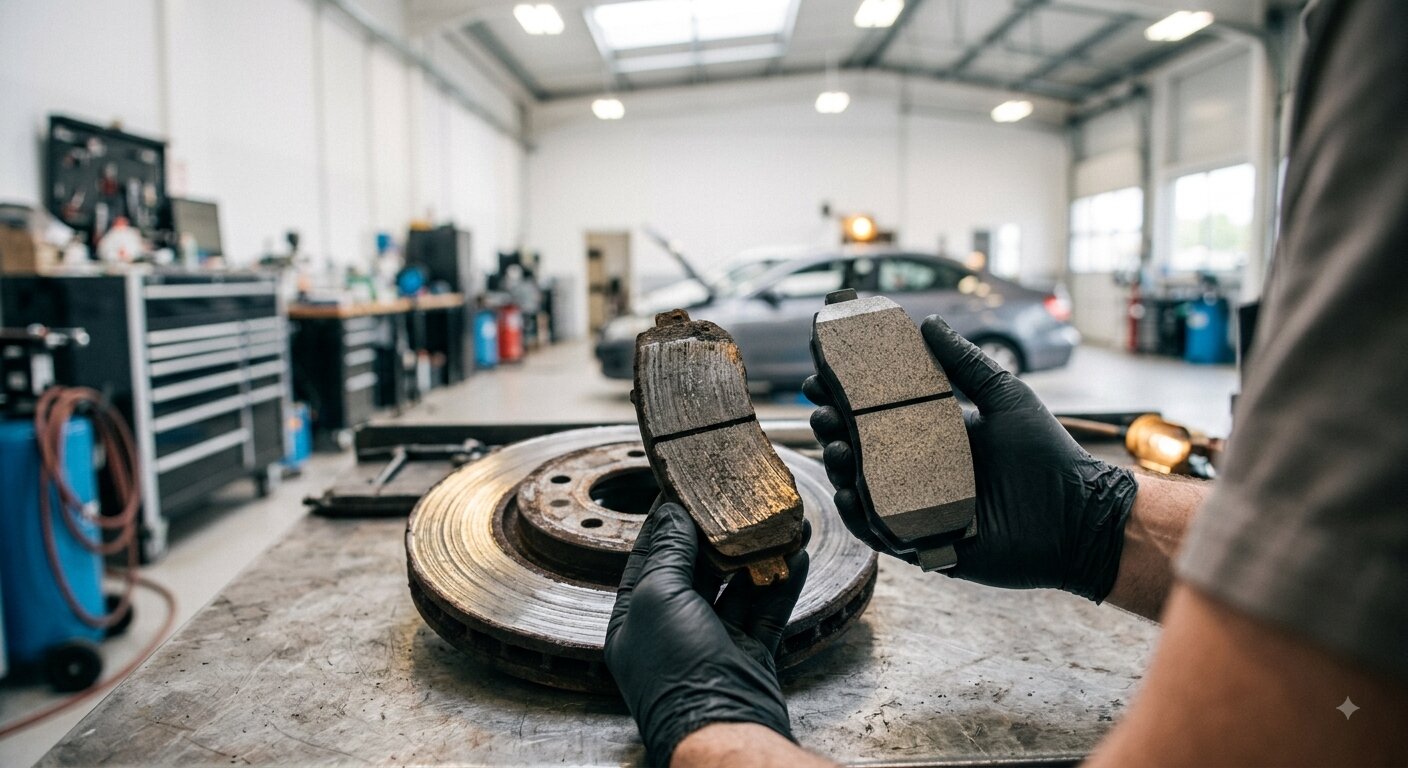
The honest answer involves a range wider than most people expect — and specific things about how and where you drive that matter more than mileage alone.
"How long do brake pads last?" is one of the most common questions we hear at our Ladson shop, and the honest answer is: it depends enormously. You'll find "25,000 to 70,000 miles" cited in most places online, which isn't wrong but isn't very useful either. That's a range wide enough to span the difference between replacing your brakes twice or five times over 150,000 miles.
What actually determines where on that range your pads land is a combination of driving style, driving environment, vehicle weight, pad material, and — specific to our area — South Carolina's heat and the stop-and-go driving patterns on our major corridors. Once you understand those factors, you can make a much better prediction for your own situation and stop being surprised when your pads wear faster or slower than you expected.
Here's the complete picture.
The typical brake pad lifespan range — a factor of nearly 3x difference between the shortest and longest-lasting examples. Knowing where you fall in that range, and why, is what this article is about.
📋 In This Article
- How Brake Pads Work and Why They Wear
- The Real Factors That Determine How Long Yours Last
- Why SC Driving Conditions Accelerate Brake Wear
- Brake Pad Warning Signs: What to Listen and Feel For
- What Happens If You Ignore Worn Brake Pads
- How We Measure Brake Pads
- How Much Does Brake Pad Replacement Cost?
- Should You Replace Rotors at the Same Time?
- FAQ
How Brake Pads Work and Why They Wear
Disc brakes work through friction. When you press the brake pedal, hydraulic pressure pushes a caliper piston against the brake pad, which in turn clamps against the rotor — a metal disc spinning with the wheel. The friction between the pad material and the rotor surface converts the vehicle's kinetic energy into heat, slowing the rotation.
The brake pad is the sacrificial element in this system. It's designed to wear gradually so the rotor (which is more expensive to replace) doesn't wear. The friction material — typically a mix of copper, steel wool, rubber, resin, and various fillers depending on the compound — ablates slowly with each braking event. New pads start at roughly 10–12mm of friction material. Most replacement thresholds are at 2–3mm, which is where the wear indicator (a metal tab designed to squeal when the pad is thin) makes contact with the rotor.
The rate at which that 8–10mm of friction material wears away is determined by everything below.
The Real Factors That Determine How Long Yours Last
Driving style — by far the biggest variable. Hard, late braking from high speeds generates enormous heat and wears pads exponentially faster than gradual, anticipatory braking. A driver who frequently accelerates hard and brakes hard may wear through a set of pads in 20,000–25,000 miles. A driver who looks ahead, coasts to decelerate before applying the brakes, and rarely makes hard stops may get 60,000–70,000 miles from the same pads on the same vehicle. Nothing else comes close to driving style as a determinant of pad life.
Vehicle weight. More mass requires more braking force to stop. A 3-cylinder subcompact at 2,500 lbs stops much more easily than a loaded three-quarter-ton diesel at 7,500 lbs. Heavier vehicles — full-size SUVs, trucks, vehicles towing trailers — go through brake pads significantly faster. If you regularly tow with your truck on the way to a boat ramp or job site, your rear pads especially may see accelerated wear.
Front vs. rear pads. Front brakes do the majority of stopping work — typically 60–70% on most passenger vehicles, because weight transfers forward under braking. Front pads wear faster than rear pads on almost every vehicle. On many cars, you'll replace front pads twice before the rears need attention.
Traffic patterns. City driving involves far more braking events per mile than highway driving. A driver who commutes daily in stop-and-go traffic from Summerville or Goose Creek into North Charleston — covering 15 miles in 45 minutes — generates more braking events per mile than someone who mostly cruises on I-26. Brake-heavy commutes accelerate wear.
Pad material. Three main compounds are common: organic (NAO — non-asbestos organic), semi-metallic, and ceramic. Organic pads are soft, quiet, and gentle on rotors but wear faster. Semi-metallic pads are durable and handle heat well but can be noisier and harder on rotors. Ceramic pads are quiet, durable, produce less dust, and are gentler on rotors than semi-metallic — but cost more. The compound we install depends on the vehicle's OEM specification and your priorities, which we discuss before any brake job.
Rotor condition. Warped or deeply grooved rotors create uneven contact with the pad, accelerating wear on the high spots and reducing braking efficiency. A rotor in poor condition is effectively sandpaper to the pad material.
Why SC Driving Conditions Accelerate Brake Wear
Several things about driving in the Lowcountry consistently shorten brake pad life compared to the "average" that national estimates are based on:
Stop-and-go corridors. The US-17 corridor from Savannah Highway to North Charleston, Dorchester Road, the stretch of I-526 near North Charleston — these are among the most congested arterials in the region. Heavy traffic with frequent full stops generates far more braking events per mile than highway cruising. If your daily commute runs through any of these corridors, you're in the "shorter end of the range" category for pad life.
Heat cycling from afternoon thunderstorms. This is specific to our summer driving pattern and it's hard on rotors more than pads directly — but the connection matters. Rotors heat up during highway driving, then get rapidly cooled by heavy rain. This thermal cycling causes rotor warping. Warped rotors cause brake pulsation (a vibration or shudder when braking), and more importantly, they accelerate uneven pad wear. Drivers who frequently experience the classic SC pattern of hot driving followed by afternoon thunderstorm downpour are more susceptible to rotor warping than drivers in drier climates.
Salt air and humidity. Brake rotors are iron and corrode rapidly in our coastal environment — so rapidly that you can see surface rust on a rotor after a single damp night. Surface rust isn't usually a safety concern (it clears with the first few brake applications), but in vehicles that sit for extended periods or are driven primarily at low speed, the light rust layer combined with pad contact can cause uneven wear. More significantly, brake caliper hardware — the slide pins and guide brackets — corrodes in our environment, which can cause calipers to partially seize. A partially seized caliper keeps the pad in light contact with the rotor even when you're not braking, which wears pads very quickly on one corner and generates heat. We check caliper slide condition at every brake inspection.
Brake Pad Warning Signs: What to Listen and Feel For
Your brakes will tell you when they're getting thin — if you know what to listen for.
High-pitched squealing when braking. The single most reliable warning sign. Modern brake pads have a wear indicator — a small metal tab mounted at the edge of the pad that's designed to contact the rotor when the pad wears to approximately 2–3mm. When it contacts the rotor, it produces a metallic squealing sound specifically when braking. This is the designed warning signal. Don't confuse it with the squeal that happens occasionally in damp conditions (light surface rust on a cold morning) — that clears after a few brake applications. A consistent squeal every time you brake is the wear indicator talking.
Grinding metal-on-metal sound. If the squealing was ignored and the pads have worn completely through, the metal backing plate contacts the rotor directly. The sound is a harsh grinding or scraping. At this point you've entered rotor damage territory — the rotor surface is being scored, and you'll need new rotors in addition to pads. Do not drive on grinding brakes. This is a same-day repair.
Pulsating or vibrating brake pedal. A pedal that pulsates when you apply the brakes — rhythmically pushing back against your foot — indicates rotor warping. This is common in our heat-cycling environment. Warped rotors accelerate uneven pad wear and reduce braking consistency.
Longer stopping distances. This is the most important warning sign and the least dramatic-sounding. If you've noticed your car takes noticeably longer to stop than it used to — you're finding yourself reaching the intersection before the car has fully stopped — your brakes need inspection. This could be worn pads, glazed pads, air in the brake lines, or low brake fluid. All of it warrants prompt attention.
Pulling to one side when braking. If the car pulls left or right when you apply the brakes, one side of the braking system is applying more force than the other. Often this is a seized caliper on one side — and a seized caliper accelerates pad wear dramatically on that corner. Pulling under braking means something is wrong and needs diagnosis.
Brake warning light. On most modern vehicles, a brake warning light (an exclamation mark inside a circle, or the word "BRAKE") can indicate low brake fluid — often caused by worn pads, which cause the caliper pistons to extend further and drop the fluid level. If this light comes on, check the fluid reservoir under the hood. Low fluid with otherwise-functioning brakes typically means the pads have worn significantly. Have it inspected.
What Happens If You Ignore Worn Brake Pads
The consequences of waiting too long escalate quickly:
Pad replaced at the squeal stage: Straightforward pad replacement. Rotors typically fine. Cost: $150–$280 per axle.
Pad replacement at the early grinding stage: Pads plus rotor resurfacing or light replacement. Cost: $250–$450 per axle.
Pad replacement after significant metal-on-metal contact: Pads, rotors (definitely replacing now, too scored to resurface), and possibly caliper inspection. Cost: $350–$600+ per axle.
Pad replacement after caliper damage from overheating: Pads, rotors, and caliper replacement. Cost: $500–$900+ per corner.
Complete brake failure from ignored grinding: If metal-on-metal contact continues long enough, the backing plate can cut through the rotor. At this point you may lose braking ability on that corner entirely. This is a dangerous situation, and the repair bill is the least of your concerns.
The squeal indicator exists specifically to prevent this escalation. Take it seriously. At Ladson Auto Repair Shop, we provide honest brake repair and inspection with written estimates before any work begins — no surprises, no pressure.
How We Measure Brake Pads
Brake pad thickness is measured in millimeters and assessed in one of two ways during an inspection:
Through the wheel spoke. On many vehicles, the caliper and pad are visible through the wheel without removing the wheel. A trained technician can estimate pad thickness visually. This is what's done during a quick inspection as part of an oil change.
After wheel removal. More accurate. When we perform a brake inspection or when the wheels are off for any service, we measure pad thickness with a brake pad thickness gauge at multiple points. This gives a precise measurement and catches uneven wear across the pad face.
The measurements translate to a general status: above 5mm is typically "OK," 3–5mm is "monitor / service approaching," 2–3mm is "service recommended now," below 2mm is "immediate attention needed."
We measure and document pad thickness at every oil change. That documentation means we can tell you not just where the pads are today, but how fast they're wearing based on your last two or three visits — which is how we give you accurate timing estimates rather than just "you need brakes soon."
How Much Does Brake Pad Replacement Cost?
At Ladson Auto Repair Shop, brake pad replacement costs depend on the vehicle and whether rotors need service as well. Here's the realistic range:
| Service | Typical Cost | Notes |
|---|---|---|
| Front brake pad replacement | $150 – $280 | Pads only; rotors serviceable |
| Rear brake pad replacement | $130 – $250 | Pads only; rotors serviceable |
| Front pads + rotor resurfacing | $200 – $350 | When rotors are serviceable |
| Front pads + rotor replacement | $300 – $500 | When rotors are too thin to resurface |
| Rear pads + rotor replacement | $280 – $450 | Common on rear disc vehicles |
| Brake fluid flush (recommended with brake service) | $80 – $120 | Every 2 years or with major brake work |
| Caliper slide service | $50 – $100/axle | Recommended when corrosion is present |
We provide a written estimate before any brake work begins. No surprises.
Should You Replace Rotors at the Same Time?
Not always — but often. Here's our actual decision criteria:
Resurface the rotors if they're within service thickness specifications (rotors have a minimum thickness stamped on them), the surface scoring is minor, and the rotors aren't warped. Resurfacing removes a small amount of material from the rotor face to restore a smooth surface.
Replace the rotors if they're at or below minimum thickness (resurfacing would make them too thin), if they're warped beyond acceptable tolerance, if they have deep grooves that would transfer to the new pads immediately, or if they show significant heat damage (blue discoloration, hot spots).
Replace even if they look ok when a rotor has been through a very hard service life, when the vehicle is a heavier truck or SUV where rotor thickness margin matters more, or when the customer wants maximum pad life from the new set (new pads on fresh rotors bed in perfectly and last longer than new pads on worn rotors).
We'll show you the rotor condition and explain the measurement before making a recommendation. If the rotors are borderline, we tell you so and give you both options.
Frequently Asked Questions
My brake pads were just replaced 18,000 miles ago. Can they really be worn out already?
One wheel's brake pad is much thinner than the other three. Is that normal?
I hear squealing in the morning but it goes away. Is that the wear indicator?
Do I need to replace front and rear brakes at the same time?
My car has drum brakes in the rear. Are those different?
Get Your Brake Pads Checked — Included With Every Oil Change
We measure brake pad thickness at every visit and document it in your service record. Walk-ins welcome Monday through Friday.
Or book online: Book Appointment Online
This article was written by the automotive service experts at Ladson Auto Repair Shop, located at 3322 Ladson Rd, Ladson, SC 29456. Proudly serving Ladson, Summerville, Goose Creek, North Charleston, and the greater Charleston, SC metro area.
Need Help? Call Ladson Auto Repair Shop
If you have questions about your vehicle or need to schedule a repair, our experienced mechanics are here to help. We provide honest diagnostics, fair pricing, and a 12-month/12,000-mile warranty on all repairs.
📞 Call Now: 843-494-9179Serving Ladson, Summerville, North Charleston, Goose Creek, and Hanahan, SC.