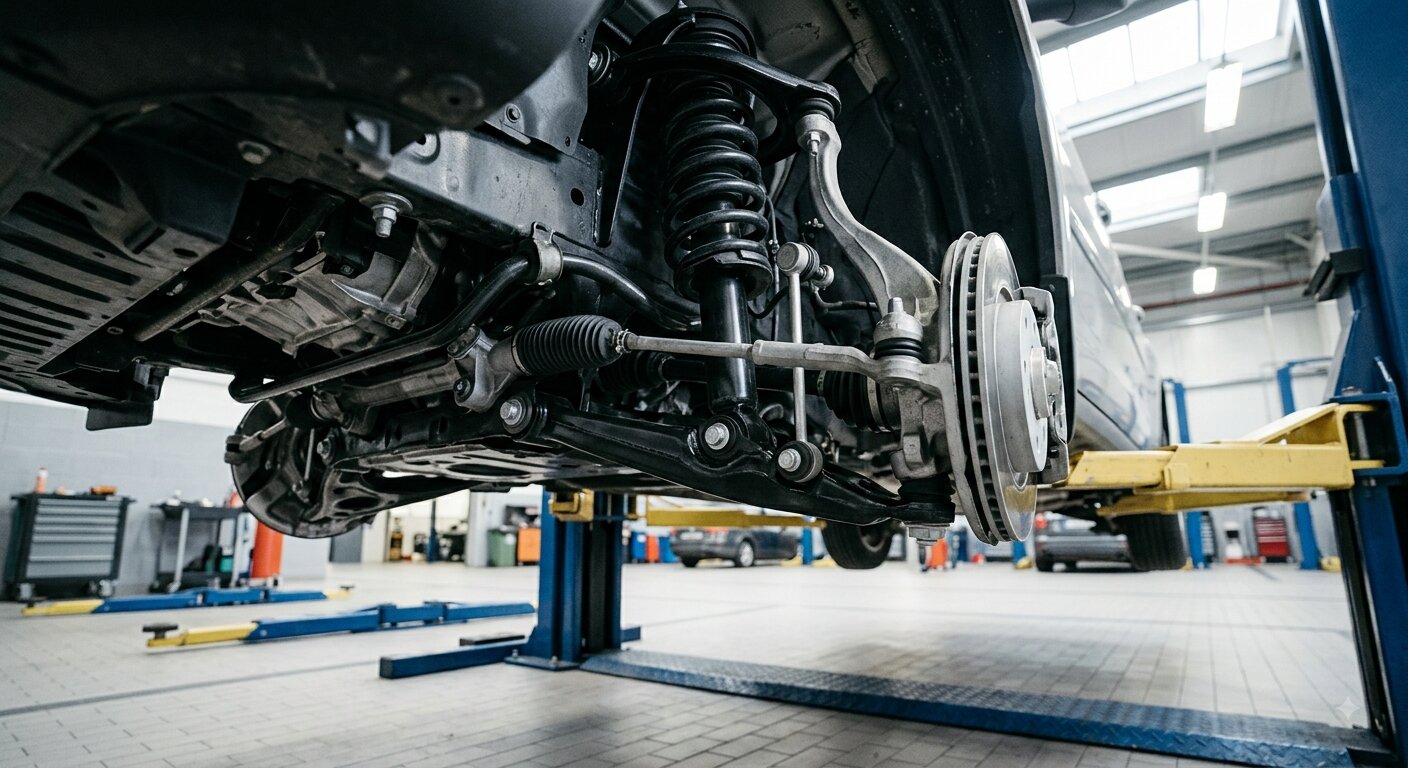
You hit a pothole on College Park Road and now the front end clunks every time you turn. Or maybe your car is drifting to the right on I-26, and you're constantly correcting the steering wheel. Perhaps there's a shimmy in the steering wheel at highway speeds that wasn't there last month.
If any of this sounds familiar, your suspension or steering system is trying to tell you something important. And unlike a check engine light, there's no dashboard warning — just physical symptoms that get worse the longer you ignore them. Your car's suspension and steering system is responsible for keeping your tires in contact with the road, which directly affects braking, handling, tire life, and your safety.
In this guide, the ASE-certified technicians at Ladson Auto Repair Shop walk you through every component of your suspension and steering system, the specific symptoms of each failure, real repair costs in the Ladson area, and exactly when you need to act — before a $200 repair becomes a $1,500 one. If you are also noticing uneven tire wear or alignment issues, that guide pairs perfectly with this one.
Vehicles on the road have at least one worn suspension component, according to industry inspection data. Worn suspension components increase stopping distance 10-20% at highway speeds — the difference between stopping safely and a collision.
In This Article
- Suspension & Steering Components Explained
- 10 Warning Signs You Can't Ignore
- How We Diagnose Suspension Problems
- Complete Repair Cost Table
- Why Driving with Bad Suspension Is Dangerous
- How SC Roads Accelerate Suspension Wear
- What Happens After Suspension Repair
- How to Extend Suspension Life
- When to Repair vs Replace
- What to Expect at Our Shop
- Frequently Asked Questions
Suspension & Steering Components Explained
Your car's suspension system is a network of springs, shock absorbers, linkages, and bushings that work together to absorb road impacts and keep your tires planted on the pavement. The steering system connects the steering wheel to the wheels through mechanical links. Here are the key components:
Control spring rebound and dampen oscillations. Worn = bouncy ride, poor handling.
Connect steering rack to steering knuckle. Worn = loose steering, clunking, wandering.
Pivot points between control arms and knuckle. Worn = clunking, tire wear, wheel separation risk.
Connect frame to knuckle with bushings. Worn = drifting, vibration, metal-on-metal noise.
Reduce body roll in turns. Worn = excessive leaning, clunking on bumps.
Allow wheels to spin freely. Worn = humming, growling, wheel play.
10 Warning Signs Your Suspension or Steering Needs Repair
1. Car Drifts or Pulls to One Side
If your car drifts right or left while driving on a straight, flat road, something is wrong. Common causes include misalignment, a worn tie rod, a seized ball joint, or uneven tire pressure. This is both a safety issue and a tire-wear issue.
2. Clunking or Knocking Over Bumps
That thunk-thunk-thunk when you drive over speed bumps or potholes usually means a worn sway bar link, a loose control arm bushing, or a bad ball joint. These are load-bearing components — a failed ball joint can cause the wheel to collapse outward.
3. Excessive Bouncing After Bumps
If your car continues bouncing 2-3 times after hitting a bump, your shocks or struts are worn out. A properly functioning shock absorber should stop the oscillation in one cycle.
4. Nose Dives When Braking
If the front of your car dips sharply when you apply the brakes, it's a classic sign of worn front struts. Your stopping distance increases dramatically because the weight transfer isn't being controlled.
5. Loose or Wandering Steering
If you have to constantly make small steering corrections to stay in your lane, or if there's excessive play in the steering wheel before the wheels respond, suspect worn tie rods or steering rack issues.
6. Steering Wheel Vibration
A shaking steering wheel at certain speeds could indicate a wheel balance issue, but if it persists after balancing, you may have worn ball joints, tie rods, or a failing wheel bearing.
7. Uneven or Cupped Tire Wear
If your tires are wearing faster on the inside or outside edges, or have a scalloped/cupped pattern, your suspension is likely out of alignment or has worn components. Read more in our tire rotation and alignment guide.
8. Humming or Growling Noise (Turns)
A humming or growling noise that changes pitch when you turn left or right is almost certainly a failing wheel bearing. Wheel bearing failure is a serious safety concern — continued driving can lead to wheel separation.
9. Vehicle Sways or Leans in Turns
If your car feels like it's leaning excessively when you take a corner, or if it rocks side-to-side on a straight road, your sway bar links or bushings are worn.
10. Steering Wheel Doesn't Return to Center
After completing a turn, the steering wheel should self-center as you accelerate. If it stays cocked to one side, you likely have a binding tie rod, seized ball joint, or alignment issue.
How We Diagnose Suspension Problems at Ladson Auto Repair Shop
A proper suspension inspection is methodical and thorough. Here's what we do when a car comes in for a suspension check:
- Visual inspection: Check for leaking shocks/struts, cracked bushings, torn ball joint boots, and bent components.
- Wiggle test (parked): With the car on a lift, we physically check each wheel for play at 12-and-6 o'clock (wheel bearing) and 9-and-3 o'clock (tie rods) positions.
- Bounce test: Push down on each corner and count rebounds. More than 1.5 cycles means worn shocks.
- Road test: Drive at various speeds, over bumps, and through turns to reproduce symptoms.
- Alignment measurement: Put the car on the alignment rack to measure caster, camber, and toe.
"Most suspension problems are obvious once you get the car on a lift. We can show you exactly which joint is loose within 30 seconds of wiggling the tire. The hard part is convincing people that a $200 control arm replacement today beats a $1,500 repair when the ball joint separates on the highway."
Lead Technician, Ladson Auto Repair Shop
Complete Suspension & Steering Repair Cost Table (Ladson Area)
| Service | What's Included | Typical Cost |
|---|---|---|
| Suspension Inspection | Full visual inspection, wiggle test, road test, written report | $50 – $100 |
| Wheel Alignment (2-wheel) | Adjust front toe, caster, camber to factory spec | $60 – $90 |
| Wheel Alignment (4-wheel) | All four corners adjusted (recommended for most modern vehicles) | $80 – $130 |
| Shock Absorber Replacement | Per pair (recommended always in pairs) plus alignment | $300 – $700 |
| Strut Replacement | Per pair (front), includes mount and alignment | $500 – $1,000 |
| Tie Rod Replacement (Outer) | One side, includes alignment check | $150 – $300 |
| Tie Rod Replacement (Inner) | One side, more labor-intensive | $250 – $450 |
| Tie Rod Replacement (Both sides) | Complete inner + outer tie rod replacement with alignment | $500 – $900 |
| Ball Joint Replacement | Per joint, includes alignment | $250 – $550 |
| Control Arm Replacement | Per side, includes alignment | $350 – $850 |
| Sway Bar Link Replacement | Per pair (most affordable suspension repair) | $150 – $300 |
| Wheel Bearing Replacement | Per wheel, hub assembly replacement common on modern cars | $300 – $700 |
| Steering Rack Replacement | Complete rack, lines, fluid, alignment | $800 – $1,800 |
| Full Suspension Overhaul | All components: struts, control arms, tie rods, ball joints, alignment | $1,500 – $3,500 |
Why Driving with Bad Suspension Is Dangerous
Worn suspension isn't just a comfort issue — it's a genuine safety hazard. Here's what happens when suspension components fail:
- Increased stopping distance: Worn struts and shocks allow excessive weight transfer during braking, adding 10-20% to your stopping distance — that's an extra 20+ feet from 60 mph.
- Reduced stability in emergencies: Bad suspension makes the car unstable during sudden lane changes, increasing rollover risk.
- Tire blowout risk: Worn suspension causes uneven tire wear that can lead to tread separation or blowouts at highway speeds.
- Loss of control: A failed ball joint or tie rod can cause the wheel to fold inward or outward, resulting in complete loss of steering control.
- Reduced nighttime visibility: Worn struts cause headlight bounce, reducing your ability to see the road ahead at night.
How South Carolina Roads Accelerate Suspension Wear
South Carolina ranks among the worst states for road quality in the nation. Here's how local conditions affect your suspension:
- Potholes: Charleston and Berkeley County roads develop potholes year-round, especially after freeze-thaw cycles in winter and heavy spring rains. Each pothole impact puts hundreds of pounds of force on suspension components.
- Railroad crossings: The multiple rail crossings on Highway 78, Ashley Phosphate, and Rivers Avenue deliver repeated shock loads that accelerate wear.
- Construction zones: Ongoing road construction on I-26, I-526, and local roads means rough surfaces and unexpected transitions.
- Heat and humidity: SC's heat degrades rubber bushings faster, causing them to crack and fail. Rubber control arm bushings and ball joint boots are especially vulnerable.
- Speed bumps: The proliferation of speed bumps in Ladson, Summerville, and North Charleston neighborhoods adds cumulative wear on shocks and struts.
"We see suspension components failing 15-20% earlier on cars that spend their whole life in the Lowcountry compared to the same car driven in the upstate. It's the potholes, the heat, and the constant stop-and-go on rough roads. If you drive primarily on Highway 78 or through North Charleston, your suspension is working harder than it would almost anywhere else."
Owner, Ladson Auto Repair Shop
What Happens After Suspension Repair: The Alignment
Whenever you replace tie rods, ball joints, control arms, struts, or any component that connects the wheel assembly to the vehicle, a wheel alignment is mandatory. Here's why:
- These components set the wheel angle. Replacing them changes the alignment by default.
- Driving without an alignment will cause the new parts to wear prematurely — you'll be back in the shop replacing them again in half the expected time.
- Your steering wheel will be crooked if the alignment isn't performed.
- Tire life is directly affected. A car that's 1/4 inch out of toe can scrub off a set of tires in 5,000 miles instead of 50,000.
If you need one, our wheel alignment complements any suspension repair — and an alignment check is always included after suspension work.
How to Extend Suspension & Steering Life
| Maintenance Task | Interval | Why It Matters |
|---|---|---|
| Avoid potholes when possible | Every drive | Reduces impact loads that bend components and damage bushings |
| Slow down over speed bumps | Every drive | Halves the stress on shocks, struts, and bushings |
| Rotate tires & check alignment | Every 5,000-7,000 miles | Catches alignment problems early before they cause tire damage |
| Suspension inspection | Every 25,000 miles or 2 years | Identifies worn bushings, ball joints, and tie rods before failure |
| Shock/strut replacement | Every 60,000-80,000 miles | Maintains stopping distance, handling, and ride quality |
| Power steering fluid flush | Every 50,000 miles | Prevents steering rack wear from contaminated fluid |
When to Repair vs Replace Suspension Components
Not every clunk means you need a full suspension overhaul. But replacing only the obviously broken part while ignoring the rest can cost you more in the long run. Here's our straight-talk guidance:
| Situation | Recommendation | Why |
|---|---|---|
| Single worn sway bar link | Replace the pair ($150-$300) | Sway bar links are cheap and always wear together. Replacing both prevents an immediate return visit. |
| One bad tie rod | Replace the worn side + alignment | If the other side is still tight, you don't need to replace it. But always get an alignment afterward. |
| Worn struts on one axle | Replace both left and right | Struts must be replaced in pairs. A new strut paired with a worn one creates unpredictable handling. |
| Multiple worn components on one corner | Replace all worn parts on that corner | If the ball joint, tie rod, and control arm bushing are all loose on the same side, do them all at once — you save on labor and only pay for one alignment. |
| Worn components on multiple corners (80k+ miles) | Full suspension overhaul | At high mileage, components fail in clusters. A full overhaul costs more upfront but saves 30-40% vs. fixing one corner at a time over the next year. |
| Steering rack leak | Replace rack (not repair) | Sealed rack units can't be reliably resealed in the shop. A remanufactured rack with warranty is the safe play. |
What to Expect When You Bring Your Car In for Suspension Service
If you're hearing clunks or feeling vibrations, here's what happens when you bring your car to our shop at 3322 Ladson Rd, Ladson, SC 29456:
- Free visual inspection. We put the car on the lift and physically check every suspension joint, bushing, and bearing for play, leaks, and wear.
- Road test. We drive the car to reproduce the symptoms you're experiencing and verify our findings.
- Written estimate with photos. We show you exactly which parts are worn — you can see the play in the joint or the cracked bushing yourself. No guessing.
- Same-day service for most jobs. Sway bar links, tie rods, and ball joints are typically completed same-day. Strut replacement or steering rack jobs may require a second day.
- Alignment included. Every suspension repair that affects wheel angle includes a post-repair alignment. We don't let you drive away with a misaligned car.
- 12-month / 12,000-mile warranty on all suspension and steering repairs.
We serve drivers from Ladson, Summerville, North Charleston, Goose Creek, and Hanahan. Whether you need a quick sway bar link replacement or a full suspension overhaul, our ASE-certified team is here. Learn more about our suspension and steering services and our brake repair services.
Related Articles
Frequently Asked Questions
How much does suspension repair cost?
Costs range from $150-$300 for sway bar links up to $1,500-$3,500 for a full suspension overhaul. Most individual component replacements fall between $250 and $900, including alignment.
How do I know if my suspension is bad?
Look for excessive bouncing, nose-diving during braking, drifting/pulling to one side, clunking over bumps, uneven tire wear, loose steering, or the steering wheel not returning to center after turns.
Can I drive with bad suspension?
Driving with worn suspension is unsafe. It increases stopping distance by 10-20%, reduces stability in emergency maneuvers, causes uneven tire wear, and a failed ball joint or tie rod can cause catastrophic wheel separation.
How long does suspension last?
Most components last 50,000-100,000 miles. Shocks and struts: 60k-80k miles. Ball joints and tie rods: 70k-100k miles. SC road conditions accelerate wear by 15-20%.
What does a bad tie rod sound like?
A bad tie rod produces a clunking sound when turning at low speeds, especially over bumps. You may also feel steering wheel vibration or excessive play in the steering.
Do I need an alignment after suspension repair?
Yes. Always. Failure to align the vehicle after replacing tie rods, ball joints, struts, or control arms will cause rapid tire wear and premature failure of your new parts.