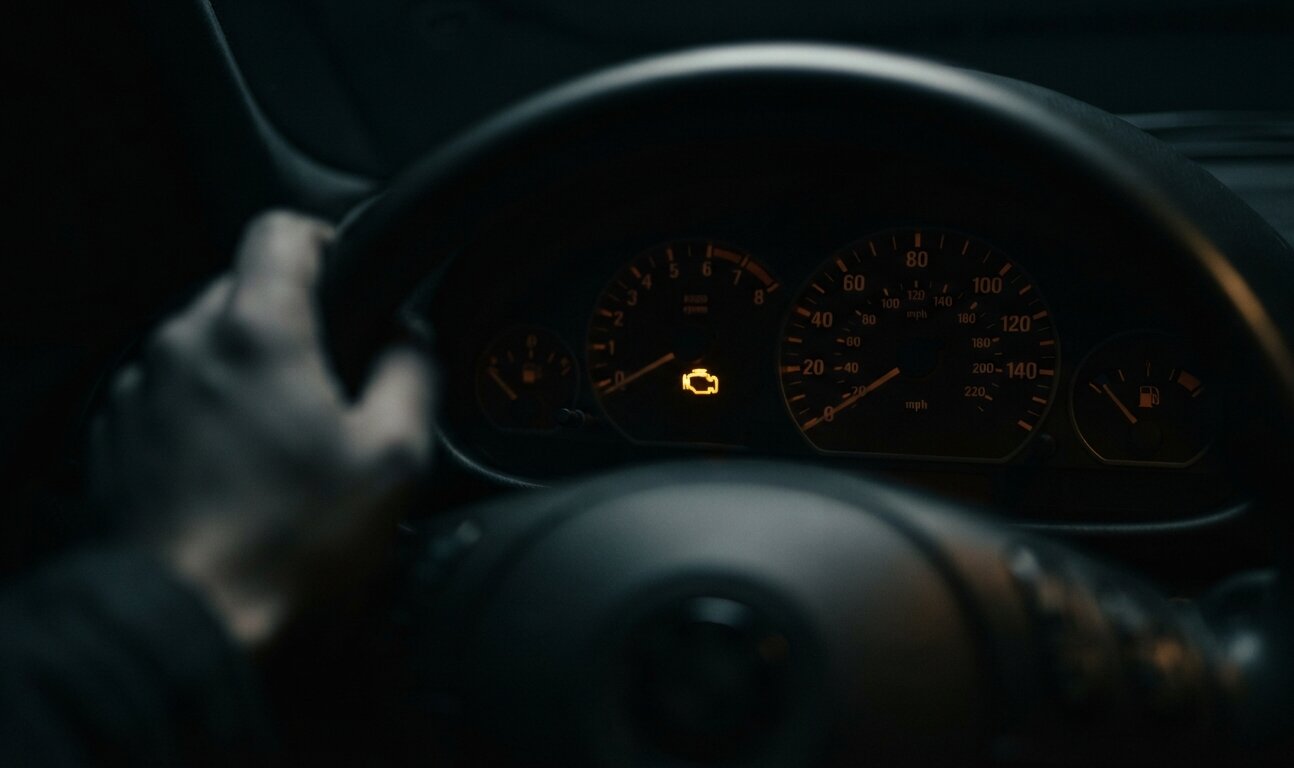
There is perhaps no sight more stressful for a modern driver than the sudden appearance of that little orange engine icon on the dashboard. One minute you're cruising down Ladson Road, enjoying the drive, and the next, your car is trying to tell you something is wrong. For many of us, the immediate reaction is a mix of anxiety and denial. You might wonder, Why is my check engine light on now? or Can I make it home before something breaks?
The first thing you need to do is look closely at the behavior of the light. Is it glowing steadily, or is it blinking rapidly? While they look similar, a solid light and a flashing check engine light represent two entirely different levels of urgency. One is a request for a service appointment; the other is a demand for immediate action to save your engine from catastrophic failure.
At Ladson Auto Repair Shop, we see drivers every day who are unsure whether to panic or ignore the warning. Understanding the check engine light meaning can save you thousands of dollars in unnecessary repairs and, more importantly, keep you safe on the road. If you're staring at your dashboard right now and aren't sure what to do, you can reach us immediately at 843-494-9179.
⚠️ SOLID (Steady) Light
What it means: The engine computer (ECU) has detected a problem that's affecting emissions or performance, but it's not causing immediate damage.
Urgency: Schedule a diagnostic within the next 1–2 weeks.
Can you drive? Yes, generally safe to drive normally to a mechanic.
Common causes: Loose gas cap, oxygen sensor issue, EVAP system leak, catalytic converter efficiency code.
🚨 FLASHING (Blinking) Light
What it means: An active, severe engine misfire is occurring RIGHT NOW. Raw unburned fuel is being pumped into your exhaust system.
Urgency: STOP DRIVING IMMEDIATELY.
Can you drive? No. Every second of driving causes escalating damage to your catalytic converter and potentially your engine.
Common causes: Failed spark plug, bad ignition coil, fuel injector failure, vacuum leak, internal engine damage.
What Does a Solid Check Engine Light Mean?
When you see a solid check engine light, your car's On-Board Diagnostics (OBD) system has detected a problem that is not currently causing an immediate threat to the engine's operation. In the world of auto repair, a solid light is essentially a "caution" sign. It means the computer has found a fault in the emissions system, the fuel system, or a sensor that is reading outside of its normal parameters.
Common causes for a solid light are often surprisingly simple. The most frequent culprit is a loose or faulty gas cap. Because your car's fuel system is sealed to prevent gasoline vapors from escaping into the atmosphere, a gap as small as a loose cap can trigger a leak detection code. Other common reasons include a failing oxygen (O2) sensor, a worn-out mass airflow sensor, or a catalytic converter that is beginning to lose efficiency.
While a solid light is generally less urgent than a flashing one, it is a mistake to ignore it indefinitely. Driving for weeks or months with a solid light can lead to decreased fuel economy and increased emissions. More importantly, a minor issue—like a faulty sensor—can eventually lead to a major issue—like a clogged catalytic converter—if left unaddressed.
If your light is solid, it is typically safe to drive short distances to your destination or to a repair shop. However, you should schedule professional check engine light diagnostics as soon as possible.
What Does a Flashing Check Engine Light Mean?
If your dashboard is displaying a flashing check engine light, you are no longer in "caution" mode—you are in "emergency" mode. A flashing check engine light is the car's way of telling you that a severe malfunction is occurring in real-time that could cause immediate and permanent damage to your vehicle.
In almost every case, a blinking light indicates an active engine misfire. A misfire happens when one or more of the cylinders fail to ignite the air-fuel mixture properly. When this happens, raw, unburned gasoline is pushed out of the cylinder and into the exhaust system. This is where the real danger lies: your catalytic converter operates at extremely high temperatures. When raw fuel hits that hot converter, it can ignite, effectively melting the internal ceramic structure.
The cost of replacing a catalytic converter can easily exceed $1,000. By continuing to drive while the light is flashing, you are risking a repair bill that is ten times more expensive than the original spark plug or ignition coil that caused the misfire.
⚠️ URGENCY BOX: WHAT TO DO NOW
If your check engine light is flashing:
- Reduce your speed immediately.
- Avoid heavy acceleration or towing any loads.
- Turn off the AC to reduce the load on the engine.
- Get to a professional mechanic immediately.
- Pull over and call a tow truck if you feel the engine shaking violently, hear loud knocking, or smell raw gasoline.
The Most Common Causes of a Check Engine Light
Whether the light is solid or flashing, the "Check Engine" warning is a broad umbrella. Here are the most common culprits:
1. Loose or Faulty Gas Cap
As mentioned, the Evaporative Emission (EVAP) system monitors the fuel tank for leaks. If the gas cap isn't tightened until it clicks, the system detects a pressure drop.
2. Oxygen (O2) Sensor Failure
O2 sensors monitor how much unburned oxygen is in the exhaust. When these fail, your car may run "rich" or "lean," leading to poor gas mileage.
3. Catalytic Converter Issues
The catalytic converter cleans exhaust gases. These rarely fail on their own; usually, they are the "victim" of another problem like long-term O2 sensor failure.
4. Mass Airflow (MAF) Sensor
The MAF sensor measures air entering the engine. If dirty or failed, it causes stalling and rough idling.
5. Spark Plug or Ignition Coil Failure
This is the primary cause of a flashing check engine light.
6. EVAP System Leak
Beyond the gas cap, cracks in hoses allow fuel vapors to leak.
Can You Drive with the Check Engine Light On?
If the light is solid: Yes, you can generally continue driving, but schedule diagnosis soon. Pay attention to your gauges—especially temperature.
If the light is flashing: No. You should stop driving as soon as it is safe to do so.
Is your check engine light on? Call Ladson Auto Repair Shop at 843-494-9179 — we'll diagnose it right and give you peace of mind.
The Truth About OBD-II Scanners
Many drivers buy inexpensive OBD-II scanners or go to auto parts stores for free code reads. While this is a great first step, it's important to understand that a code is not a diagnosis.
For example, code P0302 (Cylinder 2 Misfire) tells you where the problem is, but not why. The misfire could be caused by a worn spark plug, failed ignition coil, leaking fuel injector, or mechanical valve issue. Professional engine repair services use the code as a starting point, then perform targeted tests.
What Happens During a Check Engine Light Diagnosis?
When you bring your vehicle to Ladson Auto Repair Shop for a check engine light diagnosis, we follow a systematic process:
- Code Retrieval: Professional-grade scanners pull stored trouble codes and "freeze frame" data.
- Visual Inspection: Inspect engine bay for cracked hoses, frayed wiring, loose gas cap.
- Component Testing: Swap ignition coils, use multimeters, check voltage signals.
- Road Testing: Verify faults under specific conditions.
How Much Does Check Engine Light Repair Cost?
| Repair | Cost Range |
|---|---|
| Gas Cap Replacement | $10 – $50 |
| Oxygen (O2) Sensor | $100 – $300 |
| Ignition Coil | $150 – $400 per coil |
| Spark Plug Set | $150 – $400 |
| Mass Airflow Sensor | $200 – $400 |
| Catalytic Converter | $1,000 – $3,000+ |
Prevention Tips
- Tighten Your Gas Cap: Always ensure your gas cap clicks.
- Use Quality Fuel: Stick to Top Tier™ fuels.
- Follow Your Maintenance Schedule: Change spark plugs and air filters at recommended intervals.
- Don't Ignore "Small" Symptoms: If mileage drops by 2–3 MPG, get it checked.
🚨 Don't ignore that dashboard warning!
Solid or flashing, we'll diagnose it right. Get professional diagnostics and peace of mind today at Ladson Auto Repair Shop.
We service all makes and models. Same-day diagnostics available.
📞 Call Now: 843-494-9179Serving Ladson · Summerville · Goose Creek · North Charleston · Charleston · the entire Tri-County area
Frequently Asked Questions
Here are the most common questions we get from drivers dealing with check engine lights:
Will the check engine light turn off by itself?
Rarely. If a sensor had a "glitch" or a gas cap was loose but tightened, the light may turn off after several drive cycles. However, if there is a mechanical failure, the light stays on until the part is replaced.
Can a check engine light be a false alarm?
Yes. Electrical interference can trigger a "pending" code. However, we treat every light as a real warning until proven otherwise.
How long can I drive with a solid check engine light?
If the car is driving normally, you can usually drive for a few days while arranging repair. However, the longer you wait, the higher the risk.
Does AutoZone diagnose check engine lights for free?
They provide a free code read. They do not provide a diagnosis.
What's the most expensive check engine light repair?
Typically, catalytic converter replacement or full engine rebuild due to ignored misfires.
Seeing a check engine light? Solid or flashing, we'll diagnose it right. Don't leave your engine's health to guesswork.
Call us today at 843-494-9179 or book your appointment online.