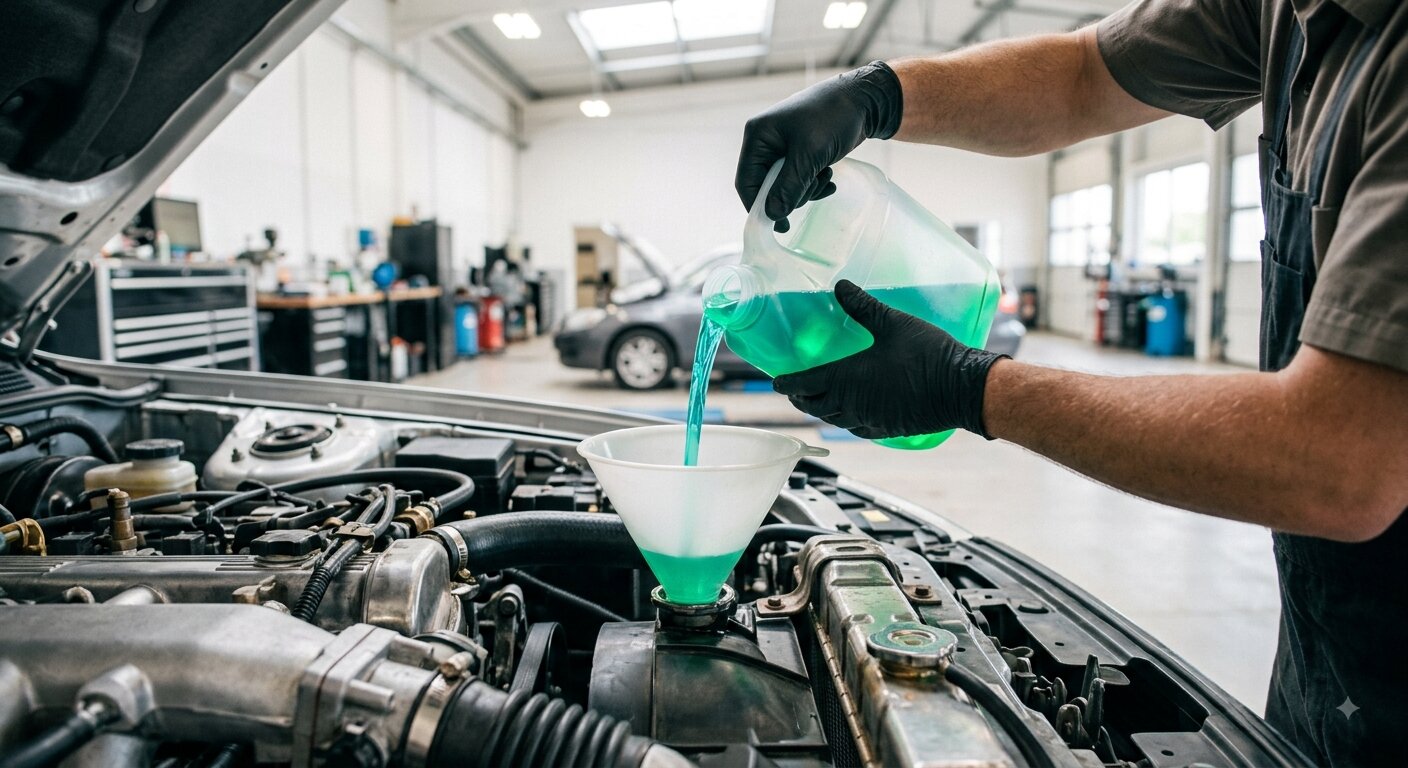
Coolant is the most overlooked fluid in most vehicles — until it causes the most expensive repair on the list.
The engine in your car runs at temperatures between 195°F and 220°F under normal operating conditions. The only reason it doesn't destroy itself is that coolant — also called antifreeze — circulates continuously through the engine block and radiator, absorbing heat from the combustion process and releasing it into the air. Without coolant, an aluminum engine head can warp in minutes. A warped head means a head gasket job, which is one of the most expensive repairs in automotive service.
Coolant doesn't last forever. Over time, the additive package that protects your cooling system from corrosion, scale, and electrolytic damage degrades. Old coolant becomes acidic, begins to attack the aluminum components in your cooling system — the radiator, heater core, water pump housing — and loses its ability to prevent electrolysis damage to metal surfaces. The consequences of degraded coolant are slow and invisible until they're not: a pinhole in the radiator, a leaking water pump seal, a head gasket seeping where it shouldn't.
Here's what you actually need to know about coolant service — without the upsell.
The cost of a professional coolant flush at Ladson Auto Repair Shop. Compare that to $1,500–$3,000 for a radiator and water pump replacement, or $2,500–$4,500 for a head gasket repair — both of which degraded coolant directly contributes to.
📋 In This Article
- What Coolant Actually Does
- How Coolant Degrades Over Time
- When Do You Actually Need a Flush?
- The Different Coolant Types — Why This Matters
- Why SC Heat Makes Cooling System Maintenance More Critical
- Flush vs. Drain-and-Fill: What's the Difference?
- Warning Signs Your Coolant Is Overdue
- What a Coolant Flush Includes at Our Shop
- Cost Table
- FAQ
What Coolant Actually Does
Coolant is a mixture of water and ethylene glycol (or propylene glycol in some formulas) with a precisely engineered additive package. The water-glycol mixture provides the actual heat transfer — glycol raises the boiling point above 212°F and lowers the freezing point below 32°F, giving you a fluid that works across an enormous temperature range. But the additive package is where coolant does its most critical work.
Those additives include corrosion inhibitors that protect aluminum, iron, and copper components from oxidation, scale inhibitors that prevent mineral deposits from building up on cooling passages, pH buffers that keep the coolant slightly alkaline (acidic coolant corrodes aluminum rapidly), and anti-cavitation agents that protect the water pump from the pitting that comes from microscopic vapor bubbles collapsing against metal surfaces.
When the additive package is fresh and intact, coolant actively protects every metal surface in your cooling system. When the additives are depleted — as they are in old, dark, or heavily contaminated coolant — you have a water-glycol mixture with no protection. It still transfers heat, but it's simultaneously attacking the components it runs through.
How Coolant Degrades Over Time
Coolant degradation is driven by several mechanisms, all of which are accelerated by the conditions we have in South Carolina:
Additive depletion. The corrosion inhibitors are consumed as they do their job — sacrificed to protect metal surfaces. A new additive package starts at a certain concentration; over two to five years of service, it depletes. Once it's gone, protection is gone.
Oxidation. Oxygen dissolved in the coolant reacts with the glycol and inhibitors, breaking them down. Higher operating temperatures accelerate oxidation. Our average summer operating conditions — sustained heat, frequent hot-cold cycles from afternoon thunderstorms — accelerate this faster than the manufacturer's generic interval assumes.
Electrolysis. The cooling system is a circuit of dissimilar metals — aluminum heads, iron blocks, copper heaters, steel fittings — all immersed in a conductive fluid. Small electrical currents flow between these metals through the coolant. Over time, this electrochemical process erodes the softer metals, particularly aluminum components. Fresh coolant with its inhibitor package buffers this. Old, depleted coolant accelerates it.
Contamination. Oil from a leaking head gasket, transmission fluid from a failed cooler line, rust particles from older steel components — these contaminants enter the coolant and further degrade its chemistry and heat transfer efficiency.
When coolant is depleted, it turns dark brown, rusty, or develops a sludgy consistency. You may also notice a sweet smell in the engine compartment — glycol has a distinctive odor that's more noticeable when coolant has leaked onto hot surfaces.
When Do You Actually Need a Flush?
The honest answer depends on what coolant is in your vehicle:
Standard green coolant (Inorganic Additive Technology / IAT): This is the old-school formula used in vehicles roughly pre-2000. Its additive package depletes faster than modern formulas. Service interval: every 2 years or 30,000 miles.
Orange/yellow extended-life coolant (Organic Acid Technology / OAT, such as Dex-Cool used in GM vehicles): Uses organic acid inhibitors that last longer than IAT. Service interval: every 5 years or 150,000 miles — but only if the system is clean and the coolant hasn't been diluted with the wrong type.
Pink/purple/blue extended-life coolant (HOAT — Hybrid OAT, used in most modern imports and European vehicles): A blend of OAT and IAT technology. Service interval: every 5 years or 100,000 miles under ideal conditions.
What actually drives the real-world decision: Mileage and time are only two factors. If the coolant is dark, murky, or has visible particles, it needs service regardless of when it was last changed. If you've bought a used vehicle without service records, assume coolant service is due — you have no way to know what type is in there, whether it's been mixed, or how old it is. If the vehicle has experienced any overheating event, the coolant should be tested and likely replaced. And as discussed below, SC's heat accelerates degradation in ways that argue for erring on the shorter end of any recommended interval.
A good rule of thumb that works for most drivers in our area: every 2–3 years regardless of mileage, or whenever a technician with a test strip or voltmeter shows you depleted inhibitors or elevated voltage in the coolant. We test coolant at every service. If we see degraded chemistry, we show you the test result and let you make the call.
The Different Coolant Types — Why This Matters
Mixing coolant types is one of the most damaging things you can do to a cooling system, and it happens more often than you'd think — particularly on used vehicles that have been to multiple shops or topped off with whatever was on the shelf.
Green IAT and orange OAT coolants have different chemistry and should never be mixed. Mixing them causes the inhibitor packages to react with each other, forming a brown gelatinous sludge that coats cooling passages and destroys heat transfer. On GM vehicles with Dex-Cool, adding green coolant is a known cause of the sludge failures that plagued those engines in the early 2000s.
Most modern vehicles require the manufacturer-specific coolant type for their aluminum-heavy engines. Toyota vehicles use a pink HOAT (Super Long Life Coolant). Honda uses a blue-green type. European vehicles typically use a purple or blue OAT. Using the wrong type — even a "universal" coolant — can accelerate the same aluminum corrosion the additive package is supposed to prevent.
At our shop, we confirm the correct coolant specification for your vehicle before every flush. We stock the major manufacturer-specific formulas and don't substitute generic "universal" products when a specific type is called for.
Why SC Heat Makes Cooling System Maintenance More Critical
Three aspects of our Lowcountry environment are particularly hard on cooling systems:
Sustained high ambient temperatures. Your cooling system is sized for a certain ambient temperature range. When air temperatures run at 95–100°F for months — as they do in our July and August — the radiator has to work harder to reject engine heat into already-hot air. The system runs at higher sustained temperatures, which accelerates additive depletion and glycol oxidation.
Heat soak during parking. When you shut off a hot engine in our summer heat, the engine bay temperature continues to rise for 20–30 minutes before it begins to cool. Your coolant sits in a hot, stagnant environment with no circulation — maximizing the oxidation and depletion rate. A vehicle that's driven and parked repeatedly in summer heat cycles through this damaging thermal soak many more times per year than one in a cooler climate.
Humidity and evaporative losses. Coolant can lose water through the overflow tank over time, raising the glycol concentration above the optimal 50/50 mix. A too-concentrated coolant actually has a higher freezing point and lower heat capacity than the optimal mix — counterintuitive but true. Topping off with distilled water is important when levels drop; topping off with undiluted antifreeze makes the chemistry worse, not better.
The practical upshot: we recommend the shorter end of any manufacturer interval for coolant service in our climate. If the manufacturer says every 5 years, we'd plan for 3. If they say every 3 years, we'd plan for 2. Our cooling system repair services include coolant testing, flushes, thermostat replacement, and water pump service — all with manufacturer-spec coolant.
Flush vs. Drain-and-Fill: What's the Difference?
These two procedures are often used interchangeably but they're different:
Drain and fill: Open the drain petcock at the bottom of the radiator, drain out the coolant, close the drain, refill with fresh coolant. Simple and inexpensive. Removes roughly 50–60% of the old coolant, since some remains in the engine block, heater core, and lines. On vehicles with clean systems and coolant that's degraded but not heavily contaminated, this is often perfectly adequate.
Flush: Uses a machine or chemical flush to push fresh coolant (or a cleaning solution) through the entire system under pressure, forcing out the old coolant from every passage — including the block, heater core, and thermostat housing. Removes 90–95% of the old fluid. Recommended when the coolant is visibly contaminated, has rust particles, has been mixed with the wrong type, or when the system is being flushed for the first time on a high-mileage vehicle.
At our shop, we make this call based on what we see. Clean coolant at its service interval gets a drain-and-fill. Visibly degraded, contaminated, or mixed coolant gets a full flush. We tell you which we're recommending and why before we start.
Warning Signs Your Coolant Is Overdue
Coolant is dark brown, rusty, or has visible particles. Fresh coolant is typically bright green, orange, pink, or blue depending on type. As it degrades, it darkens. Dark, murky coolant is past due.
Sweet smell in the engine bay or passenger compartment. Ethylene glycol has a distinctive sweet smell. If you notice it outside the car near the engine, there's likely a small leak. If you smell it inside the cabin, the heater core may be leaking — which routes coolant vapor into your ventilation system.
White residue around hose connections or the overflow tank. This is dried coolant from a slow leak or overflow. Worth investigating.
Temperature gauge running higher than normal. If your temperature gauge is consistently running higher than it used to, or creeping toward the hot end of the range without getting there, degraded coolant with reduced heat transfer capacity is one possible cause. Have it tested.
Overheating. If the temperature gauge has entered the red, pull over immediately. Continuing to drive an overheating engine causes head gasket damage within minutes and engine destruction within hours. Let it cool completely before adding coolant (never add cold coolant to a hot, dry engine) and get it towed to a shop. An overheating event can cause cascading engine damage — our engine repair services include post-overheat inspections to assess head gasket and cylinder head integrity.
What a Coolant Flush Includes at Our Shop
When we perform a coolant service, here's what's included:
We start by testing the existing coolant with a test strip and a voltmeter to measure pH, freeze point, inhibitor concentration, and electrolytic voltage — this tells us the condition of the fluid and whether a drain-and-fill or full flush is appropriate. We visually inspect all hose connections, the radiator, the overflow reservoir, and the thermostat housing for signs of leaks, corrosion, or deterioration. We flush or drain the old coolant, refill with the manufacturer-specified formula at the correct 50/50 concentration, bleed air from the system (critical — air pockets cause hot spots and inaccurate temperature readings), and re-test the fresh coolant to confirm specification. We note the coolant type used on your service record so the next shop or technician knows exactly what's in there.
Cost Table
| Service | Typical Cost | Notes |
|---|---|---|
| Coolant test (at oil change) | Included | pH, freeze point, voltage test |
| Drain and fill | $100 – $150 | Clean systems at service interval |
| Full machine flush | $150 – $250 | Contaminated or mixed coolant |
| Flush + thermostat replacement | $200 – $350 | Recommended on 100k+ mile vehicles |
| Flush + hose inspection and replacement | $250 – $500+ | Varies by vehicle and hose condition |
Frequently Asked Questions
My coolant looks fine — do I still need to change it?
Can I just top off the coolant instead of flushing it?
My car overheated once but seems fine now. Do I need a coolant flush?
The shop at my last oil change recommended a coolant flush. Do I need it?
What happens if I mix the wrong coolant type?
Schedule a Coolant Test or Flush
We test coolant at every oil change. If it's due, we'll show you — no guessing.
Or book online: Book Appointment Online
This article was written by the automotive service experts at Ladson Auto Repair Shop, located at 3322 Ladson Rd, Ladson, SC 29456. Proudly serving Ladson, Summerville, Goose Creek, North Charleston, and the greater Charleston, SC metro area.
Need Help? Call Ladson Auto Repair Shop
If you have questions about your vehicle or need to schedule a repair, our experienced mechanics are here to help. We provide honest diagnostics, fair pricing, and a 12-month/12,000-mile warranty on all repairs.
📞 Call Now: 843-494-9179Serving Ladson, Summerville, North Charleston, Goose Creek, and Hanahan, SC.