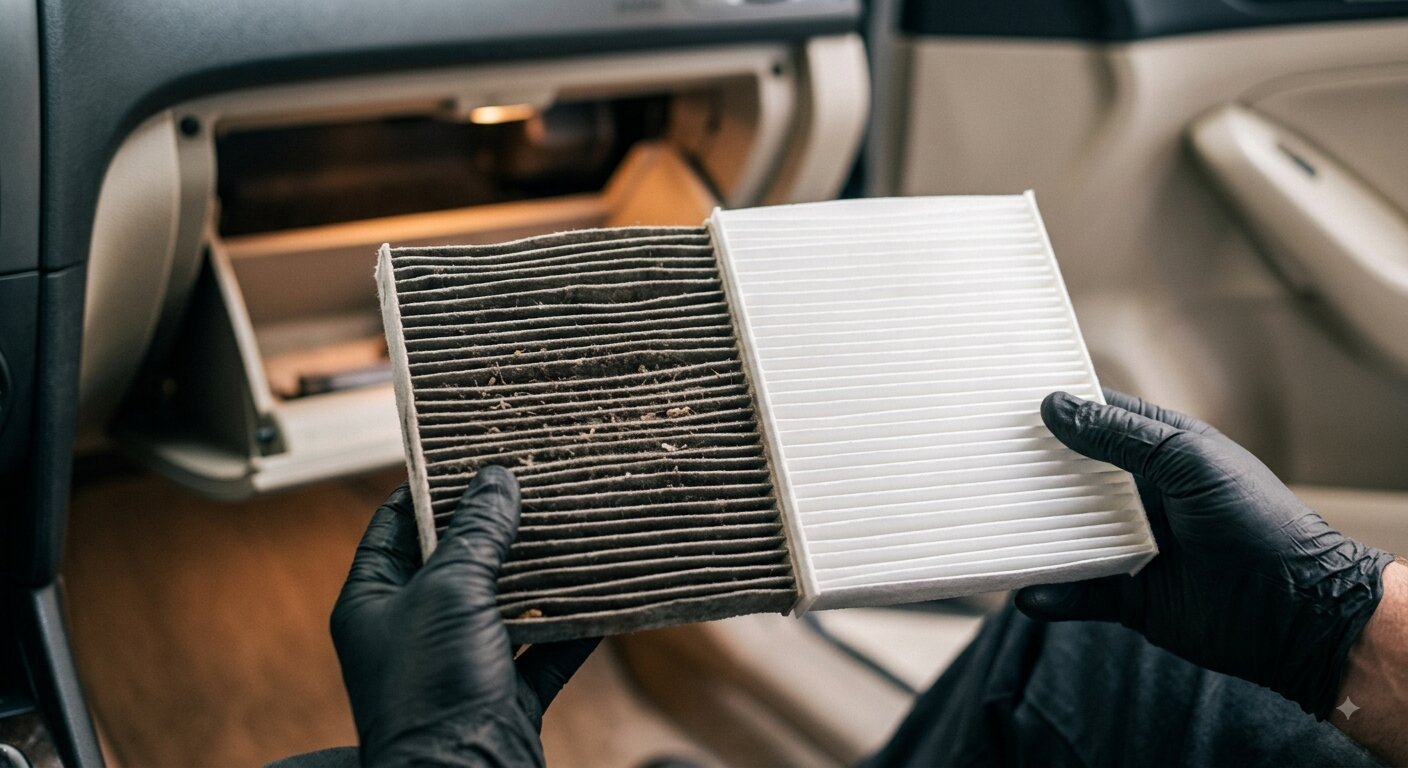
The honest answer — and why "every 15,000 miles" is almost certainly wrong for anyone driving in the Lowcountry.
Here's something that surprises a lot of people: your car has two air filters — one for the engine and one for you. Most drivers know vaguely about the engine air filter. Almost no one thinks about the cabin air filter until something goes wrong with the AC or the car starts smelling musty, at which point the filter has usually been overdue for replacement for a year or more.
The cabin air filter sits behind your glove box or under the dashboard and cleans every cubic foot of air that passes through your heating and air conditioning system before it reaches you and your passengers. Pollen, dust, mold spores, exhaust particles, and road dust all get caught in it. In a clean environment with mild seasons, the 15,000–25,000 mile manufacturer interval is reasonable. In the Lowcountry — where pollen season is extreme, humidity is year-round, and the AC runs eight to nine months a year — that interval is frequently too long.
Here's what you actually need to know.
The cost of a cabin air filter replacement at Ladson Auto Repair Shop — one of the least expensive maintenance items on your vehicle and one of the most commonly skipped. Compare that to the cost of an evaporator cleaning when mold establishes itself on a wet, clogged filter.
📋 In This Article
What a Cabin Air Filter Actually Does
Your car's HVAC system pulls air from outside the vehicle, pushes it through the filter, then through the evaporator core (which cools it) or heater core (which warms it), and out through the vents into the cabin. The cabin air filter is positioned in that airflow path to clean the air before it reaches you.
A typical cabin air filter is a pleated paper or activated carbon element designed to catch particles down to 0.3 microns — that's fine enough to capture most pollen grains, dust, mold spores, and a significant fraction of exhaust particulates. Activated carbon filters (which cost a few dollars more) also absorb odors from exhaust fumes and road smells.
What the filter doesn't do: it's not a HEPA filter and doesn't stop viruses or ultrafine combustion particles. But for the size range that causes most allergy symptoms and visible dust accumulation in the cabin — pollen, dust, dander, mold spores — it does its job well when it's clean.
When it's clogged, it does nothing well. Airflow through the HVAC system drops, the filter stops catching new particles efficiently, and anything accumulated on the filter face can shed back into the airstream when the system reverses pressure.
How Often to Change It — the Real Answer
Manufacturer recommendations vary from 12,000 to 25,000 miles. Most land around 15,000–20,000 miles or once per year, whichever comes first.
For most people in most places, once a year at your annual service is about right. In the Lowcountry, we recommend checking it twice a year — once in late spring after pollen season and once in early fall — and replacing it whenever it shows significant loading, regardless of mileage. Which brings us to why.
Why the Lowcountry Means More Frequent Changes
Three things make cabin air filter life shorter in the Charleston–Ladson–Summerville area than the manufacturer's generic recommendation assumes:
Pine pollen season. If you've parked outside in late March or April here, you know what pine pollen season looks like. Loblolly pines produce extraordinary quantities of pollen that turns everything yellow-green for weeks. Your HVAC intake draws outside air continuously when the fan is running. During peak pollen season — typically mid-March through mid-April — your cabin filter is loading far faster than at any other time of year. A filter that looked clean in February can be visibly heavy with yellow-green pollen by early May. A post-pollen-season inspection in late April or early May is worth adding to your calendar.
Year-round humidity. Relative humidity in our area regularly exceeds 80% in summer. High humidity means a constantly damp filter — and a damp filter is a filter that supports mold and bacteria growth. The musty smell that Lowcountry drivers notice from their vents, particularly when first turning on the AC after a wet night, often traces directly to a mold-colonized cabin filter.
Extended AC season. The AC in a typical Charleston-area vehicle runs from March through November — eight to nine months. That's significantly more total airflow hours through the cabin filter than a vehicle in a northern state where AC runs for four months. More airflow hours means faster loading.
The practical result: a cabin filter that would last 18 months in Denver may need replacement after 10–12 months here, particularly if the vehicle is garaged outside.
Signs Your Filter Is Overdue
Your car will tell you the cabin air filter needs attention in a few ways:
Reduced airflow from the vents. This is the most direct sign. If you've noticed that even on the highest fan setting, the airflow from your vents feels weaker than it used to, a clogged cabin filter is among the most likely causes. The blower motor has to work harder to push air through a restricted filter, and on many vehicles, the airflow simply drops noticeably.
Musty or unpleasant smell from the vents. A filter loaded with pollen, dust, mold, and road grime doesn't smell neutral. When you turn on the AC — especially after the car has sat overnight — you may notice an earthy, musty, or vaguely unpleasant smell coming from the vents. This is often the filter itself and the moisture it's accumulated.
Increased dust on your dashboard. A saturated filter begins to pass particles rather than catching them. If you've noticed your dashboard and interior surfaces seem dustier than usual despite the same cleaning routine, this is a possible cause.
Visible loading on inspection. Pull the filter and hold it up to a light. If light doesn't pass clearly through the pleats, or if you can see visible debris accumulation — especially yellow pollen, leaves, insects, or dark grime — it's overdue.
Allergy symptoms in the car that have gotten worse. If someone in your vehicle is sensitive to pollen or dust and has noticed their symptoms are worse in the car than they used to be, a clogged filter is worth checking before assuming anything else.
What Happens If You Never Change It
Skipping cabin air filter replacement is one of those deferred maintenance items where the consequences are slow and incremental until they're not. Here's the progression:
The first effect is reduced airflow and reduced filtration efficiency — both annoyances more than emergencies. Over time, however, a heavily loaded filter that's accumulated moisture in our humid climate becomes a mold growth medium. Mold that establishes on the filter surface doesn't stay there — it spreads to the evaporator housing, the evaporator fins, and the ductwork downstream of the filter. Once mold reaches the evaporator core, a new filter alone won't fix the problem. The evaporator itself needs treatment, which is a more involved process than a simple filter swap.
On vehicles where the filter gets so restricted that the blower motor is working against significant resistance for months, premature blower motor wear is also a possibility. Blower motor replacement runs $300–$600 depending on vehicle and location — not cheap for a problem that started as a $40 filter.
Where Is It and Can You Change It Yourself?
The cabin air filter is located in one of three common places depending on your vehicle:
Behind the glove box is the most common location on modern vehicles. On many cars — Hondas, Toyotas, Hyundais, and others — you can remove the glove box by releasing two clips, drop it down, slide the old filter out, and slide the new one in. No tools required. The process takes five minutes once you've done it once.
Under the dashboard on the passenger side. Slightly less accessible than the glove box location, but still typically tool-free.
Under the hood in the cowl area. Less common, but some vehicles have the cabin air intake at the base of the windshield. This is the easiest of all — lift a cover, pull the filter, replace.
For many vehicles, this is a straightforward DIY job if you're comfortable following a YouTube video for your specific make and model. The filter itself is $15–$35 at an auto parts store. If you'd rather have us handle it at your next oil change — which takes us about four minutes — the total cost including the filter runs $40–$80.
The one caution: a few vehicles have genuinely awkward filter access that involves significant dashboard disassembly. If the first 60 seconds of a YouTube video for your vehicle looks intimidating, let us do it.
Cost at Our Shop
| Service | Cost |
|---|---|
| Cabin air filter — standard | $40 – $60 (filter + labor) |
| Cabin air filter — activated carbon (odor-absorbing) | $55 – $80 (filter + labor) |
| Cabin air filter + evaporator deodorizer treatment | $80 – $130 |
We check the cabin air filter at every oil change as a standard part of our multi-point inspection. If it's due, we'll show it to you and give you the option — we won't add it to the bill without asking.
Frequently Asked Questions
My car has 18,000 miles and I've never changed the cabin filter. Is it too late?
Does a cabin air filter affect AC performance?
Do I need the carbon/activated charcoal filter or is the standard one fine?
I just had my car serviced at a quick-lube place and they recommended replacing my cabin filter. Should I trust that?
Can a dirty cabin filter cause the AC to smell bad?
Get Your Cabin Filter Checked at Your Next Oil Change
We check it automatically — no extra charge, no appointment needed for oil changes.
Or book online: Book Appointment Online
This article was written by the automotive service experts at Ladson Auto Repair Shop, located at 3322 Ladson Rd, Ladson, SC 29456. Proudly serving Ladson, Summerville, Goose Creek, North Charleston, and the greater Charleston, SC metro area.
Need Help? Call Ladson Auto Repair Shop
If you have questions about your vehicle or need to schedule a repair, our experienced mechanics are here to help. We provide honest diagnostics, fair pricing, and a 12-month/12,000-mile warranty on all repairs.
📞 Call Now: 843-494-9179Serving Ladson, Summerville, North Charleston, Goose Creek, and Hanahan, SC.