For most car owners, the timing belt is the "invisible" component of engine maintenance. Unlike your oil, which you check with a dipstick, or your tires, which you can see wearing down, the timing belt is tucked away behind plastic covers, deep inside the heart of your engine. You don't think about it—until your mechanic mentions it during a routine inspection, or worse, until it snaps while you're cruising down Highway 17.
The reality is that a timing belt is one of the most critical components of your vehicle, and its replacement is often one of the more expensive maintenance items on your checklist. However, ignoring it is a gamble where the stakes are your entire engine. Many drivers in the Lowcountry aren't even aware their vehicle has a belt instead of a chain until they are faced with a repair bill, leaving them wondering if the cost is justified.
If you've been told you're due for a service or you're simply trying to budget for upcoming maintenance, you've come to the right place. At Ladson Auto Repair Shop, we believe in transparency over scare tactics. If you have immediate concerns about your engine's timing, call us at 843-494-9179.
What Is a Timing Belt and What Does It Do?
In simple terms, the timing belt is the "conductor" of your engine's internal orchestra. Its primary job is to synchronize the rotation of the crankshaft (which connects to the transmission and moves the pistons up and down) and the camshaft (which opens and closes the intake and exhaust valves).
For an engine to run, these two components must be perfectly timed. The critical danger arises from "interference" engines. Most modern engines are interference engines, meaning the area where the piston reaches its highest point overlaps with where the valves open. As long as the timing belt is intact, the valves stay out of the way. However, if the belt breaks, the synchronization vanishes instantly. The camshaft stops turning, leaving valves stuck open, while the crankshaft continues to spin, driving pistons upward.
The result is catastrophic: pistons slam into open valves at thousands of RPM. This bends valves, cracks pistons, and can damage the cylinder head.
Timing Belt vs. Timing Chain: Which One Do You Have?
🔧 Timing Belts
Made of high-quality reinforced rubber. They are quieter and cheaper to manufacture, but rubber degrades over time regardless of mileage.
Replacement: Must be replaced at specific intervals (60,000–100,000 miles).
⛓️ Timing Chains
Made of metal (similar to a bicycle chain). Designed to last the life of the engine under normal conditions.
Replacement: Typically only replaced if there's a problem. Louder than belts and more expensive to repair.
How do you know which you have? Check your owner's manual. If you see a requirement to replace a belt every 60,000–100,000 miles, you have a timing belt — our serpentine and timing belt replacement service covers both. If there's no mention of a replacement interval, you likely have a timing chain.
When Should You Replace Your Timing Belt?
Because a broken timing belt usually provides no warning, replacement is based on mileage and time:
- Mileage: Most manufacturers recommend every 60,000–100,000 miles.
- Time: Rubber undergoes dry rot. Even at 30,000 miles over 6+ years, replace it.
What Happens If You Don't Replace It?
In a non-interference engine, a broken belt simply stops the engine. You'll be stranded, but a new belt fixes it.
In an interference engine, failure is catastrophic. The moment the belt snaps, pistons destroy valves. Repair costs after failure: $1,000–$5,000+ vs. $100–$1,500 preventive.
| Scenario | Service | Estimated Cost (SC) | Engine Status |
|---|---|---|---|
| Preventive | Timing Belt & Water Pump Kit | $100 – $1,500 | Healthy |
| Reactive | Full Engine Rebuild | $1,000 – $5,000+ | Catastrophic Failure |
Timing Belt Replacement Cost Breakdown
Parts Costs:
- Timing Belt: $10 – $150
- Tensioner and Idler Pulleys: $100 – $150
- Water Pump: $100 – $100
- Seals and Coolant: $10 – $100
Labor Costs: 3–8 hours depending on engine layout.
Total Estimated Cost Ranges:
- 4-Cylinder Economy Car: $100 – $100
- V6/V8 or Transverse Engine: $100 – $1,500
- Luxury/Performance Vehicle: $1,500 – $1,500+
Need a quote for your specific vehicle? Call Ladson Auto Repair Shop at 843-494-9179 — we'll give you a transparent estimate based on your make, model, and engine.
What's Included in a Timing Belt Service?
A comprehensive service should include:
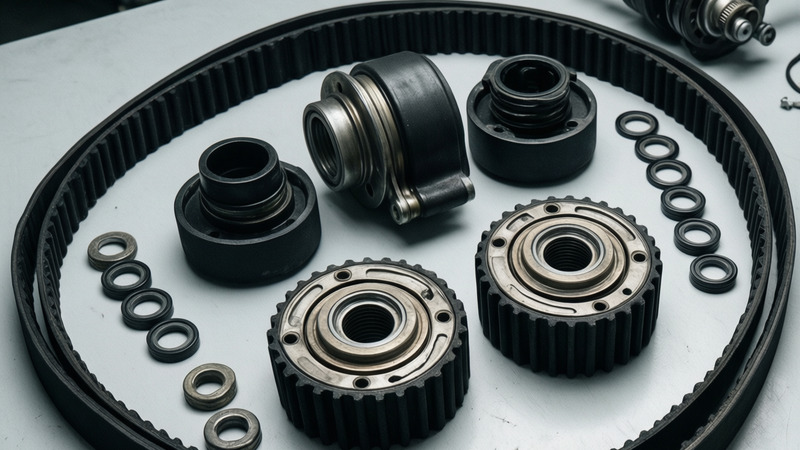
- The Timing Belt
- Tensioner and Idler Pulleys
- The Water Pump
- Front Crankshaft and Camshaft Seals
- Fresh Coolant
Can You Replace a Timing Belt Yourself?
We respect the DIY spirit, but we strongly advise against it. The difficulty isn't wrenching—it's precision. Replacing a timing belt requires "setting the timing" by aligning specific marks on gears perfectly. If off by even one tooth, the engine runs poorly or pistons hit valves. Many modern cars require specific locking tools.
I've seen more engines destroyed by well-meaning DIYers than I can count. The timing belt job isn't about strength—it's about precision. One tooth off on a Toyota interference engine and you're looking at a $3,000 cylinder head replacement. The $800 you save isn't worth the risk.
— Lead Technician, Ladson Auto Repair ShopFrequently Asked Questions
How do I know if my car has a timing belt or chain?
Check your owner's manual for a "timing belt replacement interval." If not mentioned, you likely have a chain. Call us at 843-494-9179 with your VIN and we can look it up.
Can a timing belt last 200,000 miles?
While some get lucky, it is extremely risky. Rubber degrades regardless of mileage. We strongly recommend sticking to the manufacturer's interval.
What does a bad timing belt sound like?
You might hear high-pitched squealing or rhythmic "slapping." However, many belts make no sound until they snap.
Is timing belt replacement covered by warranty?
Generally, no. Timing belts are "wear and tear" items like brake pads.
Should I replace the water pump with the timing belt?
Yes. In almost every case, the water pump is driven by the timing belt. Since labor is already paid for, replace the $150 pump now to avoid $100 labor later.
🛡️ Protect Your Engine from Catastrophic Failure
Preventive maintenance is always cheaper than an engine rebuild. Don't gamble with your engine's future.
Call Ladson Auto Repair Shop for a transparent quote or book your service online today.
Serving Ladson · Summerville · Goose Creek · North Charleston · Charleston · the entire Tri-County area
This article was written by the automotive service experts at Ladson Auto Repair Shop, located at 3322 Ladson Rd, Ladson, SC 29456. We specialize in complete auto repair including timing belt replacement, engine diagnostics, brake repair, AC service, oil changes, and preventive maintenance for all makes and models. Proudly serving Ladson, Summerville, Goose Creek, North Charleston, and the greater Charleston, SC metro area.