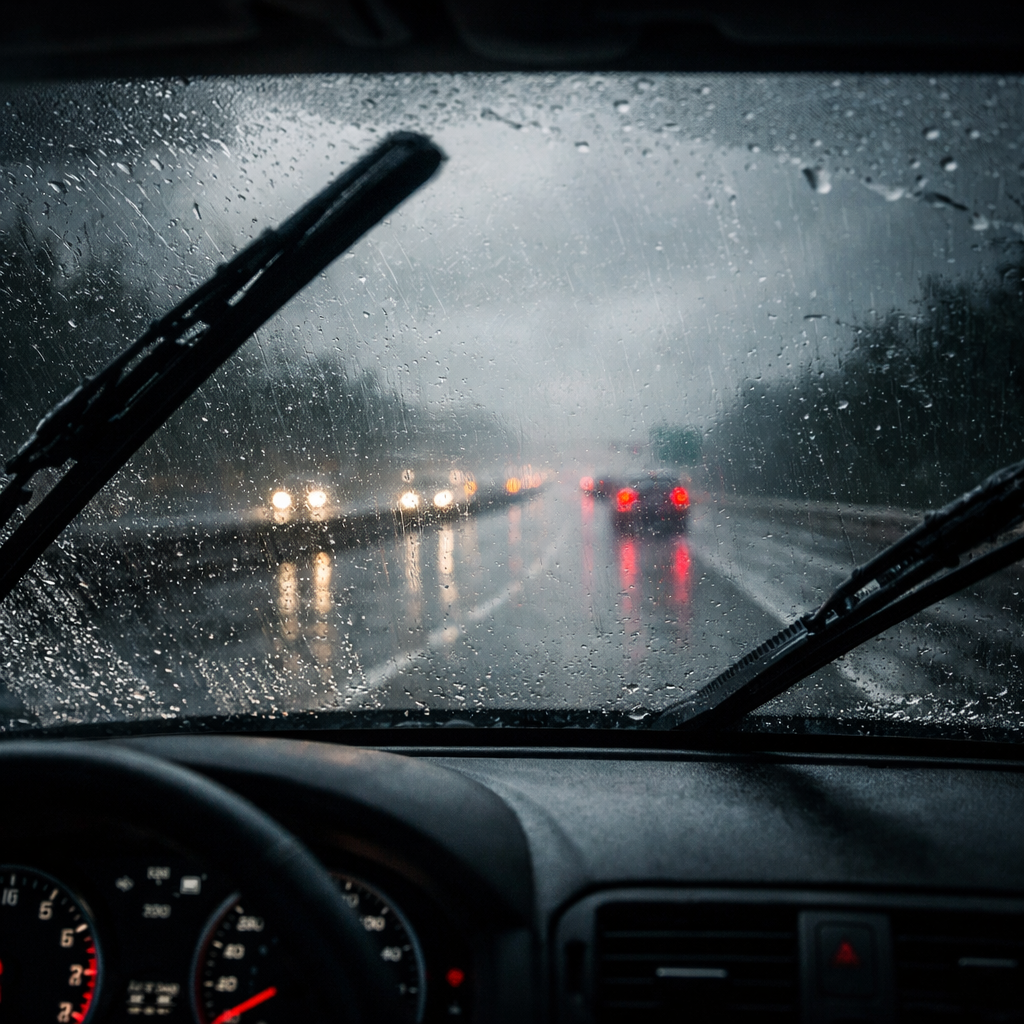
You know how it goes. It's 2:00 PM on a Wednesday in April. You're leaving the Walmart on Summerville Highway 78, and the sky is a perfect Carolina blue. By the time you merge onto I-26 near Exit 203, you can see a wall of black clouds rolling in from the west like something out of a disaster movie. By the time you pass the Ladson Road exit at 205A, you can't see the taillights of the car twenty feet in front of you.
Rain is hammering your windshield so hard it sounds like gravel. Your wipers are on full speed but they're smearing more than clearing. Water is pooling in the right lane. You tap the brakes and the car slides — just a little — before the tires catch again. Your hands tighten on the steering wheel. Your heart rate jumps.
Sound familiar? If you've lived in the Lowcountry for more than one spring, you've been through this. And if you're honest with yourself, you've probably driven through it with wipers that belong in a trash can, tires that are borderline bald, and brakes you've been "meaning to get checked."
South Carolina spring storms don't give warnings. They don't wait for you to be ready. They arrive fast, they hit hard, and they turn every road — from the interstate to Dorchester Road to the side streets of College Park — into a driving hazard. The only thing you can control is whether your car is prepared.
In this guide, our team at Ladson Auto Repair Shop is going to walk you through every single thing you should check on your car before storm season — not just the basics, but the details most people overlook until it's too late. This isn't generic advice from a national website. This is specific to our roads, our weather, our flooding patterns, and the cars we see every day at our shop on Ladson Road.
of rain per year — that's what the Ladson/Summerville area receives on average, with the heaviest concentration during spring and early summer thunderstorms. That's 30% more than the national average.
⚡ Quick Storm-Ready Checklist
In a hurry? Here's the at-a-glance version. Details on each item below.
Wiper Blades
Replace if streaking, chattering, or older than 12 months
Tire Tread Depth
Penny test — if you see Lincoln's head, replace tires
Tire Pressure
Check all 4 tires + spare against door jamb spec
Brake Pads & Rotors
Squeaking = replace before first storm
All Exterior Lights
Headlights, taillights, brake lights, turn signals
Battery Health
Load test — storms demand max electrical draw
Defogger & AC
Front/rear defog must work instantly in heavy rain
Emergency Kit
Flashlight, phone charger, reflective triangle, rain poncho
📋 In This Article
- Why South Carolina Spring Storms Are Uniquely Dangerous
- Check #1: Windshield Wiper Blades
- Check #2: Tire Tread Depth & The Science of Hydroplaning
- Check #3: Tire Pressure
- Check #4: Brake Pads and Rotors
- Check #5: Headlights, Taillights & The SC Wiper Law
- Check #6: Battery and Charging System
- Check #7: Defogger and HVAC System
- Check #8: Emergency Kit
- Known Hydroplaning Zones in the Ladson/Summerville Area
- What to Do If You Start Hydroplaning
- Driving Through Standing Water: When to Stop
- Storm-Ready Costs at a Glance
- Frequently Asked Questions
Why South Carolina Spring Storms Are Uniquely Dangerous for Drivers
Not all rain is created equal. A light drizzle in Oregon is a completely different driving experience than what we get here in the Lowcountry. South Carolina spring storms have specific characteristics that make them more dangerous than rain in most other parts of the country:
Intensity: It's not just rain — it's a fire hose
Lowcountry spring thunderstorms don't drizzle. They dump. Our region regularly sees rainfall rates of 2–4 inches per hour during intense cells. To put that in perspective: a "heavy rain" event in Seattle might deliver 0.5 inches per hour. Our storms drop four to eight times that amount. This overwhelms road drainage systems, creates instant standing water, and reduces visibility to near zero.
Speed of onset: Zero to downpour in 10 minutes
Unlike coastal frontal systems that you can see coming for hours, spring pop-up thunderstorms in the Charleston metro area form rapidly over warm, humid air masses. You can be driving under clear skies at Exit 205A on I-26 and hit a complete wall of rain before you reach Exit 203. There's no gradual buildup — it goes from dry to catastrophic in minutes.
Flat terrain = standing water
The Lowcountry is flat. Ladson sits at roughly 40 feet above sea level. Summerville is at about 75 feet. There's minimal natural slope to carry water away from roadways. When 3 inches of rain falls in 30 minutes, the water has nowhere to go. It pools in travel lanes, collects in underpasses, and floods low-lying intersections — particularly along Dorchester Road, parts of Highway 78, and the low spots on College Park Road near Goose Creek.
Oil-slicked roads: The first 15 minutes are the worst
After days or weeks of dry weather, road surfaces accumulate a thin film of oil, rubber particles, and automotive fluids. When the first rain hits, this film mixes with the water to create an extremely slippery surface — far slicker than the road will be 20 minutes into the storm after the oils have washed away. The most dangerous moment to be driving is in the first 10–15 minutes of rainfall after a dry spell.
People move here from up North and think they know how to drive in rain. But a spring thunderstorm in the Lowcountry is nothing like a rainy day in Connecticut. The rain is heavier, the roads flood faster because everything is flat, and the oil buildup makes the first few minutes feel like driving on ice. We see a huge spike in cars coming in with storm-related damage every April and May — bent wheels from potholes hidden under standing water, brake issues from driving through deep puddles, and of course, accidents from hydroplaning on bald tires.
— Owner, Ladson Auto Repair Shopof all vehicle crashes in the U.S. are weather-related, and the vast majority occur on wet pavement during rainfall. South Carolina consistently ranks in the top 15 states for weather-related traffic fatalities. (Source: FHWA)
Check #1: Don't Drive Into a Storm With Dead Wiper Blades
This is the simplest, cheapest, and most neglected item on the storm prep list. And it might be the most important one for sheer survival.
Why wipers fail faster in South Carolina
Windshield wiper blades are made of rubber (or silicone in premium models). That rubber sits on your windshield, fully exposed to:
- Intense UV radiation — South Carolina gets significantly more UV exposure than northern states. UV breaks down rubber compounds, causing them to harden, crack, and lose flexibility.
- Extreme heat — your windshield surface can exceed 160°F on a summer afternoon. The wiper rubber bakes against this surface for months.
- Pollen and tree sap — during March and April, wipers become coated with sticky pine pollen and sap that bonds to the rubber edge and creates drag.
- Salt and mineral deposits — coastal humidity and salt air leave deposits on the windshield that wipers have to fight through.
The result: wiper blades that might last 12–18 months in Maine often need replacement after 6–9 months in the Lowcountry.
How to know your wipers need replacing
- Streaking: The blade leaves wet, unwiped lines across your field of vision
- Chattering: The blade "hops" across the glass instead of gliding smoothly
- Skipping: Sections of the windshield aren't being touched at all
- Squealing: A loud screech when the wipers operate (even on wet glass)
- Visible damage: Cracked, torn, or deformed rubber edge (check by lifting the wiper arm)
What to replace them with
We recommend beam-style wiper blades (like Bosch Icon or Rain-X Latitude) over traditional bracket-style blades. Beam blades have no external frame, which means:
- More consistent pressure across the entire blade length
- Less ice and debris accumulation (relevant for rare SC ice storms)
- Better aerodynamic performance at highway speeds
- Quieter operation
Cost: $15–$30 per blade. Most cars need two (some SUVs and hatchbacks need three — including a rear wiper). Total investment: $30–$90 for 6–12 months of clear vision in storms.
Check #2: Tire Tread Depth and the Science of Hydroplaning
If there's one single thing that determines whether your car stays on the road during a spring downpour, it's your tire tread depth. This isn't an opinion — it's physics.
How tires prevent hydroplaning
Your tires are covered with grooves — channels cut into the rubber — called tread. These grooves have one critical job in wet weather: channel water away from the contact patch (the part of the tire that touches the road) so that rubber can maintain contact with pavement.
A brand-new all-season tire has approximately 10/32 of an inch of tread depth. At highway speed on a wet road, a new tire can evacuate roughly one gallon of water per second through its tread grooves. That's an astonishing amount of water displacement happening continuously under each tire.
As tread wears down, the grooves become shallower, and their water-channeling capacity drops dramatically:
The penny test: How to check in 30 seconds
- Take a penny from your pocket
- Insert it into the main tread groove with Lincoln's head facing down
- Look at how much of Lincoln's head is visible:
- If the tread covers part of his forehead → Safe (6/32"+)
- If the tread reaches the top of his head → Marginal (~4/32")
- If you can see all of Lincoln's head → Bald (2/32" or less) — replace now
- Repeat at multiple points across the tire — inside edge, center, and outside edge — to check for uneven wear
When hydroplaning happens
Hydroplaning occurs when water builds up between the tire and the road surface faster than the tread can evacuate it. When this happens, the tire lifts off the pavement and rides on a thin film of water. You lose all traction — braking, steering, and acceleration all become useless until the tire regains contact with the road.
Three factors determine hydroplaning risk:
| Factor | More Dangerous | Less Dangerous |
|---|---|---|
| Speed | Faster speed = higher risk (hydroplaning can start at 35 mph with bald tires) | Slower speed = much lower risk |
| Water depth | Standing water, pooled lanes | Light film of moisture |
| Tire tread depth | 2/32" — almost zero water evacuation | 6/32"+ — maximum channeling capacity |
🚨 Critical Warning: Bald Tires + I-26 Rain = Life-Threatening
Interstate 26 between Ladson and North Charleston is heavily traveled, with 18-wheelers throwing massive spray, uneven lane surfaces that collect water, and speeds of 65–70 mph. With bald tires at highway speed in a Lowcountry downpour, hydroplaning isn't a matter of if — it's a matter of when. If your tires fail the penny test, do not drive on the interstate in rain until they're replaced.
I can't tell you how many cars come through our shop after a spring rainstorm with tires that have no business being on the road. We're talking 1/32 of tread — smooth as a racing slick. The owner says, 'They still had some life left.' Not in rain, they don't. On dry pavement, bald tires can still grip. On wet pavement, they're ice skates. One good downpour on I-26 and you're in the guardrail — or worse.
— Lead Technician, Ladson Auto Repair ShopCheck #3: Tire Pressure — The Silent Hydroplaning Multiplier
Most storm-prep articles mention tread depth but skip tire pressure. That's a mistake, because incorrect tire pressure dramatically affects wet-weather handling — even on tires with good tread.
Why under-inflation is dangerous in rain
When a tire is under-inflated, the center of the tread lifts away from the road, and the contact patch becomes wider and flatter. This wider, flatter shape is less effective at channeling water through the tread grooves. The water has nowhere to go, and the tire's hydroplaning threshold drops — meaning you can hydroplane at lower speeds than with properly inflated tires.
Why over-inflation is also a problem
Over-inflated tires create the opposite issue: only the center of the tread touches the road, creating a smaller contact patch. While the grooves may still channel water, the reduced contact area means less total grip when you brake or turn on wet pavement.
How to check it right
- Find the recommended pressure on the sticker inside your driver's door jamb (NOT the number on the tire sidewall — that's the maximum, not the recommended)
- Check all four tires plus the spare when tires are cold (before driving or after sitting for 3+ hours)
- Most passenger vehicles call for 32–36 PSI
- Remember: tire pressure increases with temperature. As spring temps rise, your tire pressure can increase by 1 PSI for every 10°F of temperature change — adjust accordingly
Check #4: Brake Pads and Rotors — Your Last Line of Defense
Tires keep you from hydroplaning. Brakes stop you when something goes wrong. In a spring storm, your brakes are working under the worst possible conditions — and if they're already compromised, a bad situation becomes catastrophic.
How rain affects braking
When you drive through heavy rain or standing water, your brake rotors (the smooth metal discs behind your wheels) get coated with a thin film of water. This water acts as a temporary lubricant between the brake pad and rotor surface. The result: a brief delay — typically a fraction of a second — before the pads can "bite" through the water film and create friction.
On dry roads with good brakes, your car traveling at 60 mph stops in approximately 120–140 feet. On wet roads, that distance increases to 170–200 feet — nearly 50% longer. And that's with good brake pads.
Now add worn brake pads to the equation. Pads that are already thin have less friction material to work with. Combined with the water film on the rotors, stopping distance can increase to 250+ feet — nearly double the dry-road distance. That's the difference between stopping safely and rear-ending the car ahead of you on Dorchester Road.
Warning signs your brakes need attention before storm season
- Squeaking or squealing: Most brake pads have a built-in wear indicator — a small metal tab that contacts the rotor when the pad is thin, creating a high-pitched squeal. This is a designed warning. Don't ignore it.
- Grinding sound: If squeaking has progressed to metal-on-metal grinding, you've gone past the pads entirely. The metal backing plate is now grinding into the rotor. This is dangerous and requires immediate repair.
- Soft or spongy brake pedal: If the pedal goes farther toward the floor than usual, there may be air in the brake lines, low brake fluid, or a problem with the master cylinder.
- Pulling to one side: If the car veers left or right when braking, one caliper may be sticking or one side may be more worn than the other — both of which are amplified in wet conditions.
- Vibration when braking: Pulsation in the brake pedal usually indicates warped rotors, which reduce braking effectiveness on both dry and wet roads.
| Brake Condition | Dry Stopping (60 mph) | Wet Stopping (60 mph) | Risk Level |
|---|---|---|---|
| New pads + good rotors | ~120 feet | ~170 feet | ✅ Safe |
| 50% worn pads | ~130 feet | ~190 feet | ⚠️ Monitor |
| Worn pads + warped rotors | ~150 feet | ~220 feet | ⚠️ Replace soon |
| Metal-on-metal (no pad left) | ~180 feet | ~250+ feet | 🚨 Dangerous |
I always tell customers: your tires decide whether you hydroplane, but your brakes decide whether you stop in time to avoid the car that just hydroplaned in front of you. In a storm, everyone's reaction time is slower because visibility is terrible. You need every foot of stopping distance you can get. If your brakes are making any noise at all on dry roads, get them checked before the next round of storms rolls through.
— Service Manager, Ladson Auto Repair ShopSqueaking brakes? Don't wait for a storm to test them. Call Ladson Auto Repair Shop at 843-494-9179 for a brake inspection before spring storm season hits.
Check #5: Headlights, Taillights, and South Carolina's Wiper Law
The law most SC drivers don't know about
South Carolina Code Section 56-5-4450 requires that headlights must be on whenever windshield wipers are in continuous use due to rain, mist, snow, or other precipitation. This isn't optional — it's law, and you can be ticketed for violating it.
But here's the part many drivers miss: Daytime Running Lights (DRLs) don't count. DRLs — those dim lights that automatically turn on when you start the car — typically only illuminate the front headlights at reduced power. They do NOT activate your taillights. This means that in heavy rain, the car behind you can't see you. You're invisible from behind in a wall of spray.
You must manually turn on your full headlight switch so that both front headlights (at full brightness) AND taillights are active.
What to check
- Both low-beam headlights: Turn them on and walk to the front of the car. Are both working? Is one dimmer than the other? (Dim headlights may indicate corroded connectors — common in our salt-air environment.)
- Both taillights: Have someone stand behind the car while you turn on the headlights. Both red taillights should be on.
- Brake lights: Press the brake pedal and have someone confirm both brake lights illuminate. A failed brake light means the driver behind you has no warning when you're stopping — especially dangerous in heavy rain.
- Turn signals: Check front and rear turn signals on both sides. In a storm, lane changes are already nerve-wracking — working signals are essential for communicating your intentions.
- Headlight clarity: Many cars older than 5–7 years develop yellowed, hazy headlight lenses from UV exposure. This can reduce light output by 50–80%. A headlight restoration service costs $50–$80 and dramatically improves nighttime and rainy-day visibility.
Check #6: Battery and Charging System — Storms Demand Maximum Power
Why storms are the ultimate battery stress test
Think about what your car's electrical system has to power during a heavy storm:
- Windshield wipers (high speed) — drawing 5–10 amps
- Headlights — 10–15 amps
- Rear defroster — 15–25 amps
- HVAC blower motor (for defogging) — 15–20 amps
- AC compressor clutch — 3–5 amps
- Phone charger, radio, GPS — 3–5 amps
Total electrical load during storm driving: 50–80+ amps. That's significantly more than normal driving. A healthy battery and alternator handle this without issue. But a battery that's 4+ years old, or one that's been slowly weakening through South Carolina's brutal summer heat cycles, may not be up to the task.
A failing battery under heavy electrical load can cause: dimming headlights (reduced visibility at the worst possible time), slow wiper speed, failed defroster, and in the worst case — a dead car on the side of I-26 in a thunderstorm.
South Carolina heat kills batteries
Most people think cold weather kills car batteries. In reality, heat is the primary killer. High temperatures accelerate the chemical reaction inside the battery, causing internal corrosion and electrolyte evaporation. A battery that might last 5–6 years in Minnesota typically lasts 3–4 years in South Carolina. The damage happens silently during summer — and shows up the following spring when you demand peak performance during a storm.
What to do
- If your battery is 3+ years old, have it load-tested. This is a free or low-cost service at most auto shops (including ours).
- Inspect the battery terminals for white or green corrosion. Corroded terminals increase resistance and reduce the amount of power available to your electrical systems.
- If the battery tests "weak" or "marginal," replace it proactively. Don't wait for it to die during a storm.
Check #7: Defogger and HVAC — Because Fog Inside Is as Dangerous as Rain Outside
Here's a scenario every Lowcountry driver has experienced: it's pouring rain, humidity is 90%, and suddenly your windshield fogs up from the inside. You can barely see through the rain on the outside and you can't see through the condensation on the inside. You're essentially driving blind.
Why it happens in SC storms
Fog forms on the inside of your windshield when the temperature of the glass (cooled by rain outside) drops below the dew point of the humid air inside the cabin. South Carolina's extreme humidity means the dew point is always high — so it takes very little temperature difference to create instant fogging. The more people in the car (breathing = adding moisture), the faster it fogs.
How your car fights fog
- Front defroster: Blows heated, dehumidified air onto the windshield. The AC compressor activates automatically in most cars when you select the "defrost" setting — because the AC removes moisture from the air before it's heated and blown onto the glass.
- Rear defroster: Electric heating wires embedded in the rear glass. They heat the glass directly to prevent condensation.
- AC system: Your air conditioning isn't just for cooling — it's a dehumidifier. If your AC isn't working, your defogger's effectiveness drops by 50% or more because the air being blown onto the windshield is still moisture-laden.
What to test before storm season
- Turn on the front defroster. Does air blow onto the windshield? Does the AC compressor engage? (You should hear it click on.)
- Turn on the rear defroster. After 2–3 minutes, touch the rear glass — you should feel warmth along the embedded wires.
- If your AC system isn't blowing cold air, get it checked before storm season. A non-functional AC means your defroster is working at half capacity. (See our AC troubleshooting guide for more details.)
People don't connect their AC system with storm safety, but they should. If your AC isn't working, your defroster is just blowing hot, humid air onto the windshield — which can actually make fogging worse. We've had customers come in saying, 'My defroster doesn't work,' and the real problem is a dead AC compressor. Fix the AC, fix the fog problem.
— Lead Technician, Ladson Auto Repair ShopCheck #8: Build a Storm Emergency Kit for Your Trunk
Even with a perfectly maintained car, there are situations where the safest decision is to pull over and wait out the storm. When that happens — or if you have a breakdown during severe weather — you need to be prepared.
What to keep in your trunk
| Item | Why You Need It | Approximate Cost |
|---|---|---|
| Flashlight (LED, waterproof) | Visibility if stranded at night or in dark storm conditions | $10–$20 |
| Reflective warning triangles | Alert other drivers to your stopped vehicle in low visibility | $15–$25 |
| Rain poncho | If you need to exit the car to change a tire or check damage | $5–$10 |
| Phone charger (car + portable) | Communication with roadside assistance, family, or 911 | $15–$30 |
| First aid kit | Basic injury treatment if involved in an accident | $15–$30 |
| Microfiber towels (2–3) | Wipe foggy interior windows if defroster fails; dry off after rain exposure | $5–$10 |
| Bottled water + snacks | If stranded for an extended period waiting for tow or weather to pass | $5 |
| Paper map (Berkeley/Dorchester County) | If phone dies and you need to navigate alternate routes around flooding | $5–$8 |
Total cost for a complete storm emergency kit: $75–$150. Keep it in a waterproof bag or small plastic bin in your trunk. Check it twice a year (spring and fall) and replace any expired items.
Known Hydroplaning and Flooding Zones in the Ladson/Summerville Area
Every local knows the trouble spots — the sections of road that flood first, the curves where water pools, the underpasses that become lakes. Here are the areas our shop's customers report the most storm-related driving issues:
🌊 High-Risk Storm Zones (Ladson/Summerville/Goose Creek Area)
- I-26 between Exit 205A (Ladson Road) and Exit 203 (College Park Road): The right lane pools badly in heavy rain due to uneven pavement. Tractor-trailer spray reduces visibility to near zero. Reduce speed below 50 mph in heavy rain.
- Ladson Road near the railroad crossing: Low spot collects water rapidly. Can flood 4–6 inches deep within 30 minutes of heavy rain.
- Dorchester Road (Hwy 642) south of Summerville: Multiple low spots with poor drainage. Standing water in both lanes during heavy downpours.
- College Park Road between Ladson and Goose Creek: Narrow, tree-lined sections with limited drainage. Ponding in curves is particularly dangerous.
- Highway 78 (Summerville Highway) near Walmart: Runoff from parking lots combines with road drainage issues. The right turn lane heading toward Summerville floods quickly.
- Rivers Avenue (Hwy 52) in North Charleston: Multiple underpasses that flood during heavy storms. If you see water covering the road at an underpass, DO NOT attempt to drive through.
- Hanahan area — Murray Drive and vicinity: Low-lying areas near Foster Creek flood rapidly during sustained heavy rainfall.
- Berkeley County backroads: Many rural roads in Berkeley County lack proper drainage ditches. Sand and clay soil doesn't absorb rain quickly, leading to road flooding that persists for hours after storms.
What to Do If You Start Hydroplaning: The 5-Second Response
Despite your best preparation, hydroplaning can still happen — even on good tires, if you hit a deep puddle at speed. Here's exactly what to do, step by step:
- DO NOT slam the brakes. This is the most critical instruction. Hard braking on a hydroplaning tire causes the wheels to lock (or ABS to pulse rapidly), and you'll lose all directional control. Your instinct will scream "BRAKE!" — override that instinct.
- Gently lift your foot off the accelerator. Don't jerk it off — ease off smoothly. This gradually slows the car without upsetting the balance.
- Keep the steering wheel pointed straight ahead — or, if you're already veering, steer very gently in the direction you want to go. Small, smooth inputs only. Do not make sharp corrections.
- Wait for the tires to regain contact. Hydroplaning typically lasts 1–3 seconds. You'll feel the steering wheel suddenly become "heavy" and responsive again — that's the tires biting into pavement.
- Once you have traction, gently brake if needed and reduce your speed. The road conditions that caused the hydroplane haven't changed — the water is still there.
The most dangerous reaction in a hydroplane is overcorrection. Jerking the steering wheel hard to one side while the tires have no grip means that when traction suddenly returns, the car snaps violently in the direction you're steering — often directly into another lane of traffic, a guardrail, or a ditch.
Driving Through Standing Water: The Rule That Saves Lives
Every spring storm season, the news shows footage of cars stranded — or floating — in flooded intersections and underpasses. It happens in North Charleston. It happens on Rivers Avenue. It happens on backroads in Berkeley County. And it's almost always avoidable.
The rule: Turn Around, Don't Drown
It's not just a catchy slogan from the National Weather Service — it's physics:
- 6 inches of water can reach the bottom of most passenger cars. Water can stall the engine if it reaches the air intake.
- 12 inches of water can float a small car. Your tires lose contact with the road. You are no longer in control.
- 18–24 inches of water can carry away SUVs and pickup trucks. Moving floodwater is incredibly powerful — 6 inches of moving water exerts 500 pounds of force on your car.
🚨 Critical: Never Drive Through Water of Unknown Depth
If you can't see the road surface through the water, you cannot know the depth. The pavement may be intact — or there may be a washed-out section, an open manhole, or a 3-foot-deep depression hidden under the water. The risk isn't worth it. Find an alternate route.
If your engine stalls in floodwater: Do NOT attempt to restart. Cranking the engine with water inside the cylinders causes hydro-lock — catastrophic internal engine damage. Leave the car, get to higher ground, and call for help.
Every year after the first big spring storm, we get at least two or three cars towed in that tried to drive through standing water near the railroad tracks on Ladson Road or the low spot on College Park Road. Water got into the air intake, hydro-locked the engine, and now they're looking at a $4,000–$8,000 engine replacement. All because they didn't want to turn around and take a 5-minute detour. It's the most expensive shortcut you'll ever take.
— Owner, Ladson Auto Repair ShopStorm-Ready Preparation: Costs at a Glance
Here's what it costs to get your car storm-ready at our shop — compared to the cost of not being prepared:
| Service | Prevention Cost | Cost if Ignored |
|---|---|---|
| Wiper blade replacement | $30 – $90 | Accident from zero visibility — $2,000–$20,000+ |
| Wheel alignment (2-wheel or 4-wheel) | $80 – $180 | Misalignment destroys a full tire set early — $800–$1,200 |
| Brake pad replacement | $200 – $450 | Rear-end collision from extended stopping — $2,000–$10,000+ |
| Headlight bulb replacement | $20 – $80 | Traffic citation ($135+) or accident from invisibility |
| Battery replacement | $150 – $250 | Stranded during storm + tow — $200–$400+ |
| AC / defroster repair | $100 – $400 | Fogged windshield accident — $2,000–$15,000+ |
| Headlight restoration | $50 – $80 | Severely reduced night/rain visibility |
| TOTAL (typical) | $250 – $600 | $5,000 – $50,000+ |
The math is simple: spending $250–$600 on storm preparation could prevent tens of thousands of dollars in accident damage, medical bills, and insurance deductible costs — not to mention the value of your safety and your family's safety.
🌧️ Get Your Car Storm-Ready at Ladson Auto Repair Shop
Don't wait for the next downpour to find out your wipers are shot and your brakes are thin. Bring your car to Ladson Auto Repair Shop for a complete pre-storm safety inspection. We'll check your brakes, tires, lights, wipers, battery, fluids, and defroster — and give you an honest assessment of what's ready and what needs attention.
All makes and models. Walk-ins welcome. Located on Ladson Road — easy access from I-26 Exit 205A.
📞 Call 843-494-9179 to ScheduleServing Ladson · Summerville · Goose Creek · North Charleston · Hanahan · the entire Tri-County area
Frequently Asked Questions
Here are the most common storm-driving and car preparation questions we get from Lowcountry drivers:
How do I know if my tires are safe for driving in rain?
Use the penny test: insert a penny into your tire tread with Lincoln's head pointing down. If you can see the top of Lincoln's head, your tread depth is below 2/32 of an inch — the legal minimum in South Carolina and dangerously insufficient for wet-weather driving. Tires with tread below 4/32 inch start losing significant hydroplaning resistance, especially at highway speeds on I-26. We recommend replacing tires at 4/32" for any driver who regularly drives in rain.
How often should I replace windshield wipers in South Carolina?
Every 6 to 12 months. South Carolina's intense UV radiation, summer heat (regularly exceeding 100°F), and pollen accumulation degrade wiper rubber significantly faster than in northern states. If your wipers streak, skip, chatter, or leave unwiped areas, replace them immediately — don't wait for the next rainstorm. Premium beam-style blades (like Bosch Icon) tend to last longer than traditional bracket-style blades in our climate.
Is it legal to drive without headlights in the rain in South Carolina?
No. South Carolina Code Section 56-5-4450 requires headlights to be on whenever windshield wipers are in continuous use due to rain, mist, or other precipitation. Importantly, Daytime Running Lights (DRLs) do NOT satisfy this requirement because they typically don't activate your taillights — making your car invisible from behind in heavy rain and spray. You must manually turn on your full headlight switch.
What should I do if my car starts hydroplaning?
Do NOT slam the brakes — this will make you lose all control. Instead: (1) Gently lift your foot off the gas. (2) Keep the steering wheel straight or turn very gently in the direction you want to go. (3) Wait 1–3 seconds for the tires to regain contact with the road — you'll feel the steering become responsive again. (4) Once you have traction, gently brake if needed and reduce speed. The most dangerous reaction is overcorrecting the steering, which causes the car to snap violently when traction returns.
How deep can my car drive through standing water?
The safest answer is: if you can't see the road surface, don't drive through it. As a general guide, 6 inches of standing water can stall most cars (if it reaches the air intake). 12 inches can float a small car. 18–24 inches of moving water can carry away SUVs and trucks. Never attempt to drive through flooded underpasses or roads where the depth is unknown. Turn around and find an alternate route — "Turn Around, Don't Drown" isn't just a slogan, it's a survival rule.
How much does a pre-storm safety inspection cost at Ladson Auto Repair Shop?
Our pre-storm safety inspection — covering brakes, tires, lights, wipers, battery, fluids, and defroster function — is included as a complimentary check with any service visit. If you come in for wiper blades, wheel alignment, an oil change, or any other service, we'll perform the full storm-readiness check at no additional charge. Individual repairs are quoted separately based on what we find, with your approval required before any work begins.
My windshield fogs up instantly in rain. How do I fix it?
Immediate fix while driving: Turn the defroster to MAX, make sure the AC button is ON (the AC dehumidifies the air before it hits the windshield), and set the temperature to warm. Do NOT use recirculate mode — switch to fresh outside air so you're not recirculating the humid cabin air. If this doesn't work quickly, crack a window slightly to equalize humidity. Long-term: if your AC system isn't working (no cold air), your defroster can't dehumidify effectively. Have the AC system checked — a faulty AC compressor is a safety issue during storm season.
Should I get all-season tires or rain-specific tires for South Carolina?
For most Lowcountry drivers, quality all-season tires with good tread depth are perfectly adequate. Brands like Michelin Defender, Continental TrueContact, and Bridgestone Turanza offer excellent wet-weather performance in the all-season category. Dedicated rain/performance tires (like Michelin Pilot Sport All Season) provide even better wet grip but wear faster and cost more. The most important factor isn't the tire type — it's the tread depth. Even the best rain tire becomes dangerous when it's worn to 3/32" or less.
What areas around Ladson flood the worst during storms?
The most commonly reported flooding areas near Ladson include: Ladson Road near the railroad crossing, the low spot on College Park Road between Ladson and Goose Creek, Dorchester Road (Hwy 642) south of Summerville, the Highway 78 area near Walmart, Rivers Avenue underpasses in North Charleston, and low-lying areas in Hanahan near Murray Drive. Check SCDOT 511 (511sc.org) for real-time road condition reports during active storms. Berkeley County and Dorchester County emergency management social media accounts also post real-time road closure information.
Don't Gamble With Spring Storm Safety
Living in the Lowcountry means accepting that spring storms are part of life. They come fast, they hit hard, and they test every system on your car — your visibility (wipers, headlights, defroster), your traction (tires), your stopping ability (brakes), and your electrical reliability (battery).
You can't control the weather. But you can control whether your car is ready for it.
Every item on this checklist is straightforward, affordable, and available at our shop on Ladson Road. A fresh set of wiper blades. A tire tread check. A brake inspection. A battery test. A light bulb replacement. Individually, each one is minor. Together, they're the difference between arriving home safely and becoming a statistic in the next SCDOT crash report.
At Ladson Auto Repair Shop, we've been helping Tri-County drivers stay safe through every type of weather South Carolina throws at us. We're located at 3322 Ladson Road — right off I-26 Exit 205A — and we're easy to reach from Summerville, Goose Creek, North Charleston, Hanahan, and everywhere in between across Berkeley and Dorchester Counties.
Call us at 843-494-9179 to schedule your pre-storm safety check. Or just stop by — walk-ins are always welcome. Let's make sure your car is ready before the next wall of rain rolls in off the coast.
This article was written by the automotive service experts at Ladson Auto Repair Shop, located at 3322 Ladson Rd, Ladson, SC 29456. We specialize in complete auto repair including brake service, wheel alignment and suspension repair, battery testing and replacement, wiper blade installation, headlight restoration, AC and defroster repair, oil changes, and preventive maintenance for all makes and models. Proudly serving Ladson, Summerville, Goose Creek, North Charleston, Hanahan, and the greater Charleston, SC metro area. Easy access from I-26 Exit 205A.