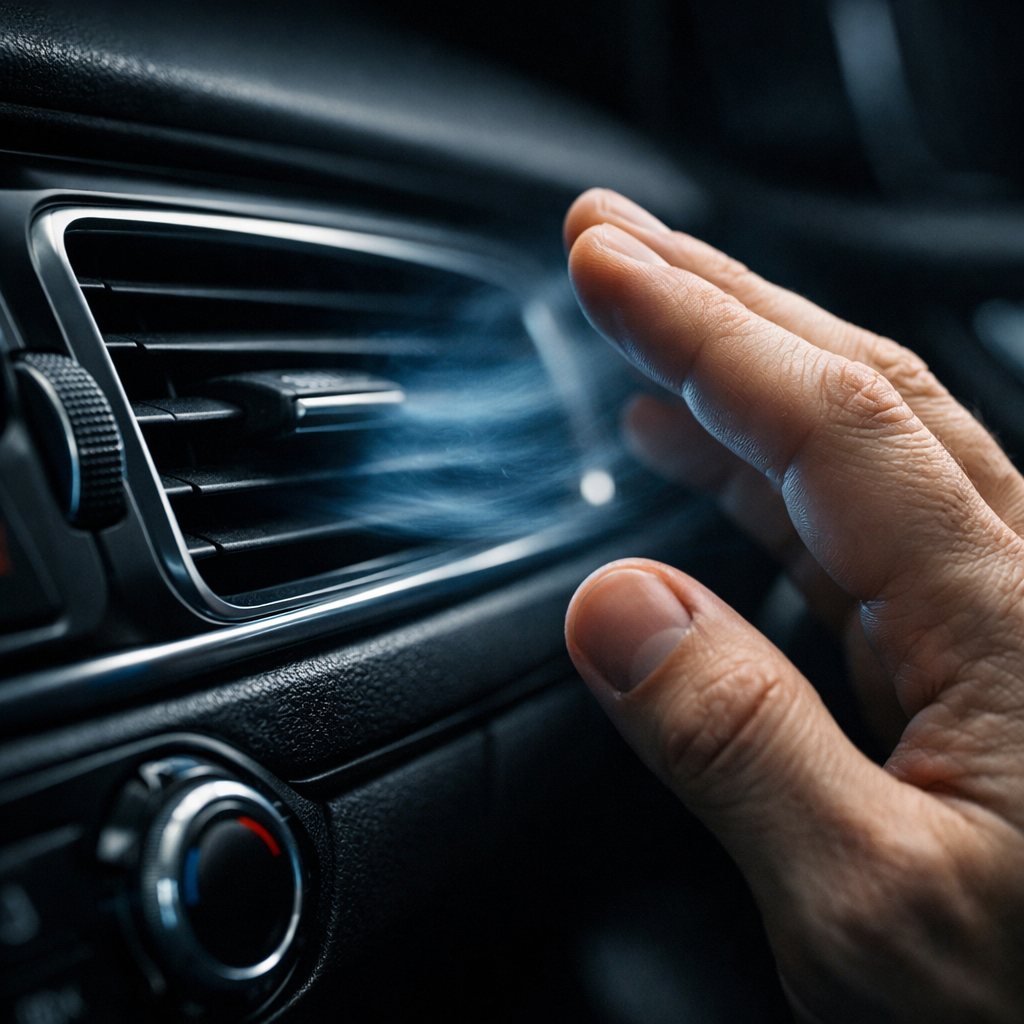
Picture this: It's a 95°F afternoon in June. You just left the Walmart on Ladson Road, and your car's air conditioning is pumping gloriously cold air. You merge onto I-26 toward Summerville, windows up, feeling civilized. Life is good.
Then you hit the traffic backup near the Ashley Phosphate Road exit. You stop. Thirty seconds later, the air coming from your vents isn't cold anymore. It's lukewarm. Then it's warm. You're sweating. You crank the fan speed to max — doesn't help. You start moving again, and magically, the cold air returns.
Sound familiar? If you live anywhere in the Charleston metro area — Ladson, Summerville, Goose Creek, North Charleston — you've probably experienced this at least once. And if you're reading this article right now, you're probably experiencing it today.
You're not imagining things. Your car AC really is blowing warm air when idling, and there are very specific mechanical reasons why. In this comprehensive guide, our team at Ladson Auto Repair Shop — specialists in AC recharge and leak detection — breaks down every possible cause, explains exactly what's happening inside your AC system, and tells you what to do about it — before South Carolina's brutal summer humidity turns your daily commute into a sauna.
of AC-related complaints at our Ladson shop involve systems that work while driving but fail at idle — making this the #1 AC issue we see every spring and summer.
📋 In This Article
- How Your Car's AC System Actually Works
- Cause #1: A Failing Condenser Fan
- Cause #2: Low Refrigerant (Freon Leak)
- Cause #3: Debris Blocking the Condenser
- Cause #4: Compressor Clutch Problems
- Cause #5: Blend Door Actuator Malfunction
- Quick Comparison: Symptoms, Causes & Costs
- Why DIY Recharge Kits Are a Bad Idea
- The South Carolina Factor: Why Heat and Humidity Make It Worse
- What to Do Right Now
- Frequently Asked Questions
How Your Car's AC System Actually Works (The 60-Second Version)
Before we dive into what goes wrong, let's quickly understand what's supposed to happen. Your car's air conditioning system is essentially a closed-loop refrigeration cycle — the same basic principle as your kitchen refrigerator, just engineered to work inside a vehicle traveling at highway speed in 100-degree heat.
Here's the simplified version:
- The compressor (driven by your engine's serpentine belt) pressurizes refrigerant gas, making it extremely hot.
- The condenser (a radiator-like unit behind your front bumper) dissipates that heat into the outside air, turning the gas into a high-pressure liquid.
- The expansion valve rapidly drops the pressure of the liquid, making it ice-cold.
- The evaporator (inside your dashboard) absorbs heat from the cabin air as the cold refrigerant passes through it.
- The now-warm refrigerant returns to the compressor, and the cycle repeats.
The critical piece of this puzzle for our problem: step #2 requires airflow across the condenser. When you're driving at 40 mph or faster, natural wind blowing through your grille provides plenty of cooling. But when you're sitting still in traffic on Highway 78 or idling in the Chick-fil-A drive-through on College Park Road, that natural airflow drops to zero.
That's why your car has an electric condenser cooling fan (or fans) — to provide forced airflow when the vehicle isn't moving. When everything works, you never notice the transition. When something fails, that's when you feel warm air at the vent and start googling "why is my AC warm at a stop light."
Nine times out of ten, when a customer tells me their AC works great on the highway but dies at a red light, I already have a pretty good idea what I'm going to find under the hood. It's almost always one of five things — and most of them are completely fixable within a few hours.
— Lead Technician, Ladson Auto Repair ShopNow let's go through each of those five things in detail.
Cause #1: A Failing or Dead Condenser Fan
How common is this? This is the single most common reason we see at our Ladson shop. If we had to put a number on it, we'd say roughly 40% of "warm air at idle" cases trace back to the condenser fan.
What's happening
Your AC condenser — that flat, radiator-looking component right behind your front bumper grille — needs constant airflow to do its job. At highway speed, the 60+ mph wind rushing through your grille provides that cooling naturally. But when you stop at the intersection of Ladson Road and College Park Road, that airflow drops to zero.
That's where the electric condenser fan steps in. It's designed to spin up automatically whenever:
- The AC compressor engages
- Engine coolant temperature exceeds a certain threshold
- The AC high-side pressure rises above the switch setpoint
If the fan motor has burned out, or if the fan relay has failed, or if a wire has corroded (very common in our salty Lowcountry air), the fan simply doesn't spin. The condenser can't reject heat. Refrigerant stays hot. The air in your cabin gets warm.
The telltale signs
- AC is ice-cold at 45+ mph but progressively warms within 30–60 seconds of stopping
- You don't hear a fan running under the hood when the car is parked and AC is on
- Engine temperature gauge may creep higher than normal at idle (since many vehicles share cooling fans between the radiator and condenser)
How we fix it
We test the fan motor, the relay, the fuse, and the fan control circuit. If the motor is dead, we replace it. If it's a relay or wiring issue (especially corrosion-related — a big problem near the coast), we repair the circuit. In most cases, this is a same-day repair.
Cause #2: Low Refrigerant (You Have a Freon Leak)
How common is this? About 30% of AC-warm-at-idle cases at our shop involve low refrigerant.
What's happening
Your AC is a sealed system. Unlike engine oil, which gets consumed over time, refrigerant (often still called "Freon," though modern cars use R-134a or R-1234yf) is supposed to stay in the system forever. If your refrigerant level is low, you have a leak somewhere — period.
Here's why low refrigerant specifically causes the "warm at idle, cold while driving" symptom:
- When the engine idles at ~700 RPM, the compressor spins slowly and can only move a small volume of refrigerant
- If the system is already low on refrigerant, this reduced volume isn't enough to create adequate cooling
- When you accelerate and the engine hits 2,000–3,000 RPM, the compressor spins 3–4x faster, moving more refrigerant per second — temporarily overcoming the shortage
As the leak gets worse, the symptom evolves: first the AC fails at idle, then it fails at low speeds, and eventually it blows warm all the time.
Common leak locations
| Leak Location | Why It Leaks | Difficulty to Repair |
|---|---|---|
| Schrader valve (service port) | O-ring deterioration from age/heat | Easy — quick seal replacement |
| Condenser | Road debris punctures, corrosion | Moderate — condenser replacement |
| Evaporator core | Internal corrosion from moisture | Difficult — requires dashboard removal |
| Hose connections / O-rings | Vibration, age, heat cycling | Easy to moderate |
| Compressor shaft seal | Wear from lack of use in winter | Moderate to difficult |
We see a lot of cars come in where the owner says 'I just had it recharged at a quick-lube place six months ago.' That's actually a red flag, not a solution. If the system needed a recharge, it means refrigerant escaped somewhere. Without finding and fixing the leak, you're just throwing money at a symptom.
— Service Manager, Ladson Auto Repair ShopHow we fix it
We perform a professional UV dye leak test. We inject a small amount of fluorescent dye into the system, run the AC, and then use an ultraviolet light to trace the exact point where refrigerant is escaping. Once the leak is found and repaired, we evacuate the system with a vacuum pump (to remove air and moisture), then recharge it with the manufacturer-specified amount of refrigerant — measured to the ounce.
Cause #3: Debris Blocking the Condenser
How common is this? About 15% of cases — more common in spring when pollen season hits the Lowcountry.
What's happening
Because the condenser sits directly behind your front bumper grille, it's the first thing that catches whatever is floating in the air or blowing across the road. Over time, the thin aluminum fins of the condenser accumulate:
- Pollen (and if you live in South Carolina, you know the yellow pine pollen tsunami that hits every March and April)
- Leaves, grass clippings, and pine needles
- Plastic bags and road debris
- Bugs — love bugs especially create a thick, baked-on layer
- Mud and dust — especially after driving unpaved roads in the rural parts of Dorchester or Berkeley County
When the condenser fins are clogged, airflow is restricted. At highway speed, the force of the wind can still push through partial blockages. But at idle, even a perfectly working condenser fan can't push enough air through a dirty condenser to dissipate heat effectively.
How we fix it
In mild cases, a careful condenser wash with low-pressure water and specialized coil cleaner restores full performance. In severe cases — especially when fins are bent or corroded — the condenser needs replacement. We also check the gap between the condenser and radiator, where debris loves to accumulate hidden from view.
Cause #4: Compressor Clutch Problems
How common is this? About 10% of cases.
What's happening
The AC compressor is bolted to your engine and spins via the serpentine belt. But it doesn't compress refrigerant all the time — there's an electromagnetic clutch that engages and disengages the compressor as needed.
When the clutch is wearing out, it may engage properly at higher RPMs (when there's more power available and the belt has more grip) but slip or fail to engage at idle RPMs. You'll notice the AC cycling on and off erratically, or hearing a brief squealing noise from the engine bay when the AC tries to kick on.
Why it gets worse in South Carolina heat
Heat causes metal components to expand. A compressor clutch that has marginal clearance might work fine on a 70°F spring morning but fail on a 98°F August afternoon because thermal expansion changes the air gap between the clutch plates just enough to prevent proper engagement.
How we fix it
We measure the clutch air gap and test the clutch coil electromagnet. Sometimes adjusting the air gap (by removing shims) restores function. More often, the clutch assembly needs replacement. In some vehicles, the clutch is serviceable separately from the compressor; in others, the whole compressor unit must be replaced.
Cause #5: Blend Door Actuator Malfunction
How common is this? About 5% of "warm at idle" cases — but it's the sneakiest one because it has nothing to do with the AC system itself.
What's happening
Inside your dashboard, there are small motorized doors (called blend doors) that control how much air passes over the hot heater core versus the cold evaporator core. The blend door actuator is a small electric motor that positions these doors based on your temperature setting.
When a blend door actuator fails or sticks, it can partially open the path to the heater core — mixing hot air with cold air. The reason this sometimes correlates with idle vs. driving: at certain engine vibration frequencies (like rough idle), the stuck door can shift position, allowing more hot air into the mix.
The telltale signs
- You hear a clicking or ticking sound from behind the dashboard when you change temperature settings
- One side of the car blows cold while the other blows warm (in dual-zone systems)
- The temperature seems to fluctuate randomly, unrelated to speed
How we fix it
We use a scan tool to command the blend door actuators through their full range of motion and identify which one has failed. Replacement usually involves removing part of the lower dashboard — not the most complex repair, but one that requires patience and the right tools.
Not sure which of these 5 causes is affecting your car? That's exactly what our diagnostic process is designed to determine. Call us at 843-494-9179 and we'll get your AC blowing cold again.
Quick Comparison: All 5 Causes at a Glance
Here's a side-by-side breakdown to help you identify which issue might be affecting your vehicle:
| Cause | Key Symptom | Typical Cost Range | Repair Time |
|---|---|---|---|
| Condenser Fan Failure | Cold while moving, warm within 30–60 sec of stopping | $150 – $400 | 1 – 2 hours |
| Low Refrigerant / Leak | Gradually warms at idle; gets worse over weeks | $150 – $800+ | 2 – 4 hours |
| Clogged Condenser | AC struggles on hot days; slightly warm at idle | $100 – $600 | 1 – 3 hours |
| Compressor Clutch Issue | AC cycles on/off; squealing noise at idle | $200 – $1,500 | 2 – 5 hours |
| Blend Door Actuator | Clicking behind dash; random temp fluctuations | $150 – $500 | 1 – 3 hours |
Note: Cost ranges are estimates based on our shop's pricing for the Ladson/Summerville area. Your actual cost depends on your vehicle's make, model, year, and the specific part required. We always provide a detailed estimate before beginning any repair.
Why DIY AC Recharge Kits Are (Almost Always) a Bad Idea
We get it. You're at AutoZone on Ladson Road, it's 97 degrees, and there's a $40 can of AC Pro with a gauge on it staring at you from the shelf. The label says "Easy! Just connect and charge!" It's tempting.
Here's why our technicians strongly advise against it:
- You can't fix a leak by adding more refrigerant. If your system is low, it's leaking. That new refrigerant will escape too — you're just paying to temporarily mask the problem.
- Overcharging is dangerously easy. Those cans don't measure by weight with real accuracy. An overcharged AC system creates excessive pressure that can destroy your compressor — turning a $200 problem into a $1,200+ problem.
- Sealant additives cause more harm than good. Many DIY recharge cans contain "leak sealant" that can clog your expansion valve, plug your condenser tubes, and contaminate the entire system. We've seen sealant damage that required a full system replacement.
- You might use the wrong refrigerant type. If your car takes R-1234yf and you pump in R-134a, you've just contaminated the system and potentially voided any remaining warranty coverage.
- Moisture is the real enemy. Professional AC service includes evacuating the system with a vacuum pump to remove all moisture. DIY recharging introduces atmospheric moisture into the system, which forms acids that corrode components from the inside out.
I'd estimate that 20% of the AC repairs we do are actually fixing damage caused by DIY recharge attempts. The customer spent $40 on a recharge can, it worked for two weeks, then failed again. They came to us, and now the compressor is damaged too. What would have been a $250 leak repair became an $1,100 compressor replacement. It's heartbreaking, honestly.
— Lead Technician, Ladson Auto Repair ShopThe South Carolina Factor: Why Heat and Humidity Make Everything Worse
If you moved here from up North — say, Ohio or Pennsylvania — you might have never experienced this problem in your old state. That's not a coincidence. South Carolina's climate creates a perfect storm for AC stress that drivers in milder climates simply don't face.
Temperature differential
Your AC system has to work harder when the temperature difference between the desired cabin temperature and the outside air is larger. On a 75°F day in Charlotte, your AC needs to cool the cabin by maybe 5–10 degrees. On a 100°F day in Ladson with a car that's been sitting in a parking lot (interior temperature: 140°F+), your AC is fighting to drop the temperature by 70+ degrees. That's a massive difference in workload.
Humidity multiplies the problem
South Carolina's relative humidity routinely exceeds 80% in summer. Your AC isn't just cooling air — it's also dehumidifying it. Removing moisture from the air requires significant energy. This is why your AC drain tube drips water under the car on humid days — that's condensation pulled from the cabin air. This added workload means a system that's "barely adequate" on a dry day will completely fail on a humid one.
Salt air and coastal corrosion
Ladson sits about 20 miles from the Atlantic Ocean, but the salt air influence extends well inland. The Berkeley and Dorchester County corridor experiences accelerated corrosion on automotive components — including AC condenser fins, electrical connectors, and copper refrigerant lines. A condenser that might last 15 years in Arizona might develop pinhole leaks in 8 years here.
The number of days per year (on average) that Ladson, SC exceeds 95°F — each one a stress test for your car's AC system.
Idling-heavy driving patterns
If you commute on I-26, Highway 78, or Dorchester Road during rush hour, you know that stop-and-go traffic is a daily reality. Unlike highway driving where constant airflow helps the AC, Lowcountry commutes involve extended idle time — exactly the conditions where a marginal AC system will fail.
What to Do Right Now If Your AC Blows Warm at Idle
If you're currently dealing with this problem, here's our recommended action plan:
Step 1: Do the fan check (2 minutes)
Park your car in your driveway or garage. Start the engine. Turn the AC to MAX cold, fan on high. Pop the hood (carefully) and look at the fan(s) near the front of the engine bay. Are they spinning? If not, you've likely found the problem. Do not reach near the fan area — if it kicks on suddenly, it can cause serious injury.
Step 2: Listen for the compressor
With the AC on MAX, listen for a "click" from the engine bay when the AC engages. You should hear the compressor clutch engage within a few seconds of turning the AC on. If you hear repeated clicking (on-off-on-off every few seconds), the system may be low on refrigerant and the low-pressure switch is cycling the compressor to protect it.
Step 3: Check the condenser visually
Look through your front grille. Can you see the condenser fins? Are they packed with debris, pollen, or bugs? If the condenser looks like a dirty air filter, cleaning it might help.
Step 4: Schedule a professional diagnosis
If steps 1–3 don't reveal an obvious cause, or if you'd rather have an expert handle it from the start (we totally understand), bring your vehicle to our shop. We'll run a complete AC system diagnostic including:
- High and low side pressure readings
- Condenser fan operation test
- UV dye leak detection
- Compressor clutch engagement test
- Vent temperature measurement (we aim for 38–45°F at the center vent)
- Blend door actuator scan
The best advice I can give is: don't wait until July. Every year, the first serious heat wave hits and our phones ring off the hook. If your AC is showing early warning signs in March or April, get it checked now. The repair is the same, but the wait time in June is a lot longer.
— Owner, Ladson Auto Repair Shop🔧 Need Your AC Checked in Ladson, SC?
Don't wait for the South Carolina summer heat to hit. Bring your car to Ladson Auto Repair Shop on Ladson Road. Our experienced mechanics will perform a professional AC system diagnostic, UV dye leak test, and condenser fan inspection.
We service all makes and models — domestic and import. Same-day appointments available.
📞 Call 843-494-9179 to ScheduleServing Ladson, Summerville, Goose Creek, North Charleston, and the entire Tri-County area.
Frequently Asked Questions
Here are the most common questions we get from drivers in the Ladson and Summerville area about AC systems that blow warm air when idling:
Why does my car AC blow warm air only when idling?
The most common cause is a failing condenser fan. When you're driving, natural airflow through the grille cools the AC condenser. When you stop, the electric fan must take over. If that fan is broken, the refrigerant stays hot and your vents blow warm air. Low refrigerant from a leak and a clogged condenser are also frequent causes. Less common but possible causes include a slipping compressor clutch and a malfunctioning blend door actuator.
Is it safe to drive with AC that only works while moving?
The car itself is safe to drive, but continuing to operate a malfunctioning AC system can lead to escalating damage. For example, if the problem is low refrigerant, the compressor may eventually burn out from insufficient lubrication (the refrigerant carries compressor oil). A compressor replacement can cost $800 to $1,500+ — far more than the original leak repair. We recommend getting the system diagnosed sooner rather than later.
How much does it cost to fix car AC that blows warm at idle?
Costs vary significantly depending on the root cause. A condenser fan motor replacement typically runs $150–$400. A refrigerant leak repair costs $150–$800 depending on the leak location (a Schrader valve seal is cheap; an evaporator core replacement is expensive because it requires dashboard removal). A condenser cleaning or replacement ranges from $100–$600. At Ladson Auto Repair Shop, we always provide a detailed written estimate before any repair work begins — no surprises.
Can I just recharge my car AC with a DIY kit from AutoZone?
We strongly advise against DIY recharge kits. If your system is low on refrigerant, it means there's a leak — and adding more refrigerant without fixing the leak is a temporary band-aid at best. At worst, overcharging the system can destroy your compressor (turning a $200 repair into a $1,500 one), and the sealant additives in many DIY kits can clog critical AC components. A professional UV dye leak test and proper evacuation/recharge is always the correct approach.
How long does an AC repair take at Ladson Auto Repair Shop?
Most AC repairs — including fan replacement, leak repair, and system recharging — are completed within 2 to 4 hours. More complex issues like compressor replacement or evaporator core replacement may require a full day. We offer same-day appointments when available and will always give you a realistic time estimate before we begin.
Does Ladson Auto Repair Shop work on all vehicle brands?
Yes. We service all makes and models — including Ford, Chevrolet, Toyota, Honda, Hyundai, Kia, Nissan, BMW, Mercedes-Benz, Jeep, Ram, and more. Whether you drive a 2008 Camry or a 2025 F-150, our technicians have the tools and expertise to diagnose and repair your AC system.
How often should I have my car's AC system serviced?
We recommend a professional AC system inspection once a year — ideally in spring before the South Carolina heat arrives. This includes checking refrigerant pressure, testing fan operation, inspecting belts and hoses, and cleaning condenser fins. Preventive maintenance is always cheaper than emergency repairs in July.
My AC is blowing warm all the time, not just at idle. Is that a different problem?
If your AC blows warm air constantly — whether driving or idling — the issue is likely more advanced: a completely failed compressor, a severely depleted refrigerant charge, an electrical fault preventing compressor engagement, or a major component failure. This still requires professional diagnosis, and many of the same causes apply (they've just progressed further). Bring it in and we'll figure it out.
Don't Let a Warm AC Ruin Your South Carolina Summer
Living in the Lowcountry means your car's air conditioning isn't a luxury — it's a necessity. From the April pollen storms to the August heat domes, your AC system works harder here than in almost any other part of the country. When it starts blowing warm at red lights and drive-throughs, that's your car telling you something needs attention.
The good news? Every cause we've covered in this article is fixable, and most repairs are far less expensive than people expect. Whether it's a $180 fan motor or a $300 leak repair, getting it fixed now saves you from the cascading damage (and cascading costs) that come from ignoring the problem.
At Ladson Auto Repair Shop, we've been keeping Tri-County drivers cool for years. We're located right on Ladson Road, easy to reach from Summerville, Goose Creek, North Charleston, and everywhere in between. Our shop is equipped with modern AC diagnostic tools, and our technicians have seen every AC problem the South Carolina climate can throw at a vehicle.
Give us a call at 843-494-9179 or stop by the shop. We'll get your AC blowing cold again — at idle, in traffic, and everywhere else.
This article was written by the automotive service experts at Ladson Auto Repair Shop, located at 3322 Ladson Rd, Ladson, SC 29456. We specialize in complete auto repair including AC diagnostics, brake service, engine repair, oil changes, and preventive maintenance for all makes and models. Proudly serving Ladson, Summerville, Goose Creek, North Charleston, and the greater Charleston, SC metro area.