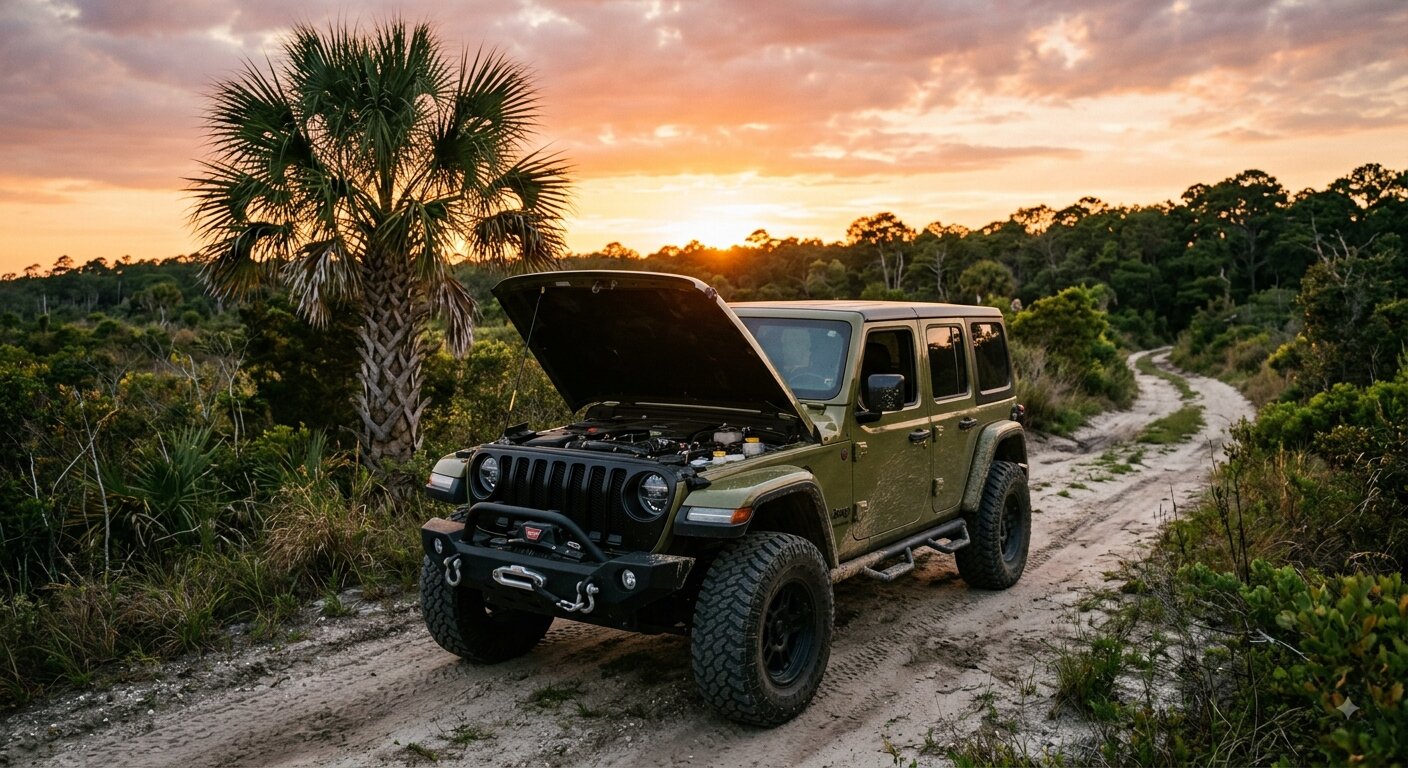
The most iconic off-road vehicle in America — and one of the more expensive ones to own. Here's exactly what breaks and what it costs.
Jeep Wranglers are everywhere in the Lowcountry. You'll see lifted ones on Highway 17 headed to Folly Beach, stock Rubicons on the way to Francis Marion National Forest, and city-spec Wranglers in every Costco parking lot from here to Mount Pleasant. We work on a lot of them. The Wrangler is an excellent vehicle for what it's designed to do, but it's important to go in with clear eyes: Wranglers have above-average ownership costs, above-average repair frequency, and some specific failure modes that are worth knowing about before you buy.
Average annual repair cost for a Jeep Wrangler is $694 — significantly higher than most SUVs at around $500. They're not unreliable in an absolute sense, but they're not Camrys either.
Average annual repair cost for a Jeep Wrangler, according to RepairPal — versus approximately $500 for the average SUV. The gap widens if you use it off-road or modify it.
📋 In This Article
Death Wobble: The Most Famous Wrangler Problem
"Death wobble" sounds dramatic, and the experience is dramatic: at certain speeds — typically 45–55 mph, often triggered by hitting a bump or road irregularity — the front end enters a violent, rapid oscillation. The steering wheel shakes, the cab vibrates severely, and the instinctive reaction is to brake hard. Slowing below the resonant speed stops it.
It's not actually dangerous if you know to take your foot off the gas and slow down without panic — but the first time it happens to an unprepared driver, it's genuinely terrifying.
The mechanism is that the solid front axle design (which gives Wranglers their off-road capability) resonates when loose steering or suspension components allow one frequency to feed into another. It's not a single part failure — it's a combination of worn components that together allow the resonance to develop.
Common contributing parts: Track bar (front), track bar mount, ball joints, tie rod ends, steering stabilizer, wheel bearings. Replacing only the steering stabilizer is a common but temporary fix. A proper death wobble repair involves inspecting all of the above and replacing anything with play.
Repair cost: $200–$800 for a thorough inspection and single-component replacement; $2,000–$3,500 if multiple worn components need replacement simultaneously.
Prevention: Wranglers used frequently off-road should have steering and suspension components inspected annually — these components wear faster on rough terrain. Lifted Wranglers with aftermarket suspension are particularly susceptible; any modification that changes suspension geometry without proper alignment and component upgrades increases death wobble risk. Our suspension, steering, and alignment services cover all Wrangler-specific issues including track bar, ball joint, and tie rod inspections.
TIPM Failure (2007–2015 JK)
The Totally Integrated Power Module (TIPM) is the electrical distribution hub of the vehicle — it controls everything from the fuel pump to the window motors to the starter relay. FCA (Fiat Chrysler, Jeep's parent company during this era) used a TIPM design in Wranglers from 2007–2015 that had significant reliability issues.
TIPM failure produces bizarre, hard-to-diagnose symptoms: the fuel pump may stay running after the engine is off (draining the battery), windows may not work, the horn may go off randomly, the starter may crank on its own, or the vehicle simply refuses to start. Because the TIPM touches so many systems, diagnosis can be difficult without a technician who knows what to look for.
A new OEM TIPM is expensive: $1,200–$1,500 installed. Remanufactured units are available for less ($500–$800) but with mixed reliability history. If you own a 2007–2015 JK and start experiencing multiple, seemingly unrelated electrical gremlins, TIPM is high on the diagnosis list.
Oil Consumption (2007–2011 JK, 3.8L Engine)
The 3.8L V6 engine used in 2007–2011 Wranglers had above-normal oil consumption. Some examples burned a quart per 1,000 miles — not a sign of impending failure necessarily, but a nuisance and an engine that must be monitored closely to avoid running low. If you own a 2007–2011 Wrangler, check the oil at every fill-up.
The 3.6L Pentastar V6 introduced for 2012 is dramatically better and addressed the oil consumption problem. It's one of the more important reasons to prefer 2012+ JK Wranglers over 2007–2011 examples. If you're experiencing oil consumption or other engine concerns on your Wrangler, our engine repair services include comprehensive diagnostics and repair for all Jeep engines.
JL Generation Problems (2018–Present)
The JL Wrangler introduced in 2018 is a much more refined vehicle than the JK, with better on-road manners, more features, and the new 2.0L turbocharged engine option. But first-year vehicles in any generation have growing pains, and the JL is no exception.
2018 JL: Frame weld defect recall. The 2018 JL was subject to a recall for improper front frame welds that could cause the frame to crack. If you have a 2018 JL Wrangler, verify this recall was completed — it's a structural safety issue.
Uconnect infotainment freezing. The Uconnect 4 and Uconnect 5 systems in JL Wranglers are more sophisticated than the prior generation — and more prone to software issues. Screens freeze, backup cameras glitch, and warning lights appear for software reasons. Most are addressed by software updates available at the dealer or through Mopar's connected services.
Death wobble in JL (if lifted). The JL's updated front suspension reduced death wobble compared to the JK. However, JL Wranglers with aftermarket lifts and larger tires still develop the wobble, particularly if suspension component upgrades weren't done correctly at the time of the lift. If your JL has a lift and exhibits front-end shimmy, the steering and suspension need inspection.
Turbo 2.0L oil consumption. Some 2018–2020 JL Wranglers with the 2.0L eTorque turbocharged engine showed above-normal oil consumption. Monitor oil level between changes if you have this engine.
Infotainment and Electrical Issues
Across both JK and JL generations, electrical complaints are the most common non-mechanical issue:
JK (2007–2018): TIPM issues (described above), battery drain from TIPM-controlled systems, radio/infotainment glitches.
JL (2018–present): Uconnect software freezes, spurious warning lights from software conflicts, backup camera issues, mild hybrid (eTorque) electrical system quirks.
Most JL electrical issues resolve with software updates — the Uconnect system can be updated at the dealer or through Wi-Fi in some configurations. If your JL has multiple warning lights that come and go, check for available software updates before assuming a hardware failure. When warning lights persist, our check engine light diagnostics can scan for codes and identify whether the issue is software-related or requires hardware repair.
SC-Specific Concerns: Off-Road Wear and Salt Air
In the Lowcountry, Jeep Wrangler owners face a specific combination of challenges:
Beach and tidal area use. Wrangler owners who regularly take their Jeep to beach access points — Edisto, Sullivan's Island, Capers Island, or tidal areas on the ACE Basin — are subjecting the undercarriage to direct salt water exposure in addition to coastal salt air. Brake components, CV axles, differential vents, and suspension components all take accelerated damage. Thorough rinsing with fresh water after salt water exposure is essential. Annual undercarriage inspection is critical.
Suspension wear from unpaved roads. Francis Marion National Forest, the Congaree flatwoods roads, and hunt club property throughout Berkeley and Dorchester County are hard on Jeep suspension. Ball joints, track bar ends, and steering components wear faster on rough unpaved surfaces. If you use your Wrangler off-road more than casually, inspect suspension annually.
Lifted Wranglers and alignment. Any Wrangler with a lift installed needs a professional alignment that accounts for the modified geometry. We see lifted Wranglers regularly that were never properly aligned after the lift, causing accelerated tire wear, handling issues, and increased death wobble risk.
Repair Cost Table
| Problem | Years | Typical Cost | Notes |
|---|---|---|---|
| Death wobble repair (single component) | JK 2007–2018, JL lifted | $200–$800 | Full inspection required |
| Death wobble repair (multiple components) | All | $2,000–$3,500 | Ball joints, track bar, tie rods |
| TIPM replacement (OEM) | 2007–2015 JK | $1,200–$1,500 | Remanufactured ~$500–$800 |
| 3.8L oil consumption monitoring | 2007–2011 | Oil every 1,000 miles | No repair, just vigilance |
| Frame weld recall (safety) | 2018 JL | FREE at dealer | Safety-critical recall |
| Uconnect software update | 2018+ JL | $0–$150 | Dealer or shop |
| Alignment post-lift | Any lifted Wrangler | $120–$200 | Essential after any lift |
| Undercarriage inspection + rinse | All, especially near coast | Included in service | Annual minimum |
Frequently Asked Questions
Is a Jeep Wrangler reliable enough for a daily driver?
I want to buy a lifted used JK. What should I inspect?
My JL Wrangler has three different warning lights on today. Is it serious?
Schedule a Wrangler Inspection or Repair
📞 Call 843-494-9179 | Book Online
Ladson Auto Repair Shop — 3322 Ladson Rd, Ladson, SC 29456.
Need Help? Call Ladson Auto Repair Shop
If you have questions about your vehicle or need to schedule a repair, our experienced mechanics are here to help. We provide honest diagnostics, fair pricing, and a 12-month/12,000-mile warranty on all repairs.
📞 Call Now: 843-494-9179Serving Ladson, Summerville, North Charleston, Goose Creek, and Hanahan, SC.